Building Enclosure logo
search
cart
facebook twitter linkedin youtube instagram Spotify Podcasts Apple Podcasts Spotify Podcasts Apple Podcasts
  • Sign In
  • Create Account
  • Sign Out
  • My Account
Building Enclosure logo
  • NEWS
    • Breaking News
  • SECTIONS
    • Columns
    • Project Profiles
    • Trade Shows
    • Sponsor Insights
  • SYSTEM DESIGNS
    • Low-Slope Roofs
    • Pitched Roofs
    • Metal Roofing Materials
    • Waterproofing
    • Sustainability
    • Insulation
    • Exterior Claddings
    • Wall Systems
    • Building Envelope
  • BLOG
    • The BE Blog
  • MEDIA
    • Podcasts
    • Webinars
    • Quiz
    • Videos
    • Polls
    • Interactive Spotlights
    • Newsletter
    • Photo Galleries
  • DIRECTORIES
    • Directory: Blue Book
    • Directory: Roofing Resource
  • PRODUCTS
  • TECHNICAL
    • Codes
      • Waterproofing
      • Roofing
    • Details
      • Waterproofing
      • Roofing
  • CONTINUING ED
  • ABOUT
    • Advertise
      • Editorial Calendar
    • Contact
    • eMag Archive Issues
  • SIGN UP!

The Difference Between Reflectance and Emittance
By Daniel Overbey
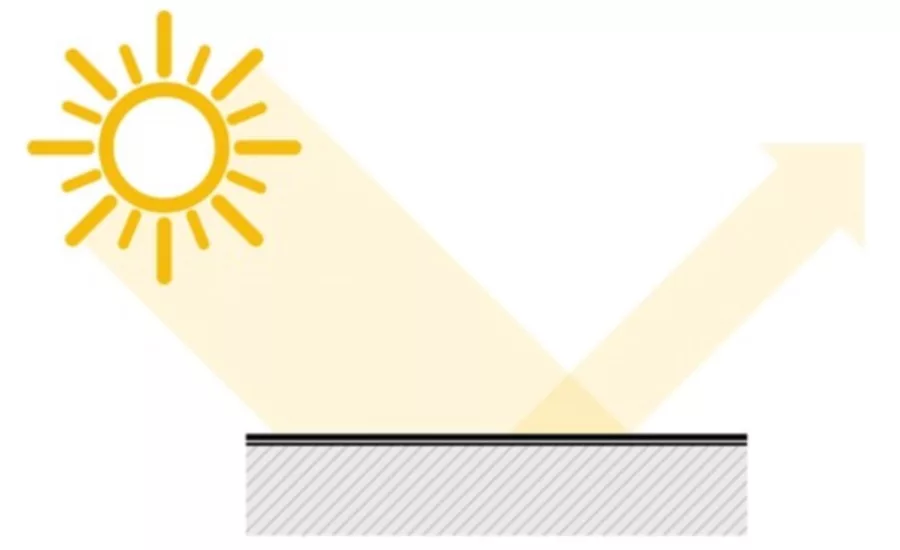
Reflectance
Illustration property of Daniel Overbey
November 18, 2015

What is emittance?

Among the three basic forms of heat transfer - conduction, convection, and radiation - the term emittance refers to a material's ability to release heat through radiation.

The term necessarily refers to the heat exchange at surface of a material because heat exchange through a solid would be conductive and heat exchange through a fluid would be convective.

Emittance is the ratio of the radiation emitted by a given material to that emitted by a "black body" at the same temperature. This unitless value would be 0.0 if no emittance was possible and 1.0 at the ideal maximum - the theoretical "black body" (i.e., a material with an emittance of unity).

The lower the emittance, the lower the radiative heat exchange. Typically, emittance is related to absorptance (i.e., highly absorptive materials will usually have high emittance) - but they are not the same characteristic. With regard to opaque materials, absorptance directly relates to reflectance.

What is reflectance? How is it different than albedo?

Recall that solar radiation striking a surface will either be reflected, absorbed, or transmitted. The combination of those three phenomena will equal 100% (irregardless of emittance). When referring to opaque materials, solar radiation will not transmit. It will only be absorbed or reflected.

Reflectance is the ratio of reflected light to incident light.

Note that reflectance refers specifically to light - the visible portion of the solar electromagnetic radiation spectrum. Light reflectance value (LRV) is a more accurate term for this ratio. The term albedo refers to overall solar radiation reflectance - not just the visible portion of the spectrum. Sometimes albedo is referred to as solar reflectance (SR).
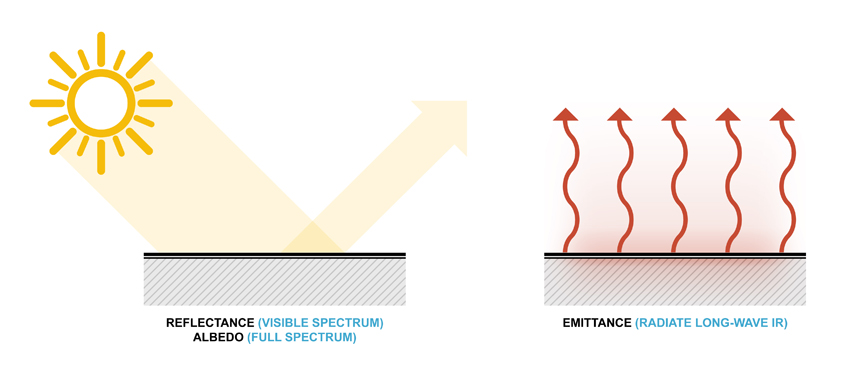
Reflectance vs. Emittance

Illustration property of Daniel Overbey

What does emittance mean in practical terms?

Radiation heat transfer is greatly influenced by a material's surface characteristics. Shiny materials are less capable of radiating heat than rougher "matte" surfaces. In general, polished metallic surfaces are poor far–IR absorbers (good reflectors) and are correspondingly poor emitters. 

What does reflectance mean in practical terms?

An example of almost perfect reflection from an opaque surface would be a well-silvered mirror. Conversely, a matte-finish black painted object would prompt almost perfect absorption. With any given surface, color will play a role. Lighter-colored surfaces will have a greater LRV. Keep in mind that the angle of light incidence will impact reflectance.

Heat is infrared radiation, but not all infrared radiation is heat.

Solar radiation exhibits a range of wavelengths within the electromagnetic spectrum - from ultraviolet (UV), to visible light, to infrared (IR). The infrared radiation coming from the Sun has a very short wavelength. It is not heat. Solar radiation of any wavelength does not become heat (i.e., thermal energy) until it strikes something on the Earth (or in its atmosphere) and becomes terrestrial long-wave IR radiation. 

Anytime heat is radiated from a material's surface, it is long-wave IR radiation, not short-wave IR (like what comes from the Sun).

How does reflectance and emittance work in tandem on "cool roofs"?

With cool roofs, color is typically the first design consideration. However, emittance also matters because the higher the emittance, the more readily the roof surface will radiate long-wave IR (heat) to the sky.

Mindful that reflectance and albedo can be different, a combination of high albedo and high emittance resists solar heat gain most effectively. They can also reduce the urban heat island effect. The concept of solar reflectance index (SRI) emerged to facilitate convenient comparisons among various roofing solutions.

How does the SRI work?

The SRI is a measure of the constructed surface’s ability to stay cool in the Sun by reflecting solar radiation and emitting thermal radiation. It is defined such that a standard black surface (initial solar reflectance 0.05, initial thermal emittance 0.90) has an initial SRI of 0, and a standard white surface (initial solar reflectance 0.80, initial thermal emittance 0.90) has an initial SRI of 100.


Solar-Performance-of-Roofing-Materials


How is the SRI calculated?

For a given material, obtain its solar reflectance (albedo) and thermal emittance ratios via the Cool Roof Rating Council standard CRRC-1. SRI is calculated according to ASTM E 1980.

Teams should design with a three-year aged SRI value. The calculation of which is based on the aged tested values of solar reflectance and thermal emittance.

Online Resources

The Heat Island Group at Lawrence Berkeley National Laboratory (LBNL) has provided a free SRI Calculator at: https://heatisland.lbl.gov/resources/technical-resources

LBNL also provides a Cool Roofing Materials Database which lists the solar performance of various roofing materials at: http://energy.lbl.gov/coolroof/

KEYWORDS: cool roofing heat mitigation reflective

Share This Story

Overbey   head shot 2020 3

Daniel Overbey, AIA, NCARB, LEED Fellow (LEED AP BD+C, ID+C, O+M), WELL AP is an Assistant Professor of Architecture at Ball State University and the Director of Sustainability for Browning Day in Indianapolis, Ind. His work focuses on high-performance building design and construction, environmental systems research, green building certification services, energy/life-cycle assessment modeling, and resilient design. He can be reached at djoverbey@bsu.edu.

Recent Comments

These are actually very helpful tips. It is...

This is the most beneficial blog for all...

This blog is a great resource for anyone...

Thank you for sharing this important information. I...

This is a very interesting subject of the...

Manage My Account
  • Sign up for the Newsletter
  • Online Registration
  • Manage My Preferences
  • Registration Customer Service

More Videos

Sponsored Content

Sponsored Content is a special paid section where industry companies provide high quality, objective, non-commercial content around topics of interest to the Building Enclosure audience. All Sponsored Content is supplied by the advertising company and any opinions expressed in this article are those of the author and not necessarily reflect the views of Building Enclosure or its parent company, BNP Media. Interested in participating in our Sponsored Content section? Contact your local rep!

close
  • 2 construction workers and a DEXcell panel
    Sponsored byDEXcell Roof Boards

    Designing Low-Slope Roofs for Resilience

  • Bell Bank headquarters in Fargo, North Dakota
    Sponsored bySto Corp.

    Drained and Back-Ventilated Rainscreens vs Pressurized-Equalized Rainscreens

  • A construction worker using DEXcell roof boards
    Sponsored byDEXcell Roof Boards

    The Hidden Strength of Low-Slope Roof Systems: Why Roof Cover Boards Matter

Popular Stories

construction industry workers in hard hats stand around a city scape

Construction Industry Revolts Over New CSI Licensing Plan

graph shows green, orange and red dot lines going up

LEED v5 and the Cost Impacts of ASHRAE Standard 90.1-2019

2 construction workers and a DEXcell panel

Designing Low-Slope Roofs for Resilience

Building Enclosure Newsletter

BE Poll

Events

April 9, 2026

Strategies for High-Performance Below-Grade Waterproofing

Credits: 1 AIA LU/HSW ; 1 IIBEC CEH; 0.1 IACET CEU

On-Demand Designing a high-performance building enclosure requires more than just surface-level protection; it demands a rigorous, performance-based mastery of below-grade water and gas mitigation. This discussion will provide an expert-level analysis of below-grade waterproofing within the comprehensive framework of the high-performance building enclosure.

April 28, 2026

Roof Design Considerations That Prevent Installation Failures and Change Orders

Credit: 1 AIA LU/HSW; 1 IIBEC CEH; 0.1 ICC CEU

On-Demand This course provides visual examples of actual field conditions. Some good, some not so good; along with design suggestions that can cut installation costs and reduce construction change orders. Upon completion of this course, you will have a better understanding of the requirements the roofing contractor must meet to provide the specified roofing system warranty, and long-term value to the owner.

View All Submit An Event

Products

Plaster and Drywall Assemblies Manual

Plaster and Drywall Assemblies Manual

This is a comprehensive manual that goes beyond codes and standards, providing expert guidance in design, detailing, material selection and troubleshooting for plaster and drywall.

See More Products
×

Enhance your expertise with unparalleled insights.

Join thousands of building professionals today. Shouldn’t you know what they know?

SUBSCRIBE TODAY!
  • RESOURCES
    • Advertise
    • Contact Us
    • Store
    • Want More
  • SIGN UP TODAY
    • Create Account
    • Newsletter
    • Customer Service
    • Manage Preferences
  • SERVICES
    • Marketing Services
    • Reprints
    • Market Research
    • List Rental
    • Survey/Respondent Access
  • STAY CONNECTED
    • LinkedIn
    • Facebook
    • Instagram
    • YouTube
    • X
  • PRIVACY
    • PRIVACY POLICY
    • TERMS & CONDITIONS
    • DO NOT SELL MY PERSONAL INFORMATION
    • PRIVACY REQUEST
    • ACCESSIBILITY

Copyright ©2026. All Rights Reserved BNP Media, Inc. and BNP Media II, LLC.

Design, CMS, Hosting & Web Development :: ePublishing