Why Fuel Source Data is Crucial for Operational Carbon Emissions Reporting
As the AIA 2030 Commitment moves to reposition itself over the coming years, it will also come into stronger alignment with AIA's Strategic Plan 2026–2030, which acknowledges within the four interconnected "PACE" goals

Last month, I co-authored a blog article through the AIA Community Hub, entitled It is time for the 2030 Commitment to evolve., in which AIA 2030 Commitment Working Group Co-Chair, Jacob Werner, and I contend that, after 15 years of progress, the AIA 2030 Commitment needs to be repositioned as we head toward 2030 and beyond. Our standpoint is that energy efficiency benchmarking alone is no longer sufficient and we recommend evolving the American Institute of Architects' (AIA) primary climate action program to track total carbon intensity by incorporating fuel source reporting, electrification metrics, expanded embodied carbon tracking, and updated baselines.
It is almost 2030. We are down to the last mile.
This article coincided with Architecture 2030's new report, 2030 Beyond the Numbers, which examines last year's AIA 2030 Commitment By the Numbers report and draws on in-depth practitioner interviews (full disclosure: Jacob and I were interviewed), independent quantitative analysis, and a comprehensive literature review to chart what the organization terms an "Acceleration Pathway" for the architecture profession’s "last mile" to zero operating emissions.
Launched in 2005, The 2030 Challenge called for the elimination of fossil fuel energy consumption in buildings — an outcome that requires three interdependent strategies:
- Reducing energy demand through efficiency;
- Eliminating on-site fossil fuel combustion through electrification; and
- Sourcing renewable energy.
The American Institute of Architects adopted the Challenge in 2006 and in 2009 launched the 2030 Commitment program to enable its implementation across professional practice.
Within the 2030 Beyond the Numbers report, the Acceleration Pathway charts the firm-level strategies and industry actions that would activate all three "levers" across the profession. The pathway comprised three sequential accelerators:
- Accelerator 1: Institutionalize Cultural Accountability
- Accelerator 2: Adopt an Emissions-Centric Measurement Approach
- Accelerator 3: Implement the Path to Zero Operating Emissions
As Architecture 2030 stated in their report, "The 2030 deadline was always a waypoint. The deeper objective is to establish zero operating emissions — buildings that use no fossil fuel energy to operate — as the default professional standard for new construction and major renovations, and ultimately to extend that standard to the full lifecycle of buildings."
In other words, the year 2030 is not the end of our decarbonization efforts; rather, it is the end of the beginning.
What this means for the AIA 2030 Challenge moving forward.
For AIA 2030 Commitment signatory firms, the next steps post-2030 will become clear over the next few years. In terms of immediate action, reporting firms are encouraged to report:
- Predicted and measured energy use intensity (EUI) data to the Design Data Exchange (DDx), just as you have for many years.
- Report embodied carbon emissions data to the DDx.
- Report energy fuel sources in order to better capture the operational carbon emissions from your projects.
The latter two will move teams through Accelerator 2 toward Accelerator 3. It will enable firms to measure and reduce the total carbon emissions of their portfolio.
Do I really need to report fuel sources? And if so, how?
As evidenced by the relatively low number of projects in the DDx reporting such, capturing energy fuel source data can be challenging for project teams. During the design phases, it will require some level of building performance simulation (BPS) beyond what many early-stage analysis platforms might provide.
Given this challenge, it might be fair to wonder just how important is it to report fuel sources?
The answer: it is crucial.
Reporting energy fuel sources alongside predicted energy use intensity (pEUI) is essential because energy efficiency alone does not tell the full decarbonization story. A building design can achieve a low pEUI while still running entirely on fossil fuels (e.g., natural gas for heating) and thus carry a significant carbon burden that energy performance metrics simply do not capture. Two building projects could have the same pEUI, but one uses coal-based electricity and natural gas for heating and the other runs off of 100% on-site renewable energy from a photovoltaic system. Same pEUI, but very different operational carbon emissions impacts.
In order to articulate just how it matters, consider the median operational carbon emissions factors for several common building energy fuel sources (see figure). Note also that any given region of the utility grid delivers electricity from a blend of energy fuel sources — all with different degrees of greenhouse gas (GHG) emissions contributions. Regarding this figure, one should also distinguish Scope 1 from Scope 2 emissions. Scope 1 emissions cover direct emissions from sources owned or controlled by an organization (e.g., combustion happening on-site such as a furnace, boiler, water heater, or kitchen range). In other words, the energy fuel is delivered to the building and burned there. On the other hand, Scope 2 emissions come from purchased energy generated off-site (e.g., electricity, steam, or chilled water produced elsewhere and delivered to the building).
As the grid decarbonizes at different rates across regions, and as all-electric buildings become an increasingly viable pathway to zero carbon outcomes, fuel source data allows design firms to track not just how much energy a building uses, but what kind — and therefore begin approximating its true carbon intensity. For the broader building design and construction industry to make credible claims about progress toward carbon neutrality, the design profession needs a portfolio-level picture of electrification trends and fossil fuel dependency. Without fuel source reporting, firms risk optimizing for the wrong metric — celebrating efficiency gains while locking in decades of carbon emissions through building systems tied to combustion.
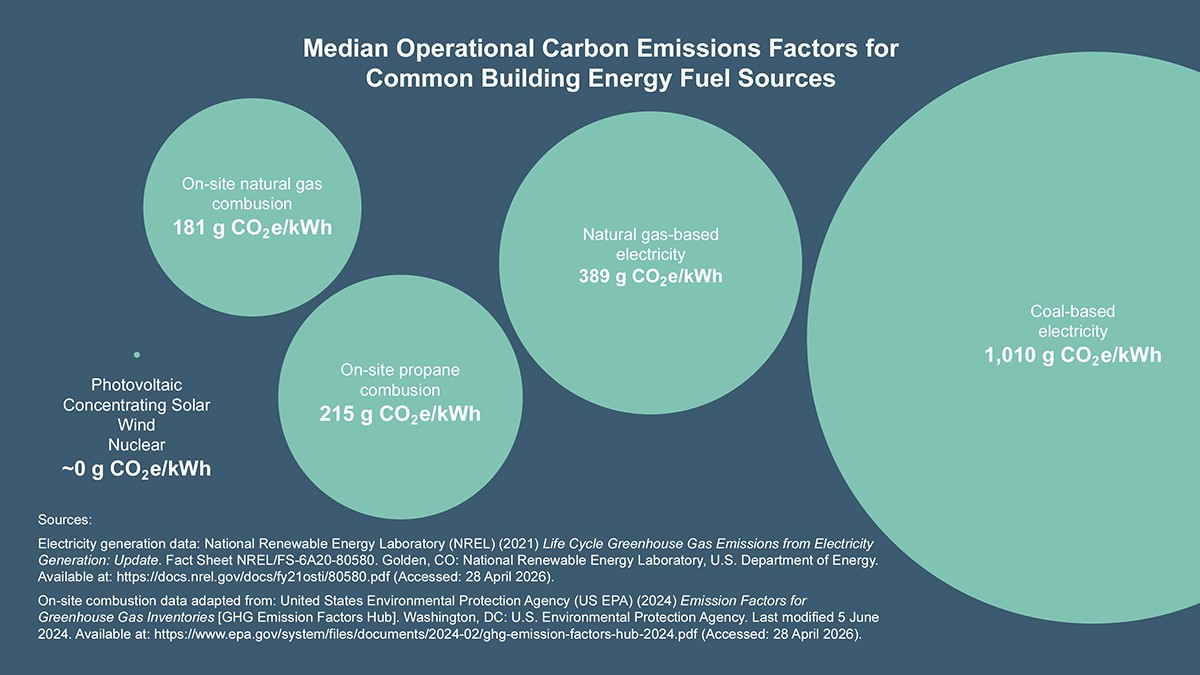 Median operational carbon emission factors for common building energy fuel sources. Figure by Daniel Overbey.
Alignment around the new "net zero" is underway.
The building design and construction industry is harmonizing efforts around this new definition of zero building (ZEB) buildings, shifting from zero energy to zero emissions. The three independent "levers" of energy efficiency, electrification, and renewable energy (on-site and/or off-site) are consistent with the 2024 National Definition of a Zero Emissions Building, which endeavored to codify the three-lever approach at the federal level.
It is also not a coincidence that achievement across all three levers are required for all LEED v5 BD+C Platinum certified buildings moving forward.
As the AIA 2030 Commitment moves to reposition itself over the coming years, it will also come into stronger alignment with AIA's Strategic Plan 2026–2030, which acknowledges within the four interconnected "PACE" goals, to advance "climate leadership that is ambitious, achievable, and embedded in practice."
It is time to get to work.