Building Enclosure logo
search
cart
facebook twitter linkedin youtube instagram Spotify Podcasts Apple Podcasts Spotify Podcasts Apple Podcasts
  • Sign In
  • Create Account
  • Sign Out
  • My Account
Building Enclosure logo
  • NEWS
    • Breaking News
  • SECTIONS
    • Columns
    • Project Profiles
    • Trade Shows
    • Sponsor Insights
  • SYSTEM DESIGNS
    • Low-Slope Roofs
    • Pitched Roofs
    • Metal Roofing Materials
    • Waterproofing
    • Sustainability
    • Insulation
    • Exterior Claddings
    • Wall Systems
    • Building Envelope
  • BLOG
    • The BE Blog
  • MEDIA
    • Podcasts
    • Webinars
    • Quiz
    • Videos
    • Polls
    • Interactive Spotlights
    • Newsletter
    • Photo Galleries
  • DIRECTORIES
    • Directory: Blue Book
    • Directory: Roofing Resource
  • PRODUCTS
  • TECHNICAL
    • Codes
      • Waterproofing
      • Roofing
    • Details
      • Waterproofing
      • Roofing
  • CONTINUING ED
  • ABOUT
    • Advertise
      • Editorial Calendar
    • Contact
    • eMag Archive Issues
  • SIGN UP!

The Health Impacts of Indoor Relative Humidity
By Daniel Overbey
HUMIDTY
October 1, 2018

In many parts of the U.S., homeowners with basements have to manage rising humidity levels for most of the cooling season. It is not uncommon for such individuals to have a dehumidifer running full-throttle in the basement from April through October. High indoor humidity levels has been associated with the growth of fungi, such as mold, among other irritants. The EPA suggests keeping indoor relative humidity (RH) under 60 percent in order to effectively minimize mold growth. The EPA cites an ideal relative humidity between 30-50 percent; however, in reality, it can be a struggle to maintain such a low RH range in spaces susceptible to taking on moisture.

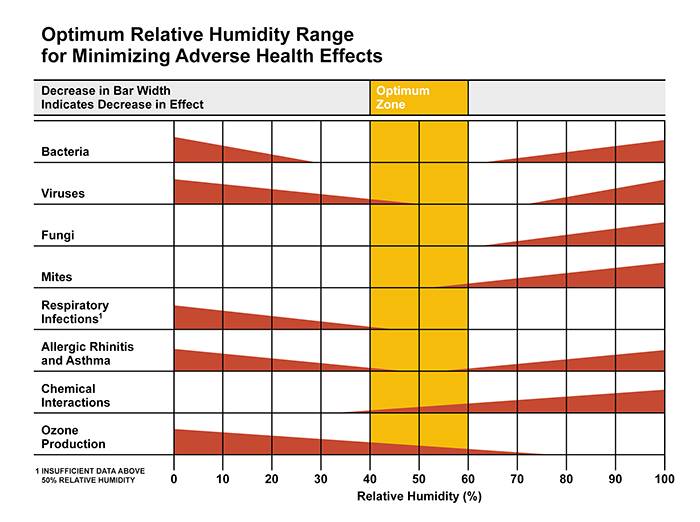
In fact, mold growth is only one of several indoor environmental contaminants whose growth correspond to indoor relative humidity levels. Figure 1 is an adaptation of a frequently cited chart by Anthony V. Arundel et al. (1986) that illustrates the relationship between indoor RH and the effect of several indoor environmental pollutions sources.


Figure 1: Optimum relative humidity range for minimizing adverse health effects.
Illustration by Daniel Overbey. Adapted from: Arundel, A.V., et al.  "Indirect Health Effects of Relative Humidity in Indoor Environments."  Environmental Health Perspectives. Vol. 65, p. 358 (1986).


Arundel et al. (1986) draw several direct health effects of indoor humidity levels:

  • Both very high and very low relative humidities may cause thermal discomfort due to perceived air temperatures.
  • Extremely low RH (<20 percent) may cause eye irritation.
  • Moderate / high RH may reduce the severity of asthma.


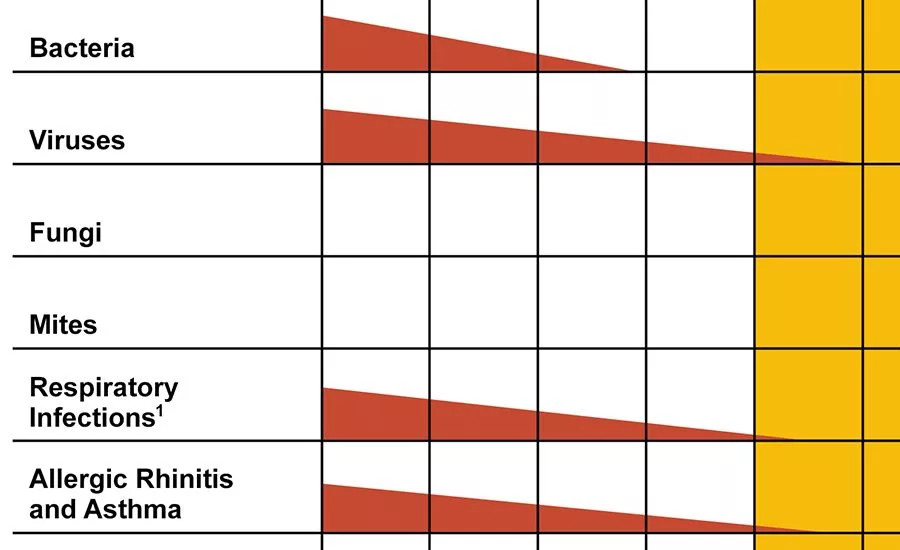
Interestingly, Arundel et al. cited little experimental evidence that mucous membranes are adversely affected by low indoor humidity levels. They stated that such experiences may be the result of the direct effect of RH on the mucous membranes of individuals with bronchial construction, rhinitis, or cold and influenza related symptoms. Moreover, Arundel et al. found low RH to improve the survival of rhinoviruses and influenza virus and human rotavirus on hard surfaces.

Arundel et al. also cite several indirect health effects of indoor humidity levels:

  • High RH fosters the growth of fungi and mites.
  • Both high and low RH can result in certain types of bacteria and virus growth.
  • Formaldehyde, sulfur, nitrogen dioxides, and other chemical respiratory irritants may be more severe in high humidity environments.
  • Indoor ozone levels are enhanced by low relative humidity.


It is important to recognize that Figure 1 does not represent quantitative data. A review of the available data on the indirect health effects of indoor humidity shows that the effects do not uniformly increase or decrease with RH levels. According to Arundel et al., the relative humidity range for minimizing as many adverse health effects as possible appears to be between 40 and 60 percent. 


Reference:

Arundel, A.V., et al.  "Indirect Health Effects of Relative Humidity in Indoor Environments."  Environmental Health Perspectives. Vol. 65, pp. 351-361 (1986).

KEYWORDS: healthy buildings moisture mold multi-family buildings

Share This Story

Overbey   head shot 2020 3

Daniel Overbey, AIA, NCARB, LEED Fellow (LEED AP BD+C, ID+C, O+M), WELL AP is an Assistant Professor of Architecture at Ball State University and the Director of Sustainability for Browning Day in Indianapolis, Ind. His work focuses on high-performance building design and construction, environmental systems research, green building certification services, energy/life-cycle assessment modeling, and resilient design. He can be reached at djoverbey@bsu.edu.

Recent Comments

These are actually very helpful tips. It is...

This is the most beneficial blog for all...

This blog is a great resource for anyone...

Thank you for sharing this important information. I...

This is a very interesting subject of the...

Manage My Account
  • Sign up for the Newsletter
  • Online Registration
  • Manage My Preferences
  • Registration Customer Service

More Videos

Sponsored Content

Sponsored Content is a special paid section where industry companies provide high quality, objective, non-commercial content around topics of interest to the Building Enclosure audience. All Sponsored Content is supplied by the advertising company and any opinions expressed in this article are those of the author and not necessarily reflect the views of Building Enclosure or its parent company, BNP Media. Interested in participating in our Sponsored Content section? Contact your local rep!

close
  • 2 construction workers and a DEXcell panel
    Sponsored byDEXcell Roof Boards

    Designing Low-Slope Roofs for Resilience

  • Bell Bank headquarters in Fargo, North Dakota
    Sponsored bySto Corp.

    Drained and Back-Ventilated Rainscreens vs Pressurized-Equalized Rainscreens

  • A construction worker using DEXcell roof boards
    Sponsored byDEXcell Roof Boards

    The Hidden Strength of Low-Slope Roof Systems: Why Roof Cover Boards Matter

Popular Stories

construction industry workers in hard hats stand around a city scape

Construction Industry Revolts Over New CSI Licensing Plan

graph shows green, orange and red dot lines going up

LEED v5 and the Cost Impacts of ASHRAE Standard 90.1-2019

2 construction workers and a DEXcell panel

Designing Low-Slope Roofs for Resilience

Building Enclosure Newsletter

BE Poll

Events

June 17, 2025

Addressing Condensation in Low-Slope Roof Assemblies

Credits: 1 AIA LU/HSW; 0.1 ICC CEU; 1 IIBEC CEH; 0.1 IACET CEU

On Demand In modern roofing systems, vapor retarders and air barriers do more than just minimize air leakage—they’re essential to maximizing performance and longevity. This engaging course dives into the next generation of moisture control: permeable vapor retarders and air barriers. Discover how these cutting-edge technologies are transforming low-slope roofing assemblies by improving energy efficiency, managing moisture, and boosting wind uplift resistance.

April 9, 2026

Strategies for High-Performance Below-Grade Waterproofing

Credits: 1 AIA LU/HSW ; 1 IIBEC CEH; 0.1 IACET CEU

On-Demand Designing a high-performance building enclosure requires more than just surface-level protection; it demands a rigorous, performance-based mastery of below-grade water and gas mitigation. This discussion will provide an expert-level analysis of below-grade waterproofing within the comprehensive framework of the high-performance building enclosure.

View All Submit An Event

Products

Plaster and Drywall Assemblies Manual

Plaster and Drywall Assemblies Manual

This is a comprehensive manual that goes beyond codes and standards, providing expert guidance in design, detailing, material selection and troubleshooting for plaster and drywall.

See More Products
×

Enhance your expertise with unparalleled insights.

Join thousands of building professionals today. Shouldn’t you know what they know?

SUBSCRIBE TODAY!
  • RESOURCES
    • Advertise
    • Contact Us
    • Store
    • Want More
  • SIGN UP TODAY
    • Create Account
    • Newsletter
    • Customer Service
    • Manage Preferences
  • SERVICES
    • Marketing Services
    • Reprints
    • Market Research
    • List Rental
    • Survey/Respondent Access
  • STAY CONNECTED
    • LinkedIn
    • Facebook
    • Instagram
    • YouTube
    • X
  • PRIVACY
    • PRIVACY POLICY
    • TERMS & CONDITIONS
    • DO NOT SELL MY PERSONAL INFORMATION
    • PRIVACY REQUEST
    • ACCESSIBILITY

Copyright ©2026. All Rights Reserved BNP Media, Inc. and BNP Media II, LLC.

Design, CMS, Hosting & Web Development :: ePublishing