The U.S. Department of Stateʼs New Consulate General Mérida
Miller Hullʼs design achieves LEED Gold Certification while drawing on Maya influences
.webp?t=1781868824)
Designed by The Miller Hull Partnership, the new U.S. Consulate General Mérida achieved LEED Gold Certification in April 2026, exceeding stringent federal performance goals while serving the needs of American citizens and visa applicants from across Mexicoʼs Yucatán peninsula. Sitting on seven acres, the new campus draws upon the dual influences of the historic Maya and colonial eras, seen through the lens of the regionʼs rich contemporary culture.
Utilizing the design‑build construction method, the project brings the best of American engineering and construction techniques to Mérida, achieving the U.S. Department of State Bureau of Overseas Buildings Operationsʼ (OBO) mission by creating a safe, secure, and effective platform for the conduct of American diplomacy. Inspired by the local culture and reflective of the strong connections between the United States and Mérida, the consulate presents a welcoming, open feel with an ambiance that is restrained, simple, and elegant.
This is Miller Hullʼs fourth project completed with OBO, following the completion of the new U.S. Embassy Niamey, the new U.S. Embassy Guatemala City, and the new U.S. Consulate General Guadalajara.
 Nic Lehoux
The area's architectural history and its unique natural environment informed the site's landscape design, with stone walls, edging, and water troughs referencing common features found in haciendas throughout the region. Official visitors and staff follow a low limestone wall to the main building entrance, marked by one of these water features. The buildingʼs limestone base folds into the main lobby, drawing people into the skylit, green core of the building.
The consular entrance is separate, with a clear and direct approach framed by a limestone wall on one side and a lushly planted garden and shaded outdoor waiting pavilion on the other. A brightly lit consular waiting space provides more service windows to accommodate visitors and is finished with durable yet inviting materials.
Glass and metal panel‑clad upper floors extend out over the stone base to create a shaded walkway around the building. An array of deep fins reaches out from this upper volume, forming a consistent sun screen intended to control glare and mitigate solar heat gain, creating comfortable interior spaces and reducing energy costs.
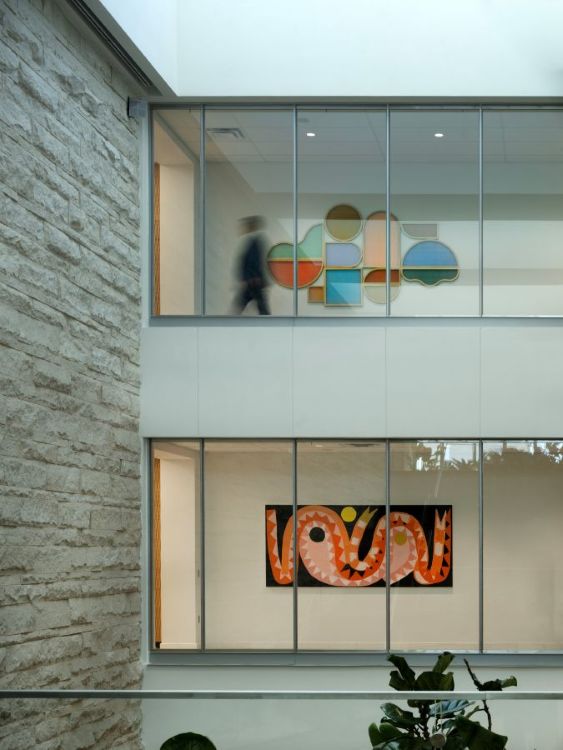
Shaped by the cenotes dotting the peninsula, the heart of the building is a lushly planted, stone‑clad, skylit atrium, which acts as the buildingʼs main circulation spine. The atrium and its “irresistible stair” extend from the lobby, past the gallery, and up through the office area, connecting the entire consulate community and creating opportunities for chance encounters and visual connections across the building.
The working and gathering spaces surrounding the consulateʼs central atrium maximize access to daylight and views while providing consulate staff with flexible, efficient workspaces. The second‑floor gallery provides space for representational and community activities and impromptu meetings and includes an integrated artwork by Cuban American artist Jorge Pardo—part of the consulateʼs Art in Embassies collection.
The new consulate exemplifies building performance by integrating utility optimization and natural hazard adaptation. LEED Gold Certified at 67 LEED points, the building conserves 49% of projected energy‑use. With daylighting and efficient HVAC systems, 29% of the energy comes from onsite renewable sources, further decreasing the projectʼs reliance on traditional energy sources and reducing long‑term operational costs.
To protect against the Yucatánʼs significant seasonal rainfall, the siteʼs design includes treatment‑providing stormwater troughs and sunken landscape areas that collect rainwater before release via stormwater injection wells. Several structures and troughs across the campus are clad in an ancient Maya material called chukum plaster—a combination of the resin from the locally endemic chukum tree and traditional limestone plaster—an ancient material widely used in the region for its natural resistance to water infiltration and cracking.
The new U.S. Consulate General Mérida is an important physical representation of the long‑term commitment to the U.S.–Mexico relationship and a permanent presence in the region. With a focus on functionality, security, and architectural excellence, this new facility provides a safe and efficient environment for consulate operations.
Looking for a reprint of this article?
From high-res PDFs to custom plaques, order your copy today!
.webp?height=740&t=1767036885&width=auto "Header - BE 1170x658 (002).png")

.webp?height=740&t=1755781744&width=auto "KEE(2).png")