Building Enclosure logo
search
cart
facebook twitter linkedin youtube instagram Spotify Podcasts Apple Podcasts Spotify Podcasts Apple Podcasts
  • Sign In
  • Create Account
  • Sign Out
  • My Account
Building Enclosure logo
  • NEWS
    • Breaking News
  • SECTIONS
    • Columns
    • Project Profiles
    • Trade Shows
    • Sponsor Insights
  • SYSTEM DESIGNS
    • Low-Slope Roofs
    • Pitched Roofs
    • Metal Roofing Materials
    • Waterproofing
    • Sustainability
    • Insulation
    • Exterior Claddings
    • Wall Systems
    • Building Envelope
  • BLOG
    • The BE Blog
  • MEDIA
    • Podcasts
    • Webinars
    • Quiz
    • Videos
    • Polls
    • Interactive Spotlights
    • Newsletter
    • Photo Galleries
  • DIRECTORIES
    • Directory: Blue Book
    • Directory: Roofing Resource
  • PRODUCTS
  • TECHNICAL
    • Codes
      • Waterproofing
      • Roofing
    • Details
      • Waterproofing
      • Roofing
  • CONTINUING ED
  • ABOUT
    • Advertise
      • Editorial Calendar
    • Contact
    • eMag Archive Issues
  • SIGN UP!
Breaking News

New Economic Study Identifies a $300 Billion Infrastructure Identity Gap in the Built Environment

A Dallas-Based Infrastructure Identity Firm UMIP Inc. Explores the Economic Impact of Fragmented Asset Records
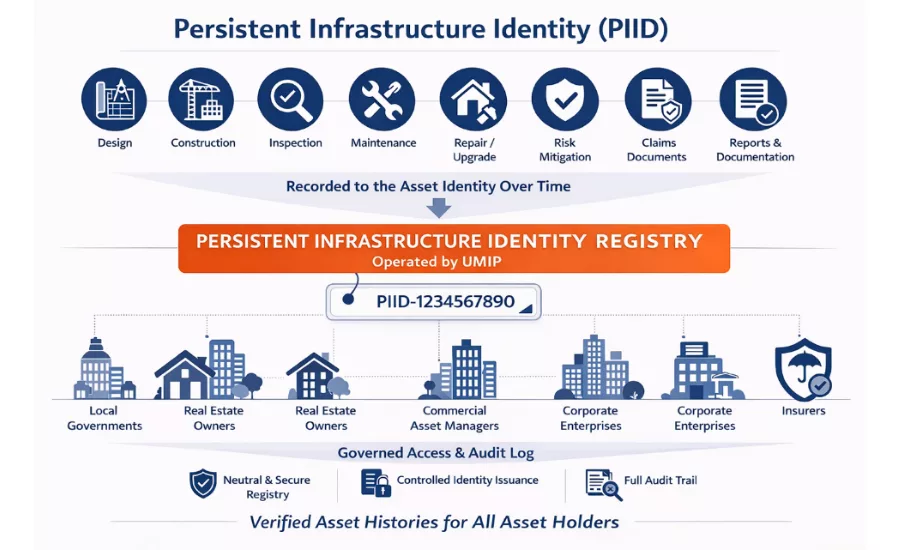
Persistent Infrastructure identity graph shows verified asset histories for all asset holders for audit and registry
UMIP Inc.
March 20, 2026

A newly released economic analysis from Dallas-based infrastructure identity firm UMIP Inc. examines how fragmented infrastructure documentation may be contributing to significant inefficiencies across the lifecycle of global infrastructure assets.

The report, titled “The Economic Impact of Persistent Infrastructure Identity: A Financial Model for Lifecycle Efficiency in the Built Environment,” evaluates how infrastructure records often become fragmented as assets move through stages of development, construction, insurance coverage, ownership transfer, and long-term operations.

According to the study, the absence of persistent identity frameworks for infrastructure assets may be contributing to measurable lifecycle inefficiencies throughout the built environment.

While industries such as automotive and aviation rely on standardized identity systems, such as Vehicle Identification Numbers (VIN) and aircraft registration numbers, buildings and infrastructure assets historically have not had a comparable identity framework capable of maintaining documentation continuity across multiple stakeholders and digital systems.

The report analyzes the financial impact of fragmented infrastructure records across several operational categories including:

  • construction rework
  • documentation reconstruction
  • insurance claims investigation
  • facility maintenance inefficiencies
  • transaction due diligence delays


Using conservative industry benchmarks and economic modeling assumptions, the study estimates that lifecycle inefficiencies associated with fragmented infrastructure documentation may exceed $20 billion annually within the United States and potentially more than $300 billion globally.

The analysis also introduces the concept of Persistent Infrastructure Identity, an emerging framework designed to assign infrastructure assets a continuous identity capable of preserving lifecycle documentation across ownership changes, operational transitions, and digital platforms.

“Infrastructure assets represent hundreds of trillions of dollars in global economic value, yet the built environment has historically lacked a persistent identity framework comparable to VIN numbers in the automotive industry,” said Trevor Vick, Founder of UMIP Inc.

“As infrastructure systems continue to digitize, establishing a persistent identity layer may help improve lifecycle transparency, reduce documentation fragmentation, and support better coordination across the infrastructure ecosystem.”

The report explores how identity frameworks could support improved coordination across stakeholders involved in construction, insurance, infrastructure finance, and long-term asset operations.

KEYWORDS: building design construction infrastructure insurance life-cycle assessment

Share This Story

Looking for a reprint of this article?
From high-res PDFs to custom plaques, order your copy today!


Recommended Content

JOIN TODAY
to unlock your recommendations.

Already have an account? Sign In

  • bar graph shows LEED v4/LEED v5/LEED v6 in various colors

    When Will LEED v4 / v4.1 and LEED v5 Expire?

    The latest version of the LEED rating system, LEED v5, is...
    Sustainability
    By: Daniel Overbey
  • Celebrating Women In AEC-2026

    Celebrating Women in The AEC Industry Part 1

    A round-up of women in the design, engineering and...
    Sustainability
    By: Lindsay Lewis
  • KEE membrane application on a roof

    A Beginner’s Guide to Single-Ply Roofing Membranes

    While PVC and TPO appear extremely similar, the chemistry...
    Low-Slope Roofs
    By: Peter Gross
Manage My Account
  • Sign up for the Newsletter
  • Online Registration
  • Manage My Preferences
  • Registration Customer Service

More Videos

Sponsored Content

Sponsored Content is a special paid section where industry companies provide high quality, objective, non-commercial content around topics of interest to the Building Enclosure audience. All Sponsored Content is supplied by the advertising company and any opinions expressed in this article are those of the author and not necessarily reflect the views of Building Enclosure or its parent company, BNP Media. Interested in participating in our Sponsored Content section? Contact your local rep!

close
  • 2 construction workers and a DEXcell panel
    Sponsored byDEXcell Roof Boards

    Designing Low-Slope Roofs for Resilience

  • Bell Bank headquarters in Fargo, North Dakota
    Sponsored bySto Corp.

    Drained and Back-Ventilated Rainscreens vs Pressurized-Equalized Rainscreens

  • A construction worker using DEXcell roof boards
    Sponsored byDEXcell Roof Boards

    The Hidden Strength of Low-Slope Roof Systems: Why Roof Cover Boards Matter

Popular Stories

construction industry workers in hard hats stand around a city scape

Construction Industry Revolts Over New CSI Licensing Plan

graph shows green, orange and red dot lines going up

LEED v5 and the Cost Impacts of ASHRAE Standard 90.1-2019

2 construction workers and a DEXcell panel

Designing Low-Slope Roofs for Resilience

Building Enclosure Newsletter

BE Poll

Events

April 9, 2026

Strategies for High-Performance Below-Grade Waterproofing

Credits: 1 AIA LU/HSW ; 1 IIBEC CEH; 0.1 IACET CEU

On-Demand Designing a high-performance building enclosure requires more than just surface-level protection; it demands a rigorous, performance-based mastery of below-grade water and gas mitigation. This discussion will provide an expert-level analysis of below-grade waterproofing within the comprehensive framework of the high-performance building enclosure.

April 28, 2026

Roof Design Considerations That Prevent Installation Failures and Change Orders

Credit: 1 AIA LU/HSW; 1 IIBEC CEH; 0.1 ICC CEU

On-Demand This course provides visual examples of actual field conditions. Some good, some not so good; along with design suggestions that can cut installation costs and reduce construction change orders. Upon completion of this course, you will have a better understanding of the requirements the roofing contractor must meet to provide the specified roofing system warranty, and long-term value to the owner.

View All Submit An Event

Products

Plaster and Drywall Assemblies Manual

Plaster and Drywall Assemblies Manual

This is a comprehensive manual that goes beyond codes and standards, providing expert guidance in design, detailing, material selection and troubleshooting for plaster and drywall.

See More Products

Related Articles

  • The American Institute of Architects

    New Report Examines Resiliency, Sustainability in the Built Environment

    See More
  • 3.jpg

    Building Innovation 2021 to Highlight the Changing Workplace in the Built Environment

    See More
  • Breaking News Image #1

    EYP, Institute for Health in the Built Environment Collaborate

    See More

Related Products

See More Products
  • energy modeling.jpg

    Energy Modeling and Computations in the Building Envelope

  • building codes illustated.jpg

    Building Codes Illustrated: A Guide to Understanding the 2021 International Building Code, 7th Edition

See More Products

Events

View AllSubmit An Event
  • August 12, 2025

    Sustainable Steel Framing in the Building Envelope

    Credits: 1 AIA LU/HSW; 0.1 ICC CEU; 1 IIBEC CEH On-Demand In this webinar, participants will get a taste of what it takes to make steel today, in the cleaner, high-tech factories that are very different from the steel mills of decades ago, and will see how their specification language and design practices can help reduce the carbon footprint of buildings using steel framing.
View AllSubmit An Event
×

Enhance your expertise with unparalleled insights.

Join thousands of building professionals today. Shouldn’t you know what they know?

SUBSCRIBE TODAY!
  • RESOURCES
    • Advertise
    • Contact Us
    • Store
    • Want More
  • SIGN UP TODAY
    • Create Account
    • Newsletter
    • Customer Service
    • Manage Preferences
  • SERVICES
    • Marketing Services
    • Reprints
    • Market Research
    • List Rental
    • Survey/Respondent Access
  • STAY CONNECTED
    • LinkedIn
    • Facebook
    • Instagram
    • YouTube
    • X
  • PRIVACY
    • PRIVACY POLICY
    • TERMS & CONDITIONS
    • DO NOT SELL MY PERSONAL INFORMATION
    • PRIVACY REQUEST
    • ACCESSIBILITY

Copyright ©2026. All Rights Reserved BNP Media, Inc. and BNP Media II, LLC.

Design, CMS, Hosting & Web Development :: ePublishing