A Forensic Approach to TPO Surface Oxidation and Long-Term Integrity
The Weld Window

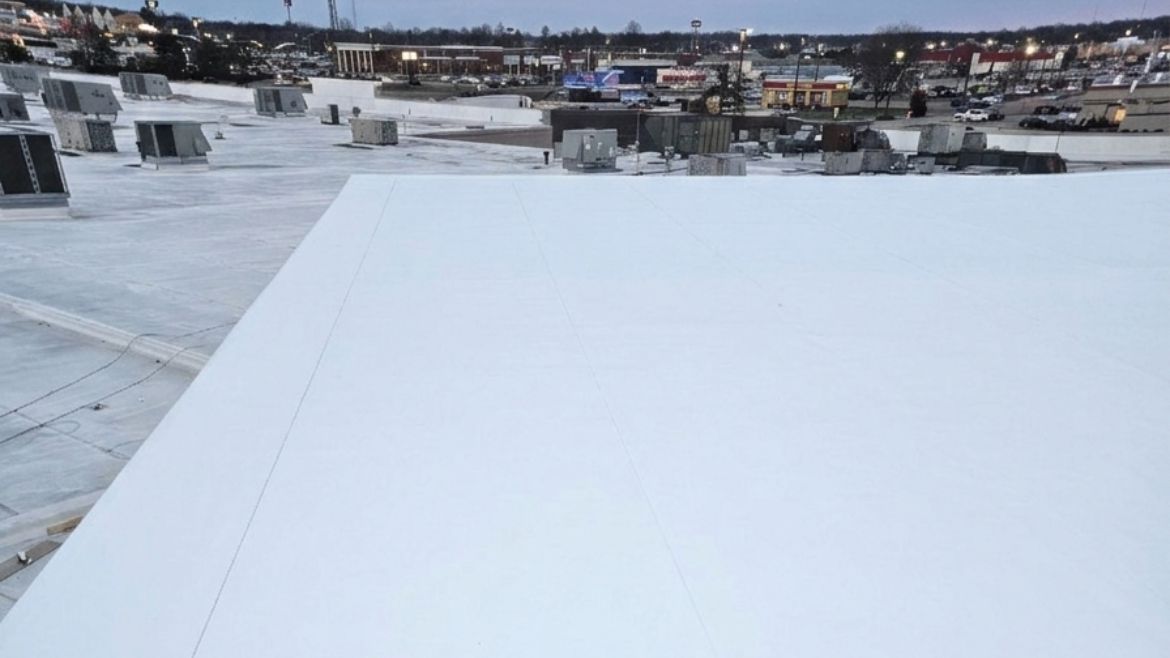
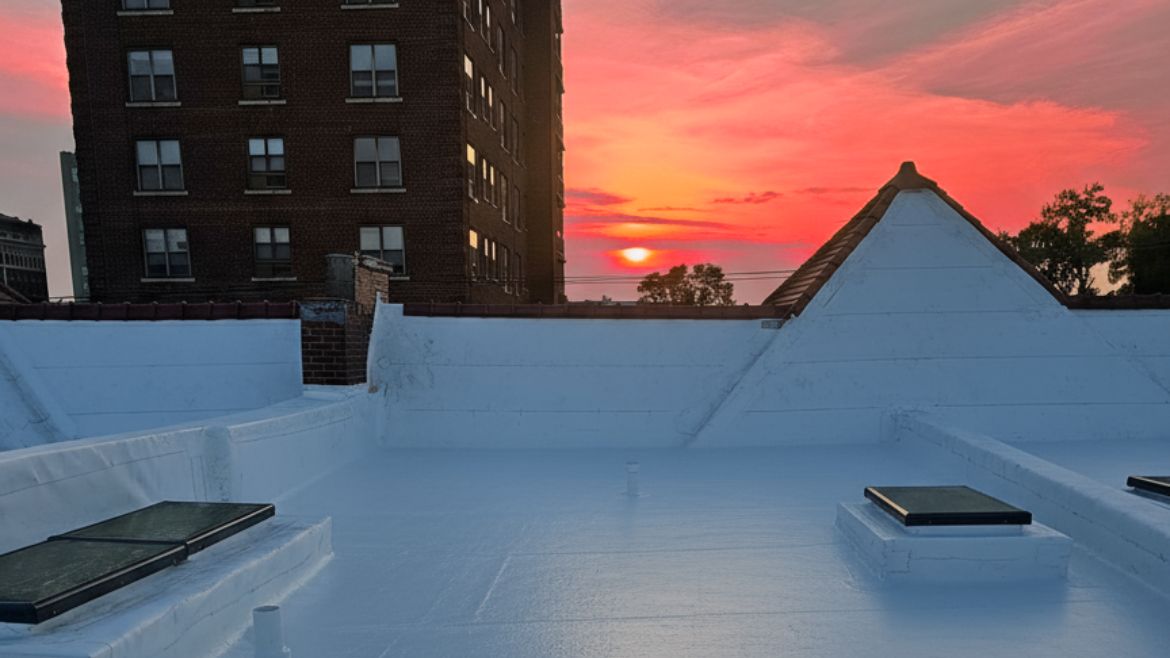
A completed high-performance enclosure (Gerhardt Apartments, St. Louis). Unlike commodity TPO, which suffers from late-lifecycle weld failure, premium membranes with stable chemistry maintain their molecular receptivity. Selecting these systems allows facility managers to transition from a cycle of recurring repair liabilities to long-term asset protection.
When a single-ply TPO (Thermoplastic Polyolefin) membrane is installed on a vast commercial facility, the primary stakeholder rarely questions its reparability 12 years in the future. The initial value proposition—competitive upfront cost, energy reflectivity, and rapid installation—is compelling. However, for building enclosure professionals and long-term asset managers, there is an invisible, ticking liability clock known as the "Weld Window".
Strategic planning for commercial roofing often focuses on immediate leak remediation. However, a deeper forensic investigation reveals that these repairs are often a symptomatic fix on an underlying pathology: an expired asset. In our extensive forensic auditing of massive commercial portfolios, we consistently find that the material science behind membrane aging dictates the financial and structural liability of every maintenance decision made a decade later.
Defining the 'Weld Window': TPO (ASTM D6878) vs. PVC (ASTM D4434)
The Weld Window is the specific timeframe during which a thermoplastic membrane remains receptive to molecular fusion through heat and pressure. For TPO, this window is dynamic. TPO was introduced in the 1990s as a budget-friendly alternative to more mature technologies. Because the technology is younger, formulations have been relatively unstable; manufacturers have had to reformulate TPO multiple times to address premature cracking and failure.
Under ASTM D6878, TPO is naturally combustible and relies on fire-retardant additives—such as magnesium hydroxide—to achieve Class A ratings. If these additives are not perfectly dispersed, or if they degrade over time, the roof's fire resistance can be compromised. More importantly for the enclosure professional, TPO suffers from significant surface oxidation. After approximately 7–10 years, the surface "weathers," becomes stiff, and loses the flexibility required for reliable repairs.
By contrast, PVC (Polyvinyl Chloride), governed by ASTM D4434, has a track record dating back to the 1960s. Due to its high chlorine content, it is naturally fire-resistant and remains heat-weldable throughout its entire service life. A new piece of PVC can be welded to a 20-year-old existing PVC roof with a strong molecular bond, effectively keeping its Weld Window open for decades.
The Material Science of Surface Oxidation and the "Grease Factor"
Surface oxidation is the silent killer of TPO repair reliability. Thermoplastics achieve a true, monolithic weld through polymer chain entanglement. When heat and pressure are applied to a fresh membrane, the polymer molecules flow across the interface and interlink.
However, TPO is exceptionally vulnerable to hydrocarbons and organic fats. For buildings with rooftop HVAC units, exhaust vents, or manufacturing outputs, exposure to grease or oil causes TPO to absorb the contaminant and swell. This absorption accelerates the loss of physical properties, leading to cracking and a total closure of the Weld Window. You are then attempting to weld a new patch to a chemically hostile, oxidized substrate. The result is a mechanical bond—a superficial attachment rather than a fusion—that is prone to delamination under dynamic thermal and wind loads.
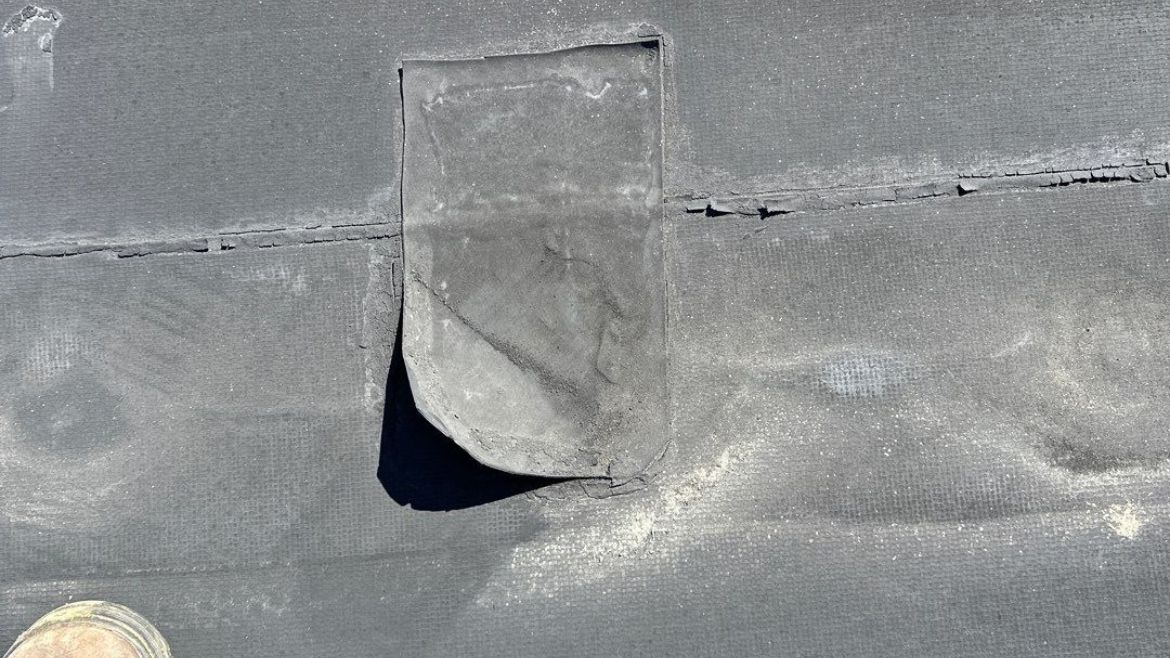 A failed TPO repair on an oxidized parent membrane that exceeded its weld window. Note the complete delamination at the edge, where the new patch material failed to interlink with the aged, chemically hostile substrate. Image courtesy of Exceptional Roofing.
Polymer Chain Scission and Molecular Decay
The closure of the Weld Window is the physical manifestation of a chemical process called polymer chain scission. TPO is a reactor-grade blend of polypropylene and ethylene-propylene rubber. UV radiation acts as a catalyst, breaking the long-molecular chains that give the membrane its flexibility and weldability. As these chains break, fire-retardant additives can migrate to the surface, creating a "chalky" layer that acts as a bond-breaker for new welds.
Unlike PVC, which uses stable plasticizers to maintain flexibility, older TPO formulations are prone to "additive depletion". Once these stabilizers are exhausted, the membrane reaches a "critical oxidation induction time," after which the degradation accelerates exponentially. Once surface scuffing and porosity appear, the molecular structure has likely reached a point of no return.
The Forensic Audit: Proving the Closed Window
To mitigate the risk of patch failure, audit teams utilize a standardized forensic methodology to quantify the condition of the membrane:
- Surface Porosity and Dirt Pickup: Aged TPO has higher dirt pickup and loses reflectivity over time. Significant scuff impregnation suggests severe oxidation.
- The "Scrape Test": A standardized metal tool should leave a minimal mark on a healthy membrane. On an aged membrane, the tool will deeply "score" or reveal brittle, crumbling material.
- Weldability Testing: If a trial repair requires aggressive abrasion or chemical primers to hold even temporarily, the asset has reached a state of "irreparable liability".
Quantifying Forensic Failure: The Peel-Bond Analysis Subjective observations are insufficient for high-value asset planning. We utilize a field-testing protocol derived from ASTM standards to quantify the status of the Weld Window. A technician cleans a 6-inch area of the aged membrane, applies a new TPO patch using a robotic or hand welder, and allows it to return to ambient temperature.
The forensic "tell" occurs during the manual peel test. On a membrane within its window, the weld results in a "Film Tearing Bond"—the patch or parent membrane rips before the weld lets go. If the patch peels away cleanly, often revealing a smooth, shiny surface on the parent membrane, the Weld Window has closed. This indicates no polymer chain entanglement occurred, making any future repair a temporary bandage.
The Liability Ripple: Beyond the Leak
Once the weld window is closed, approving a standard "repair" order shifts from maintenance to compounding liability. Delamination creates moisture ingress that leads to deck corrosion and the destruction of insulation R-value.
Case Study: The Financial Consequences of the Closed Window Consider two disparate strategies for a 100,000-square-foot industrial facility with a 12-year-old TPO assembly:
- Facility A (The Status Quo Repair Cycle): This facility ignores the forensic status of the membrane. Localized patches fail within 18 months. Over three years, the facility spends $45,000 on recurring repairs. By year 15, the facility has 20% saturated insulation, resulting in $60,000 in increased HVAC costs and a $120,000 bill for "wet-service" insulation replacement during an eventual reroof. Total unrecovered loss: $225,000.
- Facility B (The Forensic Asset Strategy): This facility performs a forensic audit in year 12. The Peel-Bond Analysis proves the asset is "irreparable". When a weather event occurs, the facility presents this forensic data to their insurance carrier. Because the roof can no longer be repaired to pre-loss condition, the carrier moves from a "patch" to a "full replacement" settlement. Facility B secures a new $500,000 building enclosure for a $5,000 deductible.
The difference is the application of forensic data to CapEx planning. Proving the "Weld Window" is closed converted a high-liability asset into a recovered capital improvement.
Conclusion: The Path Forward
The path forward is data-driven consulting. By identifying when a Weld Window is closing, stakeholders can move from a cycle of failed patches to a strategic asset replacement that is insurance-supported and structurally sound.
Looking for a reprint of this article?
From high-res PDFs to custom plaques, order your copy today!

.webp?height=740&t=1767036885&width=auto "Header - BE 1170x658 (002).png")

.webp?height=740&t=1755781744&width=auto "KEE(2).png")