How Much of the U.S. Building Stock is Green Building Certified?
The recently published Metropolis + Interface U.S. Sustainable Design Report 2026 provides a comprehensive overview of the current state of the U.S. building design and construction industry

The recently published Metropolis + Interface U.S. Sustainable Design Report 2026 provides a comprehensive overview of the current state of the U.S. building design and construction industry. The report primarily focuses on decarbonization, material transparency, and circularity.
Among the many insights offered by the report, I found the assessment of green building certification as proportion of the overall U.S. building stock to be particularly valuable. Citing primary sources, the report's authors aggregated the cumulative square footage of building stock certified under the LEED, WELL, Green Globes, and Living Future (i.e., Living Building Challenge and Zero Carbon rating systems).
Using the data exhibited in the Metropolis + Interface report as a point of departure, I sought to offer a few additional insights.
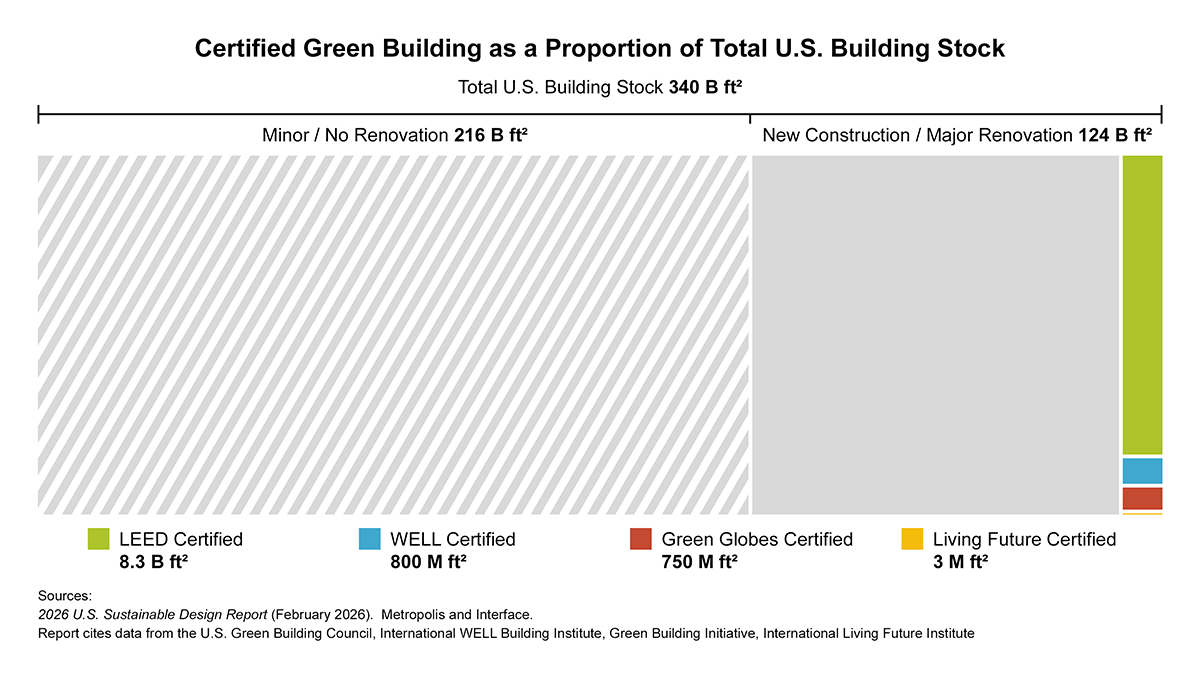
Since 2000, around 8.5% of all new construction and major renovation has been green building certified.
Initially, it would appear that only 2.9% of total U.S. building stock is green building certified. I concur. My own research suggested that the report's 340 B ft² figure is a fair approximation and, again, the figures for LEED, WELL, Green Globes, and Living Future certified building area all derived directly from the products' developers.
However, most green building rating systems used in the U.S. came online on or after the year 2000:
- Following the success of pilot-testing projects in 1998, LEED for New Construction launched in March 2000.
- Originating from the BREEAM framework, Green Globes was introduced in Canada in 2000 before being adapted for the U.S. market by the Green Building Initiative (GBI) in 2004.
- Seattle architect Jason F. McLennan and the Cascadia Green Building Council launched the Living Building Challenge in 2006.
- The International WELL Building Institute (IWBI) launched the WELL Building Standard in October 2014.
So, how much of the U.S. building stock was added after 2000?
That is a very difficult question to answer definitively. Approximating the total square footage for all new construction and major renovations in the U.S. is complicated because mixed data and various methodologies must be aggregated across public and private sector sources. Admittedly offered with fair but low-confidence level, my own research suggests that since 2000, the U.S. has added:
~90 billion square feet of new construction
~24–34 billion square feet of major renovation (i.e., includes thermal enclosure and energy-related systems)
If we only look at building stock since 2000, how does that change things?
If those approximations are true, then somewhere between 7.9% and 8.6% of all new construction and major renovation is green building certified. Keep in mind:
- This data does not consider building area certified under multiple rating systems (e.g. LEED + WELL dual certification).
- This data does not consider building area certified under rating systems aside from LEED, WELL, Green Globes, or Living Future. This data does not consider other rating systems that have significant market share in the U.S., such as Fitwel, National Green Building Standard (NGBS), Parksmart, or Phius. Though, collectively, these likely add up to less than 10 million square feet.
- This data does not consider Energy Star. Though one could argue that its structure and narrow scope precludes it from being defined as a green building rating system, if ~7 billion square feet of Energy Star certified building space since 2000 is included, green building certification would capture another 5.6%.
How much building stock is added or subtracted ever year?
A commonly referenced top-down estimate is that, "during normal economic times," the U.S. building sector will see through:
~5 billion ft² of new construction per year
~5 billion ft² renovated per year
~1.75 billion ft² demolished per year
This estimate is summarized by the Whole Building Design Guide (WBDG), citing Architecture 2030 and the U.S. Energy Information Administration (EIA) as the underlying data sources.
Considering the trajectories of market growth, product expansion, and process streamlining, we could reasonably expect to see at least ~400 to 430 million square feet of new green building certified space every year.
LEED is the most successful green building certification product the U.S. building sector has ever seen—however, every certification has a unique value proposition.
Another thing is clear from the report: LEED is the most widely recognized green building rating system in the U.S., and it is not close. There is more LEED certified space in the U.S. than WELL, Green Globes, and Living Future certified space combined—times five.
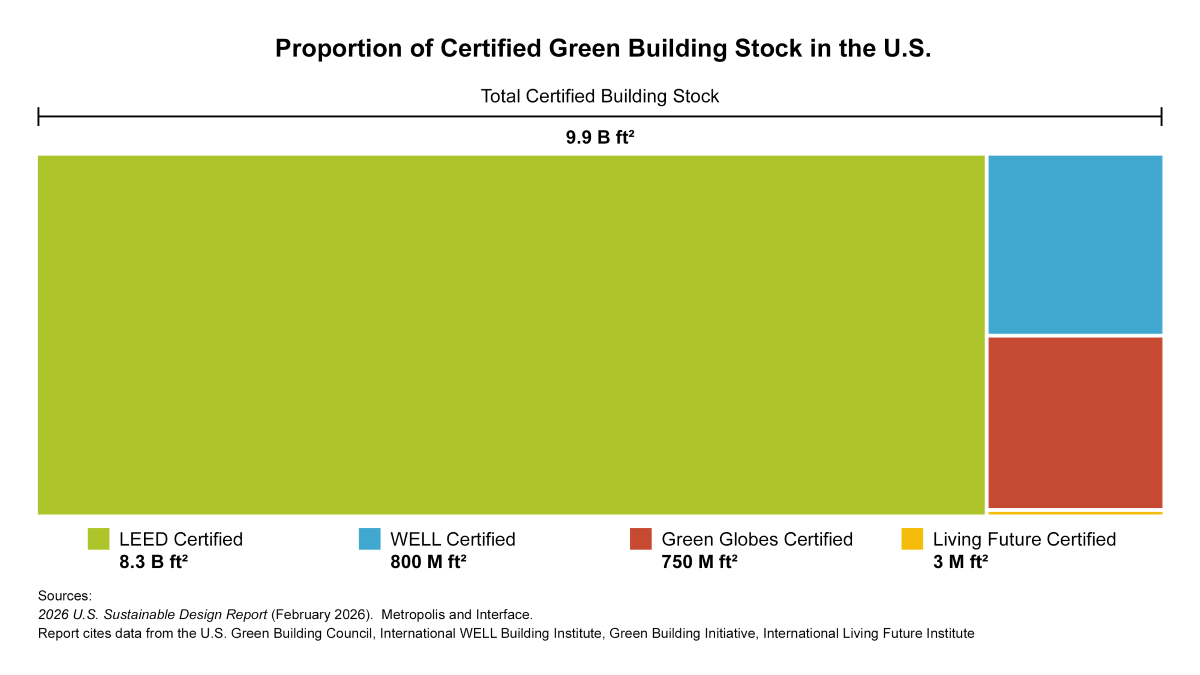 Figure 2: Proportion of certified green building stock in the U.S. Figure by Daniel Overbey.
However, every products in the marketplace has a unique value proposition.
- For instance, we need the Living Building Challenge, which extends far beyond LEED. Through continued improvements, LBC lays down a market for the 2.5% of innovators per the Rogers' diffusion of innovation curve. It serves the industry as the guiding light for the future of green building. Alway has been. But this means, LBC will forever be niche.
- While present in both, the WELL Building Standard exhibits a deeper emphasis and prioritization on health and wellness of building users than LEED. The Venn diagram LEED and WELL exhibits a lot of overlap. These two rating systems compliment each other well. There is even a crosswalk document published to help project teams strike synergies and efficiencies between the two systems.
As the future of green building certification continues to advance, it feel prudent to bring greater transparency to metrics related to market uptake.