University of South Florida Beats the Heat with Temperature-Lowering Exterior Coating System

All images courtesy of Tex-Cote.
With 246 sunny days, an average UV index of 6.9, and 74 days of 90-plus-degree temperatures a year, Tampa, Florida sees its fair share of high cooling costs for commercial and institutional buildings. Finding a way to reduce those costs was the goal of a recent dormitory refresh project at the University of South Florida (USF), where an infrared, heat-reflective, water-based coating system called TEX-COTE® COOLWALL® with KYNAR® PVDF is helping to reduce building surface temperatures and related cooling costs.
“PhD candidates at USF initially approached TEX-COTE about our COOLWALL® technology as part of a research project,” said Simon Reynolds, Director of Commercial Sales, TEX-COTE LLC. “That research dovetailed nicely with work being undertaken by the university’s housing group to renovate one of its dormitories and reduce its energy use. COOLWALL® was a natural fit.”
How Cool Walls Save Energy
Just as wearing light-colored clothing can help keep a person cool on a sunny day, cool walls with solar-reflective surfaces can help to maintain lower temperatures on a building’s surface. Lower building façade temperatures translate into reduced solar heat gain (the amount of heat from the sun that enters the building), which helps to maintain cooler indoor temperatures than would occur with less reflective exterior wall coatings. In turn, cooler indoor temperatures help to lower the building’s cooling demand and reduce the amount of waste heat released by air conditioning units.

Considering that cooling systems consume an estimated 15 percent of the electricity used by commercial and institutional buildings, property owners can recognize significant savings by reducing the energy required to run them.
“Concrete buildings like the dorm at USF are thermally massive,” Reynolds said. “They soak up energy during the day and hold onto it throughout the night, making it difficult to get any cooling effects of the night air. By reflecting that heat energy and stopping that temperature buildup, you can reduce a building’s contribution to the urban heat island effect.”
Military-Grade “Heat Signature” Technology
TEX-COTE was the first paint and coatings manufacturer to be granted a patent for heat-reflective wall coatings. For its COOLWALL® with KYNAR® Coating System, the company turned to the same heat reflective technology the military uses in the STEALTH program to reduce the amount of solar heat absorbed, and radar signals detected, on planes and vehicles. The coatings’ highly reflective pigment technology reflects the invisible portion of the light spectrum, thereby helping to reflect heat without changing color.
The coating system has been tested by the U.S. Department of Energy’s OakRidge National Laboratory and has proven to reduce surface temperatures by as much as 40 degrees Fahrenheit and provide cooling cost energy savings of up to 21.9 percent. These benefits have allowed some property owners to apply for energy-savings credits under the Leadership in Energy and Environmental Design (LEED) green building certification program.
 Testing of COOLWALL® with KYNAR®PVDFon wood and concrete/masonry construction homes around the country proved the coatings’ energy-savings performance.
At USF, surface temperature readings on the tilt-up concrete dorm coated with COOLWALL® were up to 40 degrees cooler than before being coated. Ongoing energy monitoring continues to display a reduction in cooling energy use compared to energy use before the COOLWALL® coating.
Dark Colors Can Be Cool
Traditionally, white paint has been used to keep the exterior of a building cool, because white reflects much of the sun’s radiation back into the atmosphere. Dark colors, while aesthetically pleasing, have traditionally led to heat buildup.
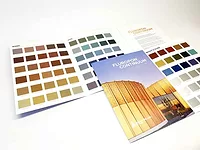
With COOLWALL® technology, buildings don’t need to be white to achieve solar reflectance benefits. For the USF dormitory, TEX-COTE supplied shades of amber, gold, tan, and red COOLWALL® coatings that matched the color scheme used throughout campus.
 The USF dormitory features bold and saturated colors.
Durability And Fade Resistance
The heat reflective technology used in COOLWALL®Coatings also provides long term benefits beyond energy savings, including increased durability and fade resistance that allows the coating system to last longer with less maintenance.
“Heat accelerates the degradation and fading of exterior coatings, especially in hot, humid locations like Florida,” Reynolds said. “COOLWALL®Coatings are much more durable and undergo significantly less thermal cycling-related expansion and contraction stress than typical acrylic or elastomeric coatings. Their color, adhesion, and other physical properties also are greatly extended, thanks to our use of water-based Kynar Aquatec® PVDF resin.”
Kynar Aquatec® PVDFresin features incredibly strong carbon-fluorine bonds that prevent film erosion when exposed to the elements, keeping the film thickness consistent –and the coating’s IR-reflecting pigments protected –over time. These bonds allow its protective properties, including solar reflectance, dirt shedding, algae and mold/mildew resistance, color and gloss retention, and chalking and fading resistance to last significantly longer. Dirt shedding and algae/mold resistance properties are particularly important as dirty surfaces reduce solar reflectance.
Most common architectural coatings technologies degrade in the harsh Florida sun. They chalk and film erode quickly within a few years and have to be repainted every 5-7 years. The resistance to film erosion provided by Kynar Aquatec®’allows the specialty heat reflective pigment technology to remain in place,doing its job day in and day out to maintain lower surface temperatures. The combination of these materials helps to reduce the cost of frequent repainting and reduces energy consumption for the long haul.
“Unlike conventional paints that rely on mildewcides, which leach out over time, COOLWALL® with KYNAR® combines mildewcides with the mildew-resistant properties that are inherent in the Kynar Aquatec® PVDF resin and will last the life of the coating,” Reynolds added.
"For decades, architects have trusted the long-term, fade-resistance performance of Kynar 500®PVDF-based finishes, which are baked onto metal surfaces of exterior building products like aluminum doors and window frames in the factory,” explained Ron Partridge, Sr. Account Manager, Kynar® PVDF Coatings, Arkema, Inc. “Kynar Aquatec® does not need to be baked, allowing it to provide the same long-term weathering performance in an air-dry, field-applied coating.”
“Like many architects and project specifiers we talk with, the decision-makers at USF agreed that the cost-benefit analysis of COOLWALL® with KYNAR® comes out solidly on the side of COOLWALL® for its cooling benefits and increased longevity,” Reynolds concluded. “Even five years post-application, we’re seeing great film integrity, excellent color and gloss retention and no mold or dirt buildup. The dorm looks like it was freshly coated yesterday!”
 Five years after the COOLWALL® with Kynar® Coatings were installed, the deep, bold hues remain true and fade-free as seen when compared against color swatches from the original application.
Looking for a reprint of this article?
From high-res PDFs to custom plaques, order your copy today!
.webp?height=740&t=1767036885&width=auto "Header - BE 1170x658 (002).png")

.webp?height=740&t=1755781744&width=auto "KEE(2).png")