The Impact of Fasteners on Building Envelope Performance
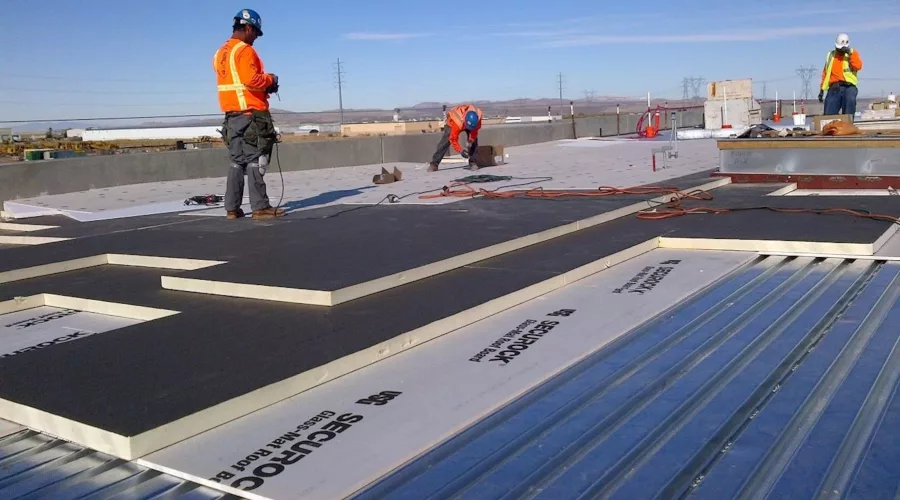
Low-slope roof assembly with thermal-barrier, insulation (2 layers), and cover board all being secured simultaneously to reduce penetrations and thermal-bridging as well as labor costs. Photo courtesy of USG.
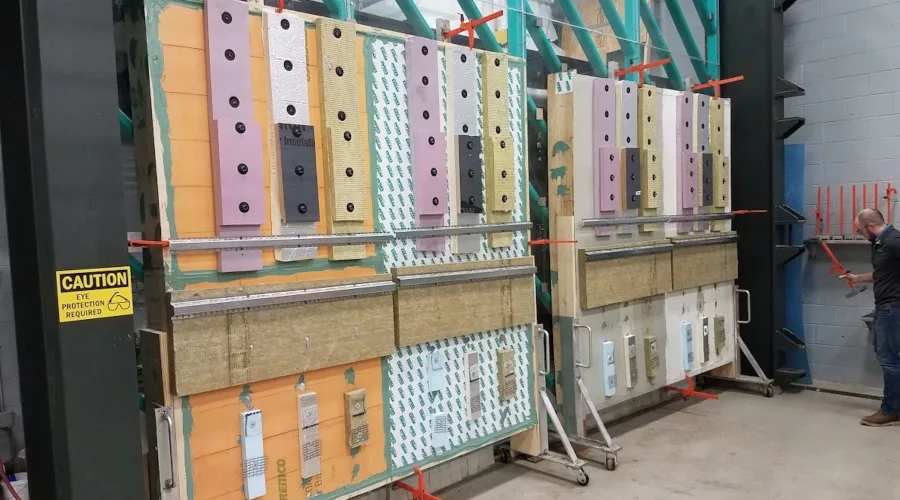
Water and air test wall assemblies with various air barriers and overlaying insulations penetrated by various tube seal fasteners, including brick anchors, insulation, lath, and channel attachment. Photo courtesy of TRUFAST.
Fasteners. Depending on perspective and experiences, they can be viewed either as a “necessary evil” or as “holding the world together”—literally. Every trade involved with designing and constructing the exterior building envelope must utilize attachment solutions to piece together each layer. Understanding the impact of fasteners penetrating through the very control layers responsible for keeping the building and occupants dry and comfortable is critical to long-term sustainability both in terms of durability and energy performance.
Every fastener ever designed and installed serves the purpose of attaching one thing to something else. Break down the many layers that make up a typical building envelope, and fasteners are at the root holding studs in place, attaching exterior sheathing to the studs to prevent structural racking and sheer, attaching layers of continuous insulation (ci) and air & water barriers (AWB), and finally the cladding. On a typical commercial roof, fasteners secure the truss system and roof deck, with layers of insulation and membranes secured over and to the structure. All of these are examples of what fasteners do: attach various materials to the structure of a building and hold it all together.
But what are the performance impacts to the various water, air, and thermal layers mentioned above?
Water
Fasteners poke innumerable holes through the weather and water barrier that have a direct impact on the ability of walls to withstand years and decades of repetitive wetting cycles. Wood structures will rot and steel structures will corrode if moisture is able to penetrate through the water-resistive barrier (often referred to as WRB) and not enabled to dry. Though the WRB is typically located behind the cladding and often beneath the layer of continuous insulation, water and vapor will always find a way through the gaps and cracks until it reaches the WRB.
Unless using fasteners capable of self-sealing their own penetration (yes, they do exist!), fastening insulation or lath to a WRB will inevitably create thousands of potential small leaks, which can add up to significant moisture penetration of the building envelope. Industry experts say that 70% of construction claims and litigation are due to water and moisture issues in the enclosure, and furthermore are the most expensive type of insurance and litigation claim. In fact, throughout the United States, water intrusion of commercial and residential structures accounts for over $20 billion in damage and remediation annually. Left untreated, moisture intrusion of the building envelope will lead to damage of the structure, and indoor air quality will suffer with the development of mold. Unfortunate but avoidable consequences of moisture penetration: unhealthy buildings and unhealthy building occupants.
Air
Those same fasteners poking holes through the WRB are also creating a potential for air leakage through the air barrier. Though perhaps not as damaging as water penetration, air leakage does directly impact energy performance and occupant comfort. The energy required to condition indoor air (whether heated or cooled) can literally escape through the walls if leaks occur through the air barrier. The short- and long-term consequences are higher energy usage and bills, as well as an increase in operational carbon emissions. What’s more, air leakage can transport moisture through the building envelope by way of moisture-laden air (i.e., water vapor), which can then condense to form liquid water within the building envelope, causing premature degradation and damage. Put simply, air leakage caused by innumerable fastener penetrations increases energy consumption and carbon emissions, and further enables moisture issues within the envelope.
Thermal
Fasteners used in the exterior building envelope often penetrate the thermal control layer. To combat the effects of thermal-bridging of structural components (e.g., steel and wood studs) it is now common to add a layer of continuous exterior insulation to serve as a “blanket” wrapped around the building. The layer of continuous insulation often consists of rigid boards such as polyiso, XPS, or mineral wool, all of which are capable of dramatically slowing down the ability of energy (heat) to transfer through the building envelope. Fasteners, however, are typically good conductors of energy and therefore create measurable thermal-bridges that can reduce the overall effectiveness of the continuous insulation.
The quantifiable reduction will depend on several factors, including fastener pattern density (i.e., how many fasteners per defined area), the material composition of the fastener (i.e., carbon steel vs. stainless steel vs. plastic), the cross-sectional dimensions of the fastener penetrating the thermal-layer (i.e., a small diameter #10 screw vs. ½” diameter brick anchor), as well as how the fastener or anchor interacts with components on either side of the thermal-control layer (i.e., a screw head in direct contact with a steel hat channel vs. a thermal-isolating plastic bushing separating the components). These and other fastener details need to be factored in to determine the true penalty in energy performance, but industry experts quantify anywhere between a 1–25% reduction in the assembly’s U-value performance vs. the stated R-value of the insulation material.
Though it is difficult to see thermal-bridging of fasteners on walls, it is readily visible to the naked eye on mechanically attached snow- or frost-covered commercial low-slope roofs: snow and ice melt over each fastener location, creating visible polka-dots of energy inefficiency.
In short, fastener penetrations through the thermal control layer can have a significant and measurable effect on overall energy performance of the building envelope.
Labor
It sounds simple, but fasteners need to be fastened: Nails need to be hammered, screws need to be driven. But not all fasteners are created or will install equally. Building envelopes require significant volumes of fasteners. The design of the fastener and the installation method employed can result either in considerable headaches or, conversely, time savings, and builders and specifiers do have a choice to avoid headaches and added expenses.
Individually, a single fastener doesn’t contribute significant cost or labor, but there is power in numbers. Consider the volume of fasteners required to secure each layer of a typical 4’x8’ masonry cavity wall section consisting of exterior gypsum sheathing (92 screws assuming typical 4” on-center along perimeter and 8” on-center in the field), commercial building wrap (28 fasteners assuming typical 16”x16” fastening pattern), continuous insulation (28 fasteners assuming typical 16"x16" fastening pattern), and finally the brick anchors (18 anchors assuming typical 16”x16” anchor pattern). This totals 166 fasteners and anchors per 4’x8’ section of wall, assuming typical manufacturer-specified attachment of each layer. And that results in significant labor to drive all of those fasteners, as well as material cost. When looking at it this way, it’s easy to see how imperative it is to consider and specify smarter attachment that can be installed faster, reduce trips around the building, and reduce—if not eliminate—added steps to properly detail and seal after installation.
Solutions Do Exist
Though optimum energy efficiency, sustainability, and labor installation costs may sound impossible based on the issues outlined above, rest assured that simple solutions do exist that address water and air penetration, thermal-bridging, and labor costs—and that won’t jeopardize the budget.
The historical challenge to attaching all the layers outlined above is the order in which each layer is added: the WRB and air barrier are always buried behind the cladding and often behind the thermal control layer or ci, leaving the WRB or air barrier susceptible to inevitable penetrations. But with challenges come opportunities to develop solutions. Various fasteners and anchors with tube seals have been developed to attach each of the subsequent layers. Tube seals are designed to penetrate through the softer exterior insulation layer and then compress against the hidden WRB and air barrier located on the surface of the harder sheathing, which can effectively seal against water and air penetration at the fastener locations. Furthermore, tube seals are made of non-metallic materials, which help separate metal-on-metal contact between the fastener and the cladding, reducing the effects of thermal-bridging of the fastener.
Various styles of tube seal fasteners and anchors exist to attach continuous insulation as well as all common cladding types, including adhered masonry (i.e., lath for stucco or stone veneer), EIFS, hat channel for ventilated rainscreen cladding attachment, and masonry cavity wall anchors.
Effective commercial roofing attachment solutions that address thermal-bridging are also available, including induction welding. Though consisting of a metallic fastener and washer, thermal-bridging is reduced by attaching both the insulation and roof membrane with the same fastener, thereby decreasing fastener density. Additionally, hybrid combinations of fasteners and adhesives are commonly used to reduce or eliminate thermal-bridging on commercial roofs. An example of a hybrid roof attachment approach is a mechanically attached initial layer of insulation, with a second layer of insulation and the roof membrane adhesively secured to the initial layer of insulation. In this example, no fasteners reach all the way through the assembly, significantly reducing the effects of thermal-bridging. Adhesives are more easily employed on low-slope or “flat” roofs versus walls because gravity is working in the roof installers’ favor by holding down the boards versus vertical wall applications where gravity works against the installers.
Testing & Validation
Few common fasteners are capable of passing stringent air and water penetration tests in full-scale assemblies that include all of the layers detailed above. Many manufacturers of building materials may perform small-scale tests of a single fastener through a single layer, but in order to understand the effects of significant volumes of penetrations and through multiple layers, leading manufacturers utilize defined full-scale tests, including ASTM E-2357 (air leakage) and E-331 (water leakage). Both tests consist of full-scale assemblies with varying levels of positive and negative pressure differential exerted on the assemblies, which measure the rate of air leakage or whether or not water is able to penetrate through to the inside of the envelope assembly. Fasteners with tube seals have been proven to effectively resist water and air leakage at fastener penetrations, even under extreme tests that subject the wall assemblies and fasteners to multiple rounds of pressure differentials as high as 25 psf, and even after multiple rounds of thermal-cycling of the wall assemblies from temperatures ranging from 0ºF to more than 180ºF (AAMA 501.5). Robust performance is achievable with simple and affordable solutions.
Conclusion
Over the past few decades, significant strides have been made toward designing and constructing sustainable buildings in North America, including code-mandated air barriers to control air infiltration, water-resistive barriers to prevent water intrusion, and continuous insulation to increase thermal efficiency. All are individually great advancements toward true sustainability, but the reality is that all of these layers are penetrated by innumerable fasteners and anchors. Special care must be take to specify and utilize fasteners that have been tested to perform and help seal against the effects of water, air, and thermal-bridging.
Looking for a reprint of this article?
From high-res PDFs to custom plaques, order your copy today!
.webp?height=740&t=1767036885&width=auto "Header - BE 1170x658 (002).png")

.webp?height=740&t=1755781744&width=auto "KEE(2).png")
.webp?height=200&t=1762351255&width=200 "Kingspan(17).png")