Building Enclosure logo
search
cart
facebook twitter linkedin youtube instagram Spotify Podcasts Apple Podcasts Spotify Podcasts Apple Podcasts
  • Sign In
  • Create Account
  • Sign Out
  • My Account
Building Enclosure logo
  • NEWS
    • Breaking News
  • SECTIONS
    • Columns
    • Project Profiles
    • Trade Shows
    • Sponsor Insights
  • SYSTEM DESIGNS
    • Low-Slope Roofs
    • Pitched Roofs
    • Metal Roofing Materials
    • Waterproofing
    • Sustainability
    • Insulation
    • Exterior Claddings
    • Wall Systems
    • Building Envelope
  • BLOG
    • The BE Blog
  • MEDIA
    • Podcasts
    • Webinars
    • Quiz
    • Videos
    • Polls
    • Interactive Spotlights
    • Newsletter
    • Photo Galleries
  • DIRECTORIES
    • Directory: Blue Book
    • Directory: Roofing Resource
  • PRODUCTS
  • TECHNICAL
    • Codes
      • Waterproofing
      • Roofing
    • Details
      • Waterproofing
      • Roofing
  • CONTINUING ED
  • ABOUT
    • Advertise
      • Editorial Calendar
    • Contact
    • eMag Archive Issues
  • SIGN UP!
Breaking News

Innovation Roundtable Shares Projects, Advice During FGIA Annual Conference
FGIA_Horizontal_RGB.jpg
February 16, 2023

Representatives from three companies shared their experience in pioneering new ideas for the betterment of the industry at the Fenestration and Glazing Industry Alliance (FGIA) 2023 Annual Conference. Moderated by Ray Garries (Global Fenestration Advisors), the “Embracing Innovation in the Windows Industry” roundtable included Scott Corley (ODL, https://www.odl.com/), Walter Simon (Halio, https://halioinc.com/) and Neall Digert (Solatube, https://solatube.com/).
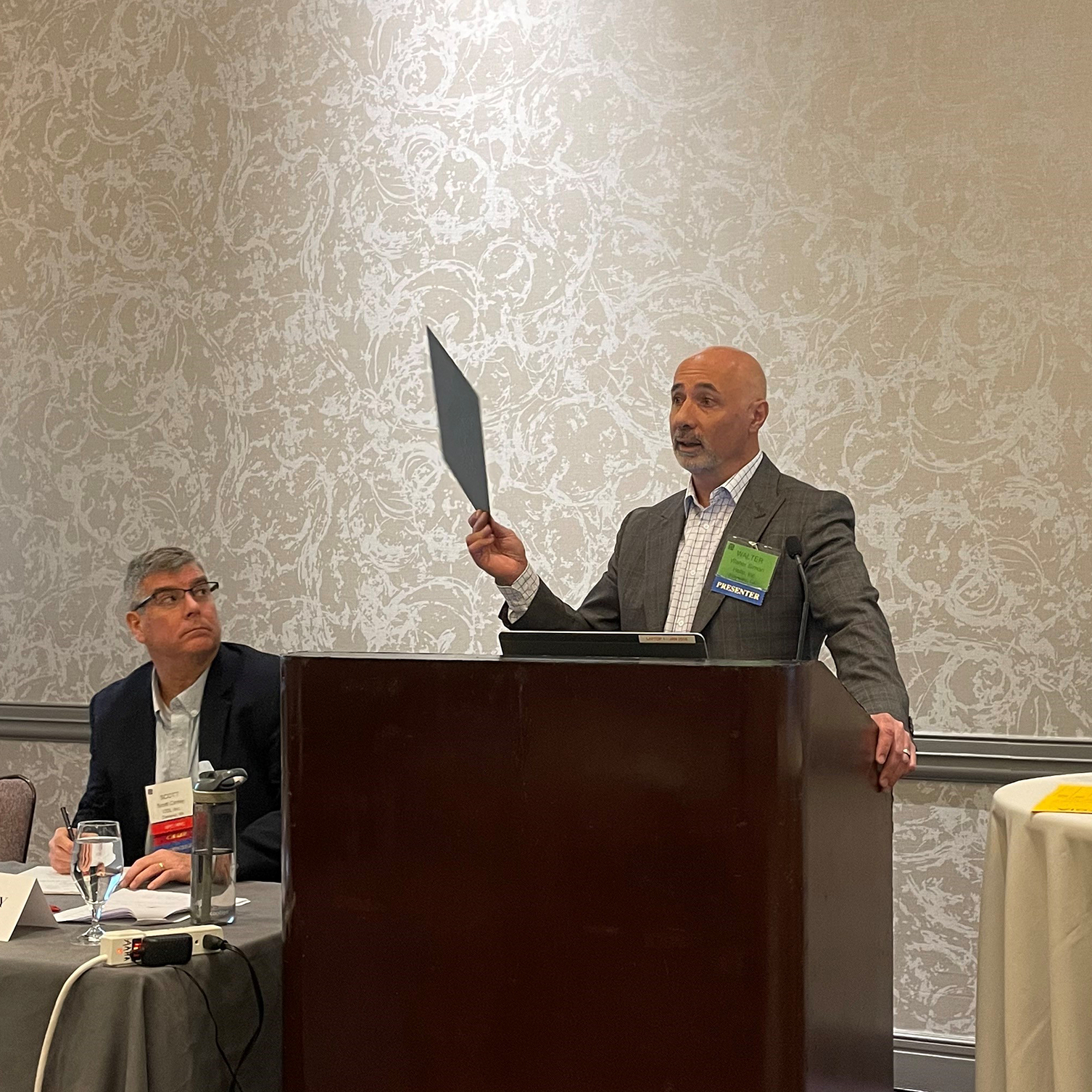
FGIA Annual Conference - Walter Simon
 “Today, we have invited companies to discuss the innovations they are doing in our industry,” said Garries. “Innovation is key to our success.” Garries pointed out that the pandemic stifled many aspects of the industry, whether it was ramping down, and then up, production or ongoing supply chain issues. “There has been a gap,” he said. “We need to innovate products and processes.”
 
Keys to Successful Innovation
 
Corley presented an innovation case study in the form of a retractable screen his company made that people and pets kept accidentally walking through and tearing apart. “We tried to solve it by printing lines on it, but it didn't show up well,” he said. The solution ended up being a variation of this original idea, resulting in simply adding two more tightly woven lines in the screens: One at the top to deter people and one at the bottom for pets. This example, Corley said, incorporated one of his biggest tenants of innovation: Solve the problems that bug customers most. “Innovation is a new way of doing things that brings value to something,” he said. “But benefits and features are not the same thing. A benefit brings something to the consumer. A feature differentiates a product from everyone else's.”
 
 Corley, who has worked in the innovation spaces for several industries, suggested participants become more comfortable with failure, or at least with redefining it. “I have been doing this for a long time in a lot of industries. But I made LOTS of mistakes. If you don't try, you won't be successful. Don't be afraid to fail. It's not failure if you're learning something along the way,” he said. “You have to sort through a lot of ideas before you can find anything really cool. We even find things in adjacent industries and bring it into ours,” he said. To start, ask these three questions: Does anyone care about this? Should we do it? Can we do it? “Where these all converge, that's the sweet spot,” he said.
 
Innovations in Electrochromic Glass
 
Simon spoke about innovations his company has made in electrochromic glass (EC). “Innovating next generation glass with improved tech impacts products and costs savings for a sustainable future,” he said. Electrochromic glass changes tint levels, darkening or lightening glass as needed, allowing daylight in when needed. But its first iteration had issues, Simon said. “More innovation was needed for EC in order to see broader adoption,” he said. “The first generation of smart glass was discolored and had very slow tinting times, taking as long as 30 minutes to get to the right level.”
 
 Simon said his company knew they needed to design something architects liked and that consumers could afford. “We asked questions and made a technology road map from concept to roll-out,” he said. Using this map, his company was able to slowly solve the big issues EC faced: Color, switching, speed and tint performance. He held up a sample of EC glass and noted, “This device can be laminated into any IGU with any coatings and any frame.” This success was after trying 50,000 different chemical compositions. “Now EC glass is beautiful and performs at a high level,” Simon said. Finally, Simon noted that, within the Inflation Reduction Act, there was a callout for EC glass. “Installations that include EC glass can collect a 30 to 50 percent tax credit on installation of the whole system, not just the glass,” he said.
 
Innovation in Daylight Illumination

FGIA Annual Conference - Neal Digert


 Digert then discussed what his company did during the pandemic to innovate a popular product: their tubular daylighting device. “Light drives us psychologically, physiologically,” Digert said. “Daylight is the perfect light source. It provides meaningful variation. Think about the role of daylight, the resource, and daylighting, its application.” His company’s original device, which behaves like a light fixture, was designed 23 years ago, but was recently improved upon.
 
 “We created next-generation optical diffuser technology,” said Digert. “We took lens technology and applied fresnel technology, winding up with a fixture that had 36 point sources. Each point could control where light goes.” Digert said architects loved it, but they also wanted something smaller and “a little more homogenous.” To accommodate, Digert’s company used time during the pandemic to tackle this innovation request. “Over COVID, we took these large macro lenses and micro-replicated them,” said Digert. “It allows us to control the pin spread and where light is going.” Plus, this change meant customers can now mix and match the types, using different lenses like narrow, wide or superwide. “You can provide ambient illumination or more,” Digert said. “Like different lenses, it can totally alter that space and how it is perceived.”

FGIA Annual Conference - Ray Garries


 Moderator Garries noted the importance of advancing innovation as a core competency in the fenestration and glazing industry. “We are at a time of new breakthroughs in many systems and materials, and our ability to harness this creativity sets our future.”
 
 
For more information about FGIA and its activities, visit FGIAonline.org.

KEYWORDS: daylighting fenestration glass glazing

Share This Story

Looking for a reprint of this article?
From high-res PDFs to custom plaques, order your copy today!


Recommended Content

JOIN TODAY
to unlock your recommendations.

Already have an account? Sign In

  • bar graph shows LEED v4/LEED v5/LEED v6 in various colors

    When Will LEED v4 / v4.1 and LEED v5 Expire?

    The latest version of the LEED rating system, LEED v5, is...
    Sustainability
    By: Daniel Overbey
  • Celebrating Women In AEC-2026

    Celebrating Women in The AEC Industry Part 1

    A round-up of women in the design, engineering and...
    Sustainability
    By: Lindsay Lewis
  • KEE membrane application on a roof

    A Beginner’s Guide to Single-Ply Roofing Membranes

    While PVC and TPO appear extremely similar, the chemistry...
    Low-Slope Roofs
    By: Peter Gross
Manage My Account
  • Sign up for the Newsletter
  • Online Registration
  • Manage My Preferences
  • Registration Customer Service

More Videos

Sponsored Content

Sponsored Content is a special paid section where industry companies provide high quality, objective, non-commercial content around topics of interest to the Building Enclosure audience. All Sponsored Content is supplied by the advertising company and any opinions expressed in this article are those of the author and not necessarily reflect the views of Building Enclosure or its parent company, BNP Media. Interested in participating in our Sponsored Content section? Contact your local rep!

close
  • 2 construction workers and a DEXcell panel
    Sponsored byDEXcell Roof Boards

    Designing Low-Slope Roofs for Resilience

  • Bell Bank headquarters in Fargo, North Dakota
    Sponsored bySto Corp.

    Drained and Back-Ventilated Rainscreens vs Pressurized-Equalized Rainscreens

  • A construction worker using DEXcell roof boards
    Sponsored byDEXcell Roof Boards

    The Hidden Strength of Low-Slope Roof Systems: Why Roof Cover Boards Matter

Popular Stories

construction industry workers in hard hats stand around a city scape

Construction Industry Revolts Over New CSI Licensing Plan

Canalino Elementary School and Canalino Family School exterior

Daylighting Design to Support Rapidly Growing Trend in Modular Building Construction

construction workers on a roof, plane flies in background

Why Specifications Are Becoming the Next Critical Layer of Construction Compliance

Building Enclosure Newsletter

BE Poll

Events

June 17, 2025

Addressing Condensation in Low-Slope Roof Assemblies

Credits: 1 AIA LU/HSW; 0.1 ICC CEU; 1 IIBEC CEH; 0.1 IACET CEU

On Demand In modern roofing systems, vapor retarders and air barriers do more than just minimize air leakage—they’re essential to maximizing performance and longevity. This engaging course dives into the next generation of moisture control: permeable vapor retarders and air barriers. Discover how these cutting-edge technologies are transforming low-slope roofing assemblies by improving energy efficiency, managing moisture, and boosting wind uplift resistance.

April 9, 2026

Strategies for High-Performance Below-Grade Waterproofing

Credits: 1 AIA LU/HSW ; 1 IIBEC CEH; 0.1 IACET CEU

On-Demand Designing a high-performance building enclosure requires more than just surface-level protection; it demands a rigorous, performance-based mastery of below-grade water and gas mitigation. This discussion will provide an expert-level analysis of below-grade waterproofing within the comprehensive framework of the high-performance building enclosure.

View All Submit An Event

Products

Plaster and Drywall Assemblies Manual

Plaster and Drywall Assemblies Manual

This is a comprehensive manual that goes beyond codes and standards, providing expert guidance in design, detailing, material selection and troubleshooting for plaster and drywall.

See More Products

Related Articles

  • FGIA-2024_InnovationRoundtable.jpg

    Roundtable Addresses Role of AI, Automation, More at FGIA Annual Conference

    See More
  • FGIA(9).png

    Interactive Sessions at FGIA Annual Conference to Touch on Innovation, Installation, Aluminum Profiles

    See More
  • FGIA_Horizontal_RGB.jpg

    Speakers for 2023 FGIA Annual Conference to Cover Commercial Glazing, Window Innovation, Glass Safety, More

    See More

Related Products

See More Products
  • 978-0-7643-3022-3.jpg

    Award-winning Green Roof Designs: Green Roofs for Healthy Cities

See More Products
×

Enhance your expertise with unparalleled insights.

Join thousands of building professionals today. Shouldn’t you know what they know?

SUBSCRIBE TODAY!
  • RESOURCES
    • Advertise
    • Contact Us
    • Store
    • Want More
  • SIGN UP TODAY
    • Create Account
    • Newsletter
    • Customer Service
    • Manage Preferences
  • SERVICES
    • Marketing Services
    • Reprints
    • Market Research
    • List Rental
    • Survey/Respondent Access
  • STAY CONNECTED
    • LinkedIn
    • Facebook
    • Instagram
    • YouTube
    • X
  • PRIVACY
    • PRIVACY POLICY
    • TERMS & CONDITIONS
    • DO NOT SELL MY PERSONAL INFORMATION
    • PRIVACY REQUEST
    • ACCESSIBILITY

Copyright ©2026. All Rights Reserved BNP Media, Inc. and BNP Media II, LLC.

Design, CMS, Hosting & Web Development :: ePublishing