States Adopt New Energy-Saving Rules but COVID-19 Slows Overall Progress
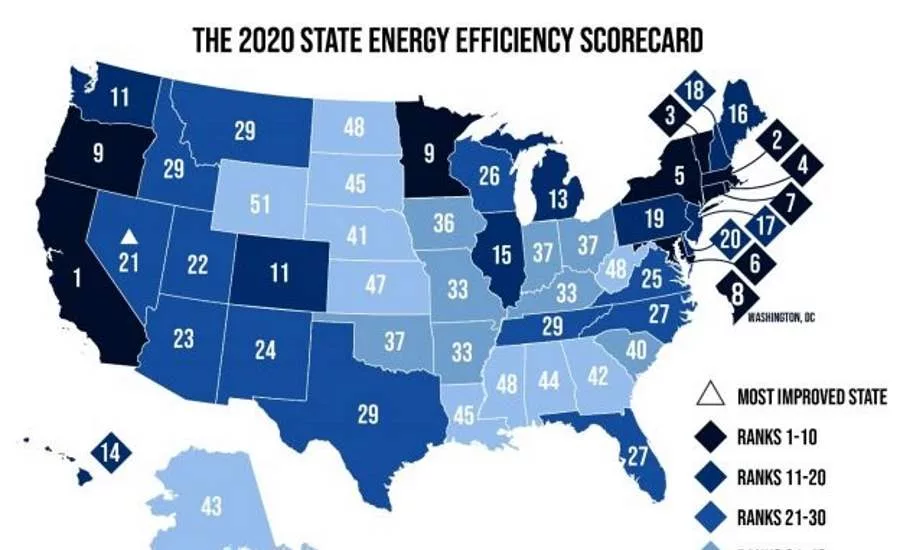
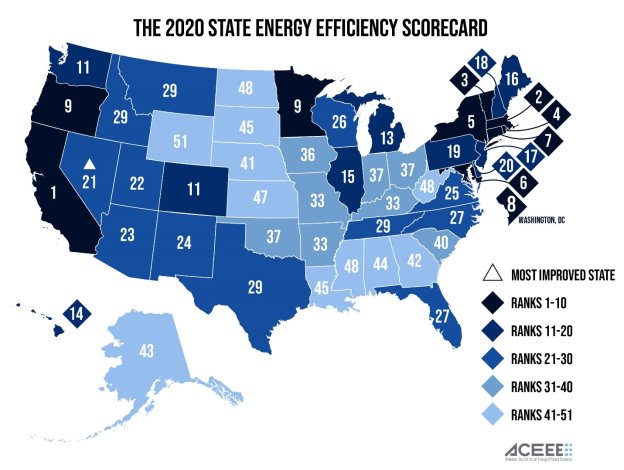
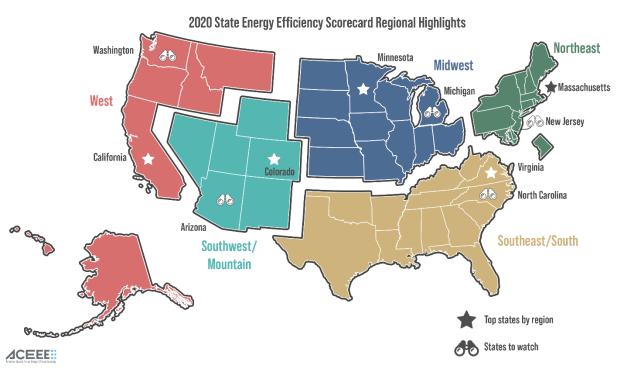
More U.S. states have adopted or advanced new energy-saving targets and vehicle and appliance rules, but COVID-19 slowed other efficiency efforts, according to the 2020 State Energy Efficiency Scorecard released Wednesday. For the first time in four years, California took first place nationwide, edging out Massachusetts, the leader in the Northeast. Other regional leaders include Minnesota in the Midwest, Colorado in the Southwest, and Virginia in the South.
The 50-state scorecard (which also includes Washington, DC) from the American Council for an Energy-Efficient Economy (ACEEE) found that states, many of which have set ambitious climate goals since 2018, had to abruptly shift their focus this year to mitigate the health and economic impacts of the deadly global pandemic. Across the country, energy efficiency workers lost jobs—with an estimated more than 300,000 still unemployed—pointing to the need for policymakers to help get them back to work.
[Register for the report launch webinar event at noon ET today featuring CO Gov. Jared Polis, NV Gov. Steve Sisolak, and California Energy Commission Commissioner Andrew McAllister]
While some efficiency efforts stalled, others advanced before or during the pandemic. In top-ranked California, for example, utility regulators in January approved $45 million in incentives for high-efficiency heat pump water heaters, a crucial technology for reducing greenhouse gas emissions. In September, Governor Gavin Newsom issued an executive order calling for the phase-out of new gasoline-powered vehicles by 2035.
Rounding out this year’s top 10, are Massachusetts (#2), Vermont (#3), Rhode Island (#4), New York (#5), Maryland (#6), Connecticut (#7), Washington, DC (#8), and Minnesota and Oregon (tied for #9).
“A number of states see that they have to act aggressively now to cut carbon emissions, but others just aren’t acting urgently. We need to see more states follow the leaders here, and quickly. Aggressive state policies combatting climate change are absolutely necessary no matter what gets done in Washington,” said Steven Nadel, ACEEE executive director. “In this pandemic and recession, policymakers can embrace efficiency efforts to help residents reduce their utility bills and to get more people back to work, all while cutting pollution.”
The report, which examines policies and programs adopted through July, scores states on 32 metrics in five areas. No state earned all 50 possible points (California got 43), showing that each has considerable room for improvement. For the first time, the report highlights top scorers regionally:
- California, in the top spot nationally and the West’s leader, has long been a trendsetter for its adoption of net zero energy building codes and stringent vehicle emissions standards. It has taken important steps to improve energy program access for low-income and disadvantaged communities and measure progress through energy equity indicators. The state has led the charge on vehicle electrification and has strengthened lighting and appliance standards amid federal rollback efforts.
- Massachusetts (#2), the leader in the Northeast, continues to excel on multiple fronts, including advanced efforts to integrate and align efficiency rules with electrification and building decarbonization strategies.
- Minnesota (#9), the Midwest’s leader, continues to report strong results from utility-run programs that help customers save energy and is developing draft rules for a Clean Cars program that would adopt California’s tailpipe and zero-emission vehicle standards.
- Colorado (#11), the leader in the Southwest/Mountain region, is working on plans to meet statewide climate goals signed last year, which target a 90% reduction in greenhouse gas emissions by 2050. In September, Governor Jared Polis released a roadmap to meet those goals.
- Virginia (#25), the South/Southeast region’s leader and a top energy story of 2020, adopted its first-ever energy-saving target—known as an energy efficiency resource standard (EERS)—and raised minimum funding levels for efficiency programs for low-income, elderly, or disabled individuals as well as veterans. It became the first Southeastern state to set a 100% clean electricity goal.
Nevada (#21) was the most improved state in the scorecard, moving up five places. It has adopted standards for light bulbs, strengthened building energy codes, and moved to implement strong vehicle standards.
In contrast, Iowa (#36) fell the farthest in the rankings, losing 13 places. Its slide occurred primarily as a result of 2018 legislation that capped certain efficiency investments, leading to a steep decline in progress in reducing electricity and gas use.
The bottom five states, each earning 7 or fewer points, are Kansas (#47), Mississippi (#48), North Dakota (#48), West Virginia (#48) and Wyoming (#51).
In each region, the report identifies a “state to watch,” where promising developments are emerging. Along with Virginia, New Jersey (#17) is the most recent to adopt specific energy-saving targets for utilities, and regulators there are seeking to ensure that low-income customers have equitable access to energy efficiency programs. Michigan (#13) regulators recently approved utilities’ plans to expand efficiency programs, North Carolina (#27) is advancing opportunities to strengthen programs, and Arizona (#23) regulators recently approved a path toward 100% carbon-free electricity, including an extension and expansion of the state’s energy efficiency goals. Washington (#11) is working to implement 2019 laws requiring 100% clean energy by 2045 and a first-of-its-kind statewide standard for reducing energy use in existing large commercial buildings.
California Governor Gavin Newsom said: "Energy efficiency has been a foundational part of California’s environmental efforts for the last four decades. Choosing to embrace a smarter way of using energy will save people and businesses money, and by leaning into energy efficient policies we will drive new technologies, creating the economy of the future. That’s why I’m proud that California is receiving this top honor from ACEEE, recognizing not only the state’s national leadership but also the ongoing role energy efficiency continues to play as a key pillar in our economic health and our fight against the climate crisis. Good climate sense is good economic sense."
Colorado Governor Jared Polis said: “My administration is dedicated to achieving 100% renewable energy by 2040, reducing air pollution, and taking bold climate action across our economy. This work will protect the health and well-being of our residents and also generate enormous economic and job growth opportunities. We’ve made significant progress in meeting our goals, and continue to leverage our lowest cost resource—energy efficiency—to modernize the way we heat and power our homes and travel across the state.”
Nevada Governor Steve Sisolak said: “I’m proud to see Nevada leading the way on energy efficiency—an important part of what we can do to reduce greenhouse gas emissions. I look forward to continuing our climate action progress in this arena and helping consumers save money on their energy bills.”
ACEEE found that a number of states have made efforts to foster equity in efficiency policies and programs. For example, multiple states, including California, New Jersey, and Oregon, have taken steps to expand programs for and better meet the needs of customers with lower incomes. Still, states can do much more to ensure that policy and program outcomes are equitable.
The report examined energy efficiency policies across five primary areas, identifying states that have adopted best practices in each, as well as opportunities ahead:
- Energy-saving targets. Maryland, Massachusetts, Rhode Island, and Vermont have adopted energy efficiency resource standards—with efficiency programs saving more than 2% of retail sales, the highest levels in the nation. As of 2020, 27 states have adopted some form of EERS.
- Vehicle efficiency. Twelve states have adopted California’s Low-Emission Vehicle (LEV) standards and Zero-Emission Vehicle (ZEV) program. Many of these states, including California, Maryland, Massachusetts, Oregon, Vermont, and Washington, have also set goals to reduce vehicle miles traveled or transportation-related greenhouse gas emissions. Since late 2019, Minnesota, Nevada, and New Mexico have also moved forward with plans to adopt California’s vehicle emissions rules.
- Building codes. Close to a dozen states and DC made significant progress strengthening efficiency standards for new construction. These include many states in which the 2018 International Energy Conservation Code (IECC) has gone into effect in recent months, including Delaware, Minnesota, New Jersey, New Mexico, New York, and Vermont. A new model code, the 2021 IECC, offers states an important opportunity to ensure that new buildings lock in low energy costs for generations of future residents.
- Appliance and equipment standards. California, Colorado, Hawaii, Nevada, New York, Vermont, and Washington have each passed appliance standards updates since early 2019 that are expected to save consumers hundreds of millions of dollars on utility bills. A few of these standards counter rollbacks of federal standards.
- State government initiatives. California, Connecticut, Delaware, Massachusetts, Rhode Island, and Vermont led in in offering loan and grant programs to spur energy savings, setting efficiency standards for public buildings and fleets, and investing proceeds from carbon pricing policies in efficiency programs.
The scorecard, now in its 14th edition, is based on data collected from states, utilities, and numerous publicly available sources. Government staff members from all 50 states and Washington, DC, were given the opportunity to comment on a preliminary draft of the findings.
Looking for a reprint of this article?
From high-res PDFs to custom plaques, order your copy today!
.webp?height=740&t=1767036885&width=auto "Header - BE 1170x658 (002).png")

.webp?height=740&t=1755781744&width=auto "KEE(2).png")



.webp?height=200&t=1754332546&width=200 "Untitled design(43).jpg")


