Building Enclosure logo
search
cart
facebook twitter linkedin youtube instagram Spotify Podcasts Apple Podcasts Spotify Podcasts Apple Podcasts
  • Sign In
  • Create Account
  • Sign Out
  • My Account
Building Enclosure logo
  • NEWS
    • Breaking News
  • SECTIONS
    • Columns
    • Project Profiles
    • Trade Shows
    • Sponsor Insights
  • SYSTEM DESIGNS
    • Low-Slope Roofs
    • Pitched Roofs
    • Metal Roofing Materials
    • Waterproofing
    • Sustainability
    • Insulation
    • Exterior Claddings
    • Wall Systems
    • Building Envelope
  • BLOG
    • The BE Blog
  • MEDIA
    • Podcasts
    • Webinars
    • Quiz
    • Videos
    • Polls
    • Interactive Spotlights
    • Newsletter
    • Photo Galleries
  • DIRECTORIES
    • Directory: Blue Book
    • Directory: Roofing Resource
  • PRODUCTS
  • TECHNICAL
    • Codes
      • Waterproofing
      • Roofing
    • Details
      • Waterproofing
      • Roofing
  • CONTINUING ED
  • ABOUT
    • Advertise
      • Editorial Calendar
    • Contact
    • eMag Archive Issues
  • SIGN UP!

Lighting Impacts on Circadian Rhythms
By Daniel Overbey
7-11-16 BLOG USE THIS
July 11, 2016

With the emergence of human health concerns, wellness, and biophilia as priorities in the building design and construction industry, the lighting profession is shifting its focus toward circadian lighting design.

Light is one of the main drivers of circadian rhythms—that is, our internal clock that keeps the body's hormones and bodily processes on a diurnal cycle, even in continuous darkness. When the human body receives light—any kind of light—the brain is stimulated and regulates physiological rhythms throughout the body's tissues and organs, impacting hormone levels and the sleep-wake cycle.


Circadian Rhythms

Circadian rhythms are kept on a regular cycle by various cues from the environment, including light. One of the ways in which the human body responds to light is facilitated by intrinsically photosensitive ganglion cells (ipRGCs). Essentially, ipRGCs are the are eyes' non-image-forming photoreceptors. They relay environmental light levels to the suprachiasmatic nucleus in the brain through the retinohypothalamic tract—this is the main clock that acts as an oscillator to synchronize clocks in peripheral tissues and organs. High frequency light will promote bodily alertness, while a lack of light will cue the body to reduce energy expenditures and prepare for rest.

Moreover, ipRGCs are especially sensitive to blue light. Skylight is going to prompt the brain to become more awake and alert. This is why staring at a tablet screen before sleeping might not be such a good idea for those with sleeping difficulties.


Zeitgebers

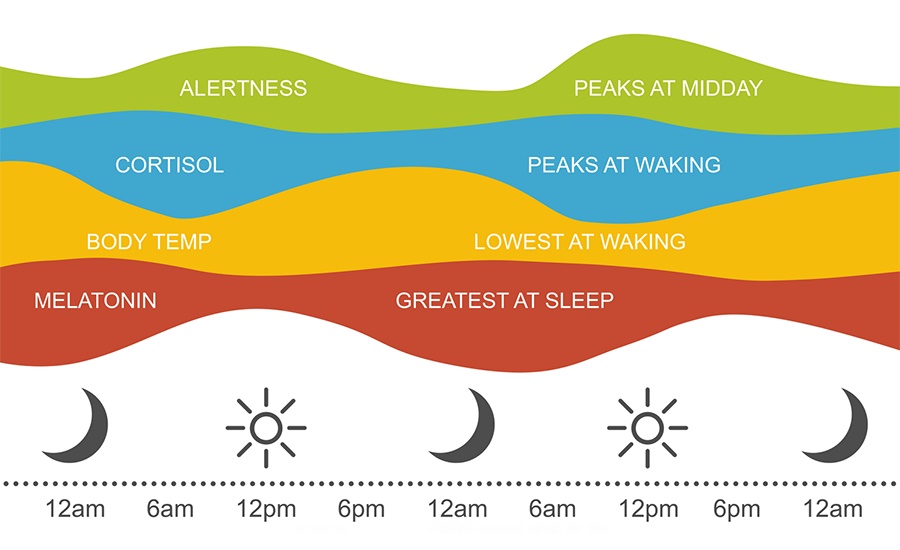
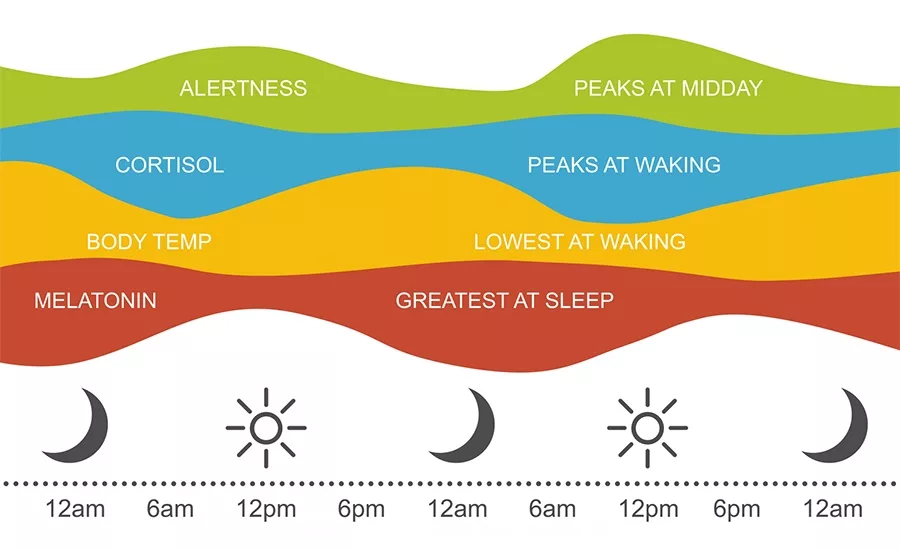
Throughout a 24-hour period, the body responds to a number of zeitgebers—the external cures that align physiological functions to the solar day. Light is one of the most important zeitgebers. Light stimulates the ipRGCs, which triggers the suprachiasmatic nucleus to prompt the pineal gland to secrete less melatonin—the "darkness hormone" whose levels acts a driver for sleep.

The human body's circadian rhythms follow a diurnal cycle in response to a number of zeitgebers, the most important of which is light.

Illustration by Daniel Overbey.


Circadian Lighting Design

Circadian lighting design does not necessitate that designers rush out and get a degree in human physiology. Rather, the biological effects of light on humans can be measured in equivalent melanopic lux (EML), which is a proposed alternate metric weighted to the ipRGCs instead of cones as one would do with traditional lux.

EML is promoted by the WELL Building Standard v1, which contains a feature dedicated to circadian lighting design.


Calculating EML

In accordance with the WELL Building Standard v1, the equivalent melanopic lux (EML) can be calculated by multiplying the visual lux (L) designed for or measured in a building by a melanopic ratio (R) based on the light source:

EML = L × R


WELL v1 provides the following melanopic ratios for common light sources:

Table: Melanopic Ratio by Light Source
Adapted from the WELL Building Standard v1.


WELL v1 provides the following examples: if incandescent lights provide 200 lux in a space, they will also produce 108 equivalent melanopic lux. If daylight is modeled to provide the same visual brightness (200 lux), it will also provide 220 equivalent melanopic lux.

KEYWORDS: lighting WELL Building Standard

Share This Story

Overbey   head shot 2020 3

Daniel Overbey, AIA, NCARB, LEED Fellow (LEED AP BD+C, ID+C, O+M), WELL AP is an Assistant Professor of Architecture at Ball State University and the Director of Sustainability for Browning Day in Indianapolis, Ind. His work focuses on high-performance building design and construction, environmental systems research, green building certification services, energy/life-cycle assessment modeling, and resilient design. He can be reached at djoverbey@bsu.edu.

Recent Comments

These are actually very helpful tips. It is...

This is the most beneficial blog for all...

This blog is a great resource for anyone...

Thank you for sharing this important information. I...

This is a very interesting subject of the...

Manage My Account
  • Sign up for the Newsletter
  • Online Registration
  • Manage My Preferences
  • Registration Customer Service

More Videos

Sponsored Content

Sponsored Content is a special paid section where industry companies provide high quality, objective, non-commercial content around topics of interest to the Building Enclosure audience. All Sponsored Content is supplied by the advertising company and any opinions expressed in this article are those of the author and not necessarily reflect the views of Building Enclosure or its parent company, BNP Media. Interested in participating in our Sponsored Content section? Contact your local rep!

close
  • HITT Construction headquarters
    Sponsored byBuilding Composites® LLC

    Pushing the Envelope

  • 2 construction workers and a DEXcell panel
    Sponsored byDEXcell Roof Boards

    Designing Low-Slope Roofs for Resilience

  • Bell Bank headquarters in Fargo, North Dakota
    Sponsored bySto Corp.

    Drained and Back-Ventilated Rainscreens vs Pressurized-Equalized Rainscreens

Popular Stories

graphic shows white arrows pointing to the right on a light green background

A Breakdown of Air Leakage Testing in LEED v5 BD+C

Open vs. closed cell foam in an attic

Open-Cell vs. Closed-Cell Spray Foam

skyscraper

NYC Tower Failure Offers Warning for Contractors

Building Enclosure Newsletter

BE Poll

Events

April 9, 2026

Strategies for High-Performance Below-Grade Waterproofing

Credits: 1 AIA LU/HSW ; 1 IIBEC CEH; 0.1 IACET CEU

On-Demand Designing a high-performance building enclosure requires more than just surface-level protection; it demands a rigorous, performance-based mastery of below-grade water and gas mitigation. This discussion will provide an expert-level analysis of below-grade waterproofing within the comprehensive framework of the high-performance building enclosure.

April 28, 2026

Roof Design Considerations That Prevent Installation Failures and Change Orders

Credit: 1 AIA LU/HSW; 1 IIBEC CEH; 0.1 ICC CEU

On-Demand This course provides visual examples of actual field conditions. Some good, some not so good; along with design suggestions that can cut installation costs and reduce construction change orders. Upon completion of this course, you will have a better understanding of the requirements the roofing contractor must meet to provide the specified roofing system warranty, and long-term value to the owner.

View All Submit An Event

Products

Plaster and Drywall Assemblies Manual

Plaster and Drywall Assemblies Manual

This is a comprehensive manual that goes beyond codes and standards, providing expert guidance in design, detailing, material selection and troubleshooting for plaster and drywall.

See More Products
×

Enhance your expertise with unparalleled insights.

Join thousands of building professionals today. Shouldn’t you know what they know?

SUBSCRIBE TODAY!
  • RESOURCES
    • Advertise
    • Contact Us
    • Store
    • Want More
  • SIGN UP TODAY
    • Create Account
    • Newsletter
    • Customer Service
    • Manage Preferences
  • SERVICES
    • Marketing Services
    • Reprints
    • Market Research
    • List Rental
    • Survey/Respondent Access
  • STAY CONNECTED
    • LinkedIn
    • Facebook
    • Instagram
    • YouTube
    • X
  • PRIVACY
    • PRIVACY POLICY
    • TERMS & CONDITIONS
    • DO NOT SELL MY PERSONAL INFORMATION
    • PRIVACY REQUEST
    • ACCESSIBILITY

Copyright ©2026. All Rights Reserved BNP Media, Inc. and BNP Media II, LLC.

Design, CMS, Hosting & Web Development :: ePublishing