Building Enclosure logo
search
cart
facebook twitter linkedin youtube instagram Spotify Podcasts Apple Podcasts Spotify Podcasts Apple Podcasts
  • Sign In
  • Create Account
  • Sign Out
  • My Account
Building Enclosure logo
  • NEWS
    • Breaking News
  • SECTIONS
    • Columns
    • Project Profiles
    • Trade Shows
    • Sponsor Insights
  • SYSTEM DESIGNS
    • Low-Slope Roofs
    • Pitched Roofs
    • Metal Roofing Materials
    • Waterproofing
    • Sustainability
    • Insulation
    • Exterior Claddings
    • Wall Systems
    • Building Envelope
  • BLOG
    • The BE Blog
  • MEDIA
    • Podcasts
    • Webinars
    • Quiz
    • Videos
    • Polls
    • Interactive Spotlights
    • Newsletter
    • Photo Galleries
  • DIRECTORIES
    • Directory: Blue Book
    • Directory: Roofing Resource
  • PRODUCTS
  • TECHNICAL
    • Codes
      • Waterproofing
      • Roofing
    • Details
      • Waterproofing
      • Roofing
  • CONTINUING ED
  • ABOUT
    • Advertise
      • Editorial Calendar
    • Contact
    • eMag Archive Issues
  • SIGN UP!
Exterior CladdingsProject Profiles

Modern Building Materials Embody Motion at Museum
By Phil Pearce
Lorin
During installation, Lorin supplied expertise on the behavior of anodized material on the building from different viewing angles as well as data on the color consistency of the coils that were produced for the museum.
September 21, 2020

It is only fitting that the U.S. Olympic Museum, showcasing the innumerable accomplishments of American athletes at the Games and honoring the history of its national team, embodies prestige, spirit, and athleticism. Opened on July 30, 2020, the museum is poised to provide such a monument to American Olympic athletes – “a timeless institution that reflects Team USA pride and helps visitors experience the thrill of the Games.”

The museum – located on 1.7 acres of land near Pikes Peak, where many Olympic and Paralympic dreams begin – is mere blocks away from the U.S. Olympic Committee headquarters. The museum honors the U.S. Olympic and Paralympic spirit by showcasing an evolving collection of athletic memorabilia from athletes, promising a new experience each visit as future champions chase and realize their dreams.

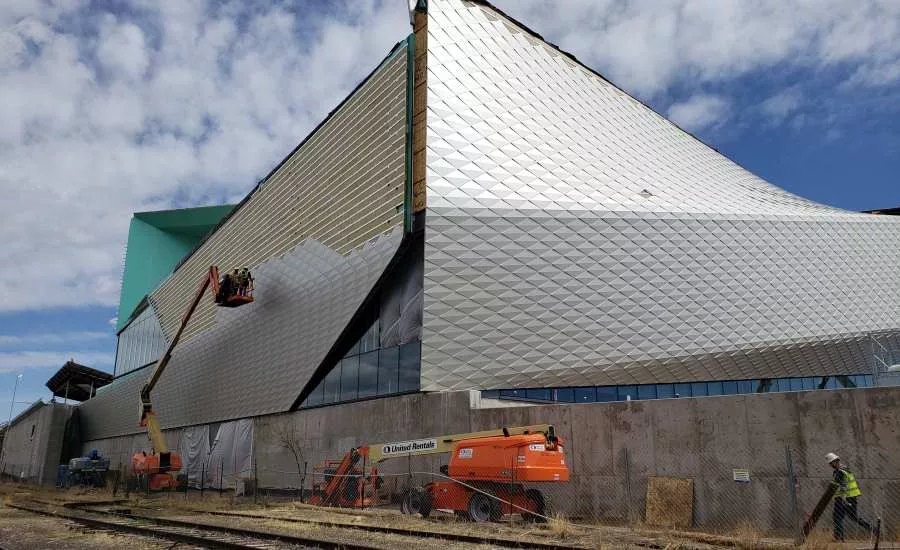
Tasked with constructing the museum’s exterior, MG McGrath, Inc. sought to create a skin that matched architecture firm Diller, Scofidio + Renfro’s vision of a building structure and overall exterior visual effect that encapsulated the passion, dedication, and endurance of an Olympic athlete.

Only a modern architectural marvel could house such an impressive collection and embody such a competitive spirit, so the project aimed to deliver an exterior that would capture the movement of an elite athlete. To achieve this, a system of custom metal panels with integrated gutters was chosen to wrap the double-curved geometry of the façade.

Stainless steel was considered as a material option for the project, but Lorin anodized aluminum panels ultimately won over for their durability, low cost, malleability, environmentally friendly qualities, and color and finish.

Lorin Industries, Inc., the global industry leader in the innovation and production of coil anodized aluminum, pioneered the cost-effective coil anodizing process, which protects the aluminum while also improving its aesthetic properties and durability. Anodized aluminum is up to two-thirds lighter than other metals, such as stainless steel. Less weight means less material is required for any given application, so the supporting structure no longer needs to be as expensive to hold up the anodized aluminum. For a project funded by contributions and taxpayers, maintaining a low cost is essential. Anodized aluminum was more economical than the stainless steel option, and its resilience ensures the panels will last long into future Olympic competitions.

Coil anodizing delivers consistent quality; handling and installation is made simple by the light and workable material. Even with its light weight, coil anodized aluminum has an exterior surface hardness second only to diamond and is therefore unmatched in abrasion resistance and durability.

Additionally, for a building sure to host countless visitors, ease of maintenance is vital to ensuring the longevity and aesthetics of the structure. Lorin’s anodized stainless finish is created by an electro-chemical process that builds an anodic layer from the aluminum, bonding it to the surface at the molecular level.

While aluminum creates its own protective oxide layer naturally, the anodizing process creates an anodic layer 2,500-25,000 times thicker than that of the naturally occurring oxide layer.

Therefore, it protects aluminum from oxidation, scratching, and other hazards far better than natural oxidizing, and it requires very minimal upkeep while resisting scratches and finger prints.

Continuous coil anodizing also delivers superior aesthetics by producing a clear, translucent oxide layer that enhances the metal’s natural beauty. Its three-dimensional crystalline structure reflects and refracts light to transform the building into a living, moving structure.

Lorin anodized aluminum covers exterior walls, low-slope walls and roof, and the interior vestibule ceiling. The aluminum skin wrapped around the building creates the illusion of a body poised to pounce like a discus thrower, captured moments before releasing the disk. To honor the long history of Olympic sport, the skin also creates a sense of perpetual motion.

Color and finish were very important during the selection process, and the Lorin material delivers a high-quality, uniform, and matte brushed finish. The clear anodized finish on the panels that was chosen for the museum exterior ensures that the building skin retains its characteristic metallic quality reminiscent of Olympic medals. Such a finish provides directionality to the panel surface, aiding the illusion of a body charged with potential energy.

8,500 panels were combined to create an exceptional finish, and every panel on the project is unique. To create the panels and manage their individual geometries, MG McGrath using 3D model-based fabrication. This requires tight quality control and management of fabrication processes, when it comes to tooling and tracking the panels. The versatility of the Lorin material – combined with MG McGrath’s ability to shape these panels into their unique geometries – makes the necessary 3-D panel shapes possible. The anodized aluminum is relatively malleable, making it a superior choice for easy shaping.

Situated in a mountainous region, the museum prioritizes environmentally friendly materials. The anodized aluminum panels are 100% recyclable helping to meet the project’s LEED requirements.

Lorin was instrumental in the initial material selection process by providing various surfacing options as well as a range of finishes for the panels. Once the material was selected, installing the aluminum panels was a collaborative effort.

During installation, Lorin supplied expertise on the behavior of anodized material on the building from different viewing angles as well as data on the color consistency of the coils that were produced for the museum. Additionally, Lorin ensured that the strict installation and fabrication tolerances of such a material were maintained during application to guarantee the highest quality surface.

At the U.S. Olympic Museum, aesthetics and functionality combine to create a state-of-the-art architectural marvel that honors past, present, and future American athletes in their pursuit for Olympic and Paralympic glory at the Games.

KEYWORDS: aluminum

Share This Story

Looking for a reprint of this article?
From high-res PDFs to custom plaques, order your copy today!


Phil Pearce is the vice president of sales and marketing for Lorin Industries Inc.

Recommended Content

JOIN TODAY
to unlock your recommendations.

Already have an account? Sign In

  • bar graph shows LEED v4/LEED v5/LEED v6 in various colors

    When Will LEED v4 / v4.1 and LEED v5 Expire?

    The latest version of the LEED rating system, LEED v5, is...
    Sustainability
    By: Daniel Overbey
  • Celebrating Women In AEC-2026

    Celebrating Women in The AEC Industry Part 1

    A round-up of women in the design, engineering and...
    Sustainability
    By: Lindsay Lewis
  • KEE membrane application on a roof

    A Beginner’s Guide to Single-Ply Roofing Membranes

    While PVC and TPO appear extremely similar, the chemistry...
    Low-Slope Roofs
    By: Peter Gross
Manage My Account
  • Sign up for the Newsletter
  • Online Registration
  • Manage My Preferences
  • Registration Customer Service

More Videos

Sponsored Content

Sponsored Content is a special paid section where industry companies provide high quality, objective, non-commercial content around topics of interest to the Building Enclosure audience. All Sponsored Content is supplied by the advertising company and any opinions expressed in this article are those of the author and not necessarily reflect the views of Building Enclosure or its parent company, BNP Media. Interested in participating in our Sponsored Content section? Contact your local rep!

close
  • HITT Construction headquarters
    Sponsored byBuilding Composites® LLC

    Pushing the Envelope

  • 2 construction workers and a DEXcell panel
    Sponsored byDEXcell Roof Boards

    Designing Low-Slope Roofs for Resilience

  • Bell Bank headquarters in Fargo, North Dakota
    Sponsored bySto Corp.

    Drained and Back-Ventilated Rainscreens vs Pressurized-Equalized Rainscreens

Popular Stories

Open vs. closed cell foam in an attic

Open-Cell vs. Closed-Cell Spray Foam

graphic shows white arrows pointing to the right on a light green background

A Breakdown of Air Leakage Testing in LEED v5 BD+C

graphic shows a building destoryed by tornados with information on the amount of torandos in 2026 in the US

Record-Breaking Tornado Activity in Illinois Signals New Challenges for Architects

Building Enclosure Newsletter

BE Poll

Events

April 9, 2026

Strategies for High-Performance Below-Grade Waterproofing

Credits: 1 AIA LU/HSW ; 1 IIBEC CEH; 0.1 IACET CEU

On-Demand Designing a high-performance building enclosure requires more than just surface-level protection; it demands a rigorous, performance-based mastery of below-grade water and gas mitigation. This discussion will provide an expert-level analysis of below-grade waterproofing within the comprehensive framework of the high-performance building enclosure.

April 28, 2026

Roof Design Considerations That Prevent Installation Failures and Change Orders

Credit: 1 AIA LU/HSW; 1 IIBEC CEH; 0.1 ICC CEU

On-Demand This course provides visual examples of actual field conditions. Some good, some not so good; along with design suggestions that can cut installation costs and reduce construction change orders. Upon completion of this course, you will have a better understanding of the requirements the roofing contractor must meet to provide the specified roofing system warranty, and long-term value to the owner.

View All Submit An Event

Products

Plaster and Drywall Assemblies Manual

Plaster and Drywall Assemblies Manual

This is a comprehensive manual that goes beyond codes and standards, providing expert guidance in design, detailing, material selection and troubleshooting for plaster and drywall.

See More Products

Related Articles

  • Tobacco Barn

    Emulating Tobacco Barn Charm with Modern Building Materials

    See More
  • OXIS on a house build

    How Modern Building Envelope Materials Support New Code Requirements

    See More
  • Mixing Old-World Craftsmanship and Modern Building Science

    See More

Related Products

See More Products
  • 9780128207918.jpg

    Eco-efficient Materials for Reducing Cooling Needs in Buildings and Construction 1st Edition

  • building codes illustated.jpg

    Building Codes Illustrated: A Guide to Understanding the 2021 International Building Code, 7th Edition

  • ninteeth century.jpg

    Sustainable Building Design: Learning from nineteenth-century innovations

See More Products

Events

View AllSubmit An Event
  • July 14, 2026

    Comparing Environmental Product Declarations (EPDs) for Structural Materials

    Credits: 1 AIA LU/HSW; 0.1 ICC CEU This presentation will explain what an EPD is, how it is developed using product category rules, and how it shows environmental impacts of typical construction products. We will then look at how various industries develop EPDs,  what different types of EPDs are available, and how these can be used in the life cycle assessment of a building project.
View AllSubmit An Event
×

Enhance your expertise with unparalleled insights.

Join thousands of building professionals today. Shouldn’t you know what they know?

SUBSCRIBE TODAY!
  • RESOURCES
    • Advertise
    • Contact Us
    • Store
    • Want More
  • SIGN UP TODAY
    • Create Account
    • Newsletter
    • Customer Service
    • Manage Preferences
  • SERVICES
    • Marketing Services
    • Reprints
    • Market Research
    • List Rental
    • Survey/Respondent Access
  • STAY CONNECTED
    • LinkedIn
    • Facebook
    • Instagram
    • YouTube
    • X
  • PRIVACY
    • PRIVACY POLICY
    • TERMS & CONDITIONS
    • DO NOT SELL MY PERSONAL INFORMATION
    • PRIVACY REQUEST
    • ACCESSIBILITY

Copyright ©2026. All Rights Reserved BNP Media, Inc. and BNP Media II, LLC.

Design, CMS, Hosting & Web Development :: ePublishing