Building Enclosure logo
search
cart
facebook twitter linkedin youtube instagram Spotify Podcasts Apple Podcasts Spotify Podcasts Apple Podcasts
  • Sign In
  • Create Account
  • Sign Out
  • My Account
Building Enclosure logo
  • NEWS
    • Breaking News
  • SECTIONS
    • Columns
    • Project Profiles
    • Trade Shows
    • Sponsor Insights
  • SYSTEM DESIGNS
    • Low-Slope Roofs
    • Pitched Roofs
    • Metal Roofing Materials
    • Waterproofing
    • Sustainability
    • Insulation
    • Exterior Claddings
    • Wall Systems
    • Building Envelope
  • BLOG
    • The BE Blog
  • MEDIA
    • Podcasts
    • Webinars
    • Quiz
    • Videos
    • Polls
    • Interactive Spotlights
    • Newsletter
    • Photo Galleries
  • DIRECTORIES
    • Directory: Blue Book
    • Directory: Roofing Resource
  • PRODUCTS
  • TECHNICAL
    • Codes
      • Waterproofing
      • Roofing
    • Details
      • Waterproofing
      • Roofing
  • CONTINUING ED
  • ABOUT
    • Advertise
      • Editorial Calendar
    • Contact
    • eMag Archive Issues
  • SIGN UP!
CodesBreaking News

New Research Leads Homeowners to Better Protection from Severe Weather
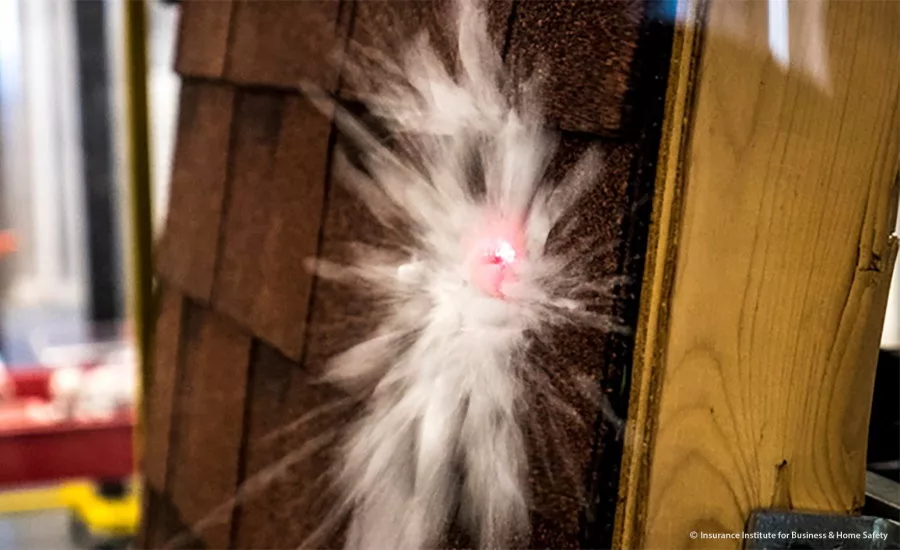
Hail_Cannon_Stone_Impact_IBHS

IBHS recreates hailstones found in nature and fires them at shingles to determine their impact resistance. Photo courtesy of IBHS.

May 22, 2020

The Insurance Institute for Business & Home Safety (IBHS) unveiled an optional hail upgrade to its rigorous FORTIFIED Home™–High Wind standard, a voluntary set of above-code design, building, and retrofitting steps to strengthen homes against severe weather. Now, in addition to helping homeowners guard against wind, FORTIFIED offers a solution to better protect against hailstorms too.

Combined, FORTIFIED Home–High Wind & Hail helps homeowners in parts of the country that face multiple threats achieve extra protection from severe thunderstorms that generate high wind, hail, and tornadoes. The result is a stronger roof shown in field and lab studies to reduce the risk of damage.

FORTIFIED Home–High Wind & Hail is based on the latest research conducted at IBHS’s state-of-the-art research center in Richburg, S.C. There, scientists recreate severe weather events with windspeeds reaching up to 130 mph and hailstorms using hailstones manufactured on-site, consistent with those that occur naturally, to understand and identify ways to reduce the damage they cause to residential properties. The hail supplement, now available to be paired with the existing high wind standard, is the result of a new impact shingle test method established by IBHS in 2019.

“Year after year, severe weather wreaks havoc on communities across the country’s heartland,” said Fred Malik, managing director of FORTIFIED programs at IBHS. “FORTIFIED Home–High Wind & Hail offers homeowners the best-known protection against the combination of weather threats common to this part of the country, providing families their best chance to return home immediately after a storm hits.”

The new hail supplement goes beyond typical impact resistance measurements and requires high-performing shingles that rank Excellent or Good in IBHS’s 2019 Hail Impact Standard Ratings. FORTIFIED Home–High Wind & Hail requires a roof covering that can withstand hail up to 2 inches in diameter. This gives homeowners added confidence their shingles have demonstrated they can perform under realistic testing scenarios, which mimic how real-world hail attacks a roof. For homeowners who regularly face hail, this can save both the hassle and expense of repeated shingle replacement.

“Not all shingles labeled as ‘impact-resistant’ perform equally. Existing standardized tests use outdated physics and are unable to replicate all the different kinds of damage we see on roofs,” says Dr. Tanya Brown-Giammanco, managing director of research at IBHS. “We’ve devoted years to better understanding the scientific characteristics of hail, replicating those characteristics in the lab, and analyzing how shingles perform against them to give consumers confidence when selecting an impact-resistant shingle.”

Roofs installed to the FORTIFIED Home–High Wind & Hail standard have multiple layers of defenses to prevent a cascade of damage that can start at the roof and impact the integrity of the entire structure during high winds. The beyond-code requirements include:

  • Stronger connections to hold the roof onto the house
  • Reinforced edges to help protect one of the roof’s most vulnerable areas from high winds
  • A sealed roof deck to prevent rain from entering the home, even if shingles are lost
  • High-performing impact resistant shingles that are superior performers based on IBHS’s innovative impact test

With this added protection, homes have shown to be durable in up to EF-2 level winds and against up to 2-inch hail.

“FORTIFIED is an effective and affordable option to combat winds up to EF-2 levels, and it’s important to note tornadoes rated as EF-4 or EF-5 have very small areas where the winds are that strong,” explains Brown-Giammanco, who is also a wind engineer and meteorologist. “In those storms, many of the homes actually face significantly lower wind speeds than those at the core. FORTIFIED can narrow the path of damage so building to this standard has the potential to bring peace of mind to homeowners routinely threatened by tornadoes and high winds.”

“A home is the largest investment most families will make, and every year they are threatened by severe weather like hail, high winds, and even tornadoes,” adds Malik. “For the extra investment when re-roofing, homeowners can benefit from the science behind FORTIFIED to avoid damage, possibly saving significantly more in repairs the next time storms strike. Oklahomans are among the first in the Great Plains and Midwest to have the added benefit of available mitigation credits on homeowner’s insurance policies, specifically for getting a FORTIFIED designation.”

IBHS is piloting FORTIFIED Home‒High Wind & Hail in Oklahoma City, in conjunction with Oklahoma-based Disaster Resilience Network, but the standard can be followed nationwide. Homeowners can find a FORTIFIED-trained roofer who specializes in resilient roofing at fortifiedhome.org/directory or by having the qualified roofer of their choice follow the building standards for FORTIFIED Home–High Wind & Hail.

To receive a FORTIFIED designation, which can qualify a home for insurance discounts in some states, including Oklahoma, homeowners must have their roofer, or a FORTIFIED evaluator, submit required documentation confirming the requirements have been met to IBHS. 

KEYWORDS: building codes building materials hail damage reports and studies shingles

Share This Story

Looking for a reprint of this article?
From high-res PDFs to custom plaques, order your copy today!


Recommended Content

JOIN TODAY
to unlock your recommendations.

Already have an account? Sign In

  • bar graph shows LEED v4/LEED v5/LEED v6 in various colors

    When Will LEED v4 / v4.1 and LEED v5 Expire?

    The latest version of the LEED rating system, LEED v5, is...
    Sustainability
    By: Daniel Overbey
  • Celebrating Women In AEC-2026

    Celebrating Women in The AEC Industry Part 1

    A round-up of women in the design, engineering and...
    Building Envelope
    By: Lindsay Lewis
  • KEE membrane application on a roof

    A Beginner’s Guide to Single-Ply Roofing Membranes

    While PVC and TPO appear extremely similar, the chemistry...
    Low-Slope Roofs
    By: Peter Gross
Manage My Account
  • Sign up for the Newsletter
  • Online Registration
  • Manage My Preferences
  • Registration Customer Service

More Videos

Sponsored Content

Sponsored Content is a special paid section where industry companies provide high quality, objective, non-commercial content around topics of interest to the Building Enclosure audience. All Sponsored Content is supplied by the advertising company and any opinions expressed in this article are those of the author and not necessarily reflect the views of Building Enclosure or its parent company, BNP Media. Interested in participating in our Sponsored Content section? Contact your local rep!

close
  • HITT Construction headquarters
    Sponsored byBuilding Composites® LLC

    Pushing the Envelope

  • 2 construction workers and a DEXcell panel
    Sponsored byDEXcell Roof Boards

    Designing Low-Slope Roofs for Resilience

  • Bell Bank headquarters in Fargo, North Dakota
    Sponsored bySto Corp.

    Drained and Back-Ventilated Rainscreens vs Pressurized-Equalized Rainscreens

Popular Stories

graphic shows white arrows pointing to the right on a light green background

A Breakdown of Air Leakage Testing in LEED v5 BD+C

Open vs. closed cell foam in an attic

Open-Cell vs. Closed-Cell Spray Foam

skyscraper

NYC Tower Failure Offers Warning for Contractors

Building Enclosure Newsletter

BE Poll

Events

April 9, 2026

Strategies for High-Performance Below-Grade Waterproofing

Credits: 1 AIA LU/HSW ; 1 IIBEC CEH; 0.1 IACET CEU

On-Demand Designing a high-performance building enclosure requires more than just surface-level protection; it demands a rigorous, performance-based mastery of below-grade water and gas mitigation. This discussion will provide an expert-level analysis of below-grade waterproofing within the comprehensive framework of the high-performance building enclosure.

April 28, 2026

Roof Design Considerations That Prevent Installation Failures and Change Orders

Credit: 1 AIA LU/HSW; 1 IIBEC CEH; 0.1 ICC CEU

On-Demand This course provides visual examples of actual field conditions. Some good, some not so good; along with design suggestions that can cut installation costs and reduce construction change orders. Upon completion of this course, you will have a better understanding of the requirements the roofing contractor must meet to provide the specified roofing system warranty, and long-term value to the owner.

View All Submit An Event

Products

Plaster and Drywall Assemblies Manual

Plaster and Drywall Assemblies Manual

This is a comprehensive manual that goes beyond codes and standards, providing expert guidance in design, detailing, material selection and troubleshooting for plaster and drywall.

See More Products

Related Articles

  • OU Housing.jpg

    Reinforced Rooms at Residence Halls Protect Students from Severe Weather

    See More
  • l5hZEDuh3t.jpg

    Designing for Severe Weather

    See More
  • BE_Podcast_weather.jpg

    PODCAST: Designing for Severe Weather

    See More

Related Products

See More Products
  • Optimizing Social Media from a B2B Perspective

  • ninteeth century.jpg

    Sustainable Building Design: Learning from nineteenth-century innovations

  • bim-3e.jpg

    BIM Handbook: A Guide to Building Information Modeling for Owners, Designers, Engineers, Contractors, and Facility Managers, 3rd Edition

See More Products
×

Enhance your expertise with unparalleled insights.

Join thousands of building professionals today. Shouldn’t you know what they know?

SUBSCRIBE TODAY!
  • RESOURCES
    • Advertise
    • Contact Us
    • Store
    • Want More
  • SIGN UP TODAY
    • Create Account
    • Newsletter
    • Customer Service
    • Manage Preferences
  • SERVICES
    • Marketing Services
    • Reprints
    • Market Research
    • List Rental
    • Survey/Respondent Access
  • STAY CONNECTED
    • LinkedIn
    • Facebook
    • Instagram
    • YouTube
    • X
  • PRIVACY
    • PRIVACY POLICY
    • TERMS & CONDITIONS
    • DO NOT SELL MY PERSONAL INFORMATION
    • PRIVACY REQUEST
    • ACCESSIBILITY

Copyright ©2026. All Rights Reserved BNP Media, Inc. and BNP Media II, LLC.

Design, CMS, Hosting & Web Development :: ePublishing