Drones For Building Inspection
Our Newest Tools
Abstract
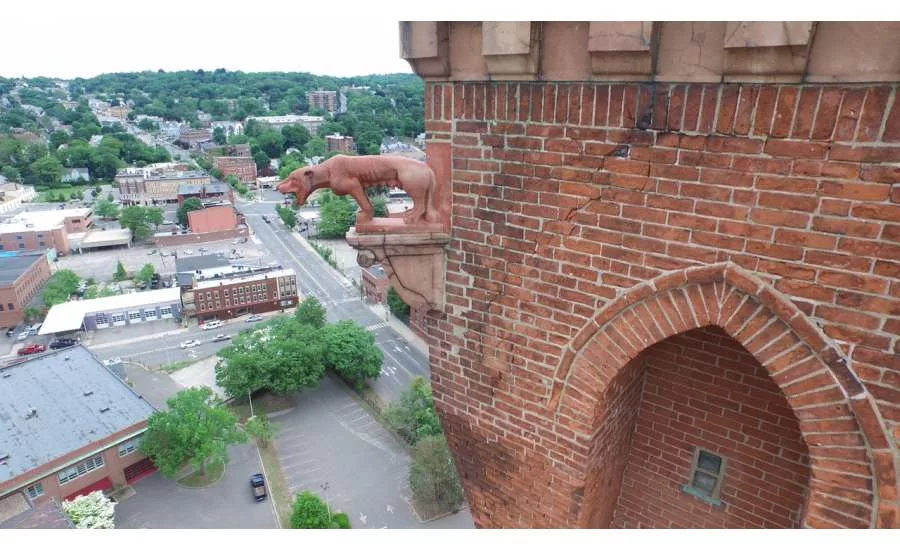
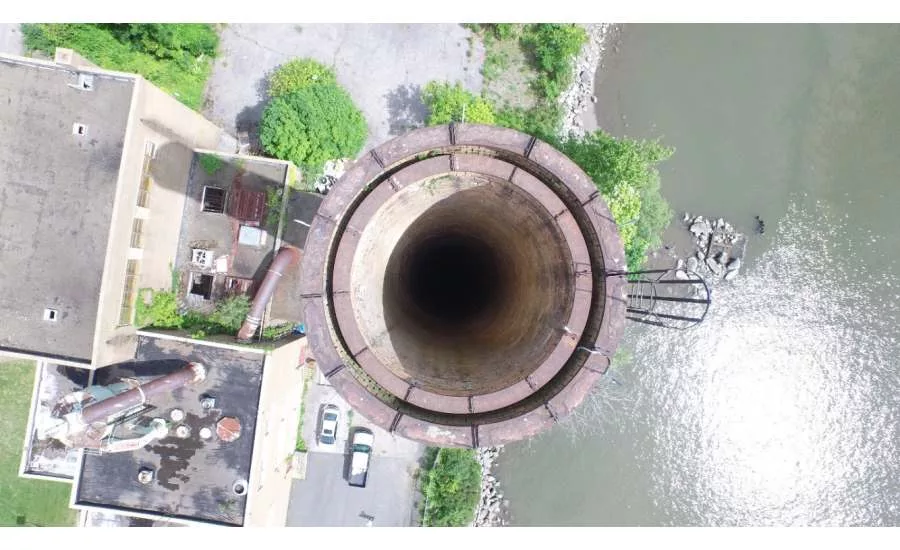
Occasionally, roofing and building enclosure professionals are presented with a challenge in getting to a particular wall or roof for up-close observations such as a church steeple, a clock tower, or a steep slope roof near the top of a multi-story wall. Often these are observed using boom lifts, binoculars, adjacent buildings or roofs, or utilizing rope access techniques that often provide limited access, poor viewing angles, and at times, unsafe situations. Today, the use of unmanned aerial vehicles, commonly referred to as drones, can aid in visual observations and condition assessments of roofing and building facades. In some circumstances, documenting existing conditions with drones can be completed at a lower cost, faster than traditional methods of visual evaluation, and most importantly, provide a safer means to complete the work.
Research into the current regulations regarding the use of drones and their operation for commercial use by architects, engineers and consultants will be presented. This case study will briefly discuss drone types, along with various onboard tools used to document conditions including infrared thermography, video and visible cameras.
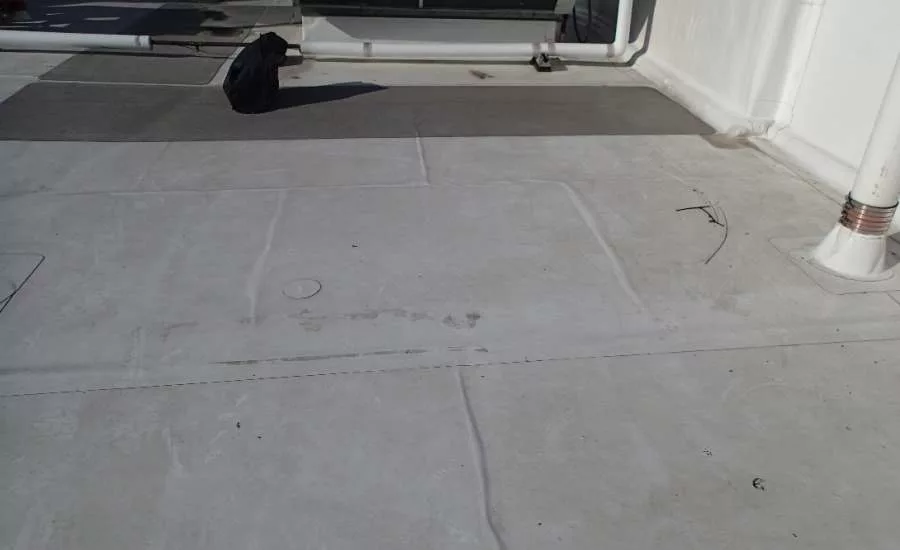
Project examples of documentation gathered from a drone-mounted camera in difficult-to-access roof areas will be provided. This study will also present innovative uses of images from drones to develop existing condition maps and measured drawings.
Assessment Challenges
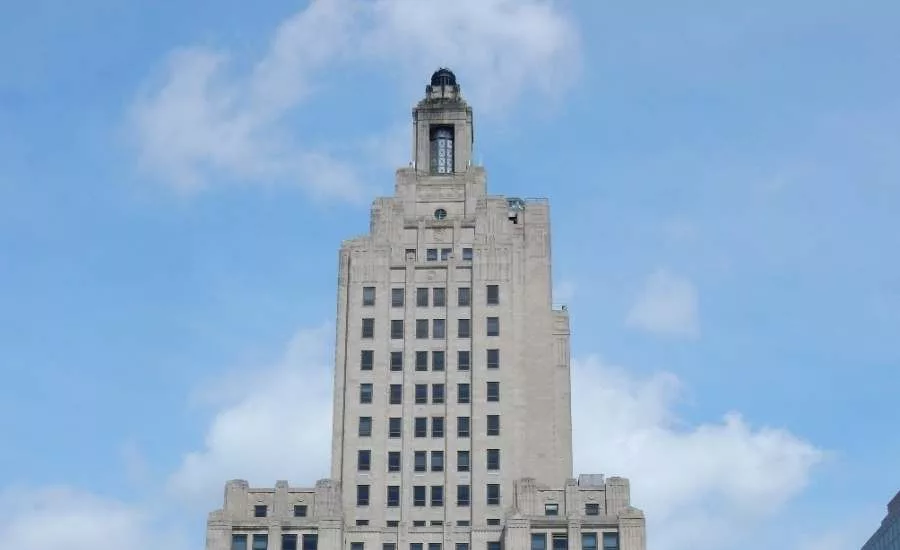
At times, the buildings we assess present unusual challenges. Gaining access to a roof is generally through a roof hatch or from a ladder at its eave, drip edge or parapet. Observation of the facades of multiple buildings can be accomplished from the ground or neighboring structures using binoculars. Sometimes, we are required by a facade ordinance to provide an up-close observation of the materials on the building. This is often completed using a personnel lift or boom. More difficult or taller structures are often surveyed using swing stages by dropping down the face of the building on each elevation. In some cases, rope access techniques are an alternative to a swing stage requiring highly trained professionals, in both rope safety and facade assessment, to complete the work. For example, this technique was used at an Art Deco style building with many offsets and setback roof areas, proving much easier to assess the condition of the limestone walls.
The list of buildings and conditions where UAS’s are being used is growing. A few examples and conditions will follow. Prior to discussions of examples of their use, a short discussion of UAS’s is appropriate.
Description of an UAS
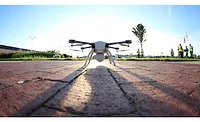
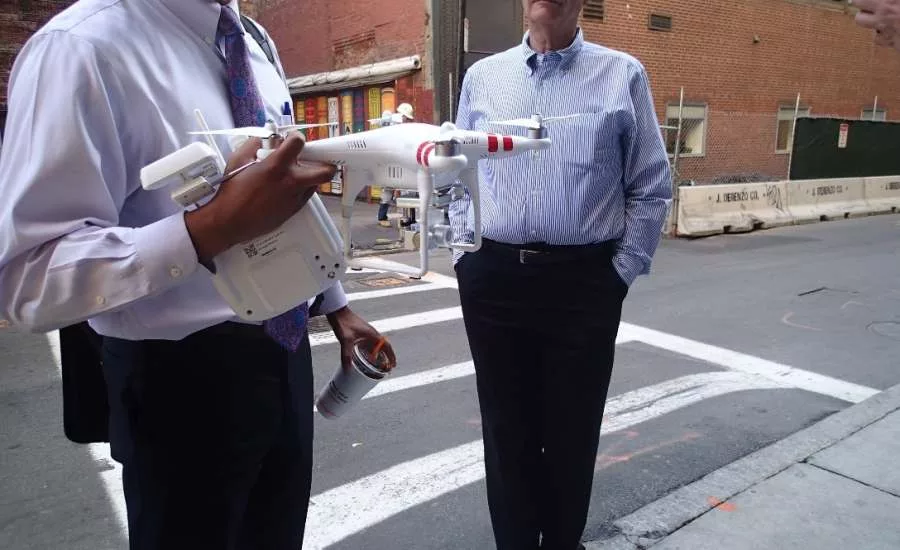
Commonly used drones contain a single rotor, three, four and eight separate rotors on various bodies with a wide range of prices and capabilities. The range of uses includes real estate, event aerial photography, action sports and building construction monitoring. Currently, the most commonly used small UAS in these type of applications is the Phantom Quadcopter series manufactured by DJI. These type of drones are capable of being outfitted with a variety of cameras and devices depending on the needs of the inspection to be performed. Additionally, these drones may be equipped with many safety and user functions including real time relay of video or images to the operator via tablet or cell phone, image stability from environmental interference, impact avoidance systems (from objects mobile and immobile), and a “return home” capability. “Return home” is a feature that allows the auto-pilot feature to return the drone back to its origin. This can be utilized in the event of poor signal, low battery life, damage to the device or predefined FAA (Federal Aviation Authority) boundary obstructions.
Here are some links to available drones that are popular for commercial use:
- http://www.dji.com/product/phantom-3
- http://www.walkera.com/en/showgoods.php?id=2294
- http://www.bhphotovideo.com
- http://3drobotics.com/solo/
There are local clubs where fellow recreational drone operators compete in agility competitions. These types of recreational drones are typically more difficult to maneuver since they require heightened skill levels. Although the example drones listed in this case study for commercial use are relatively easier to operate than recreational drones, training and/or sufficient practice is necessary to ensure that the operator understands the operating functions, navigation functions, general safety features and procedures, along with the FAA safety requirements.
It should be understood that there are FAA safety concerns for all operators, whether recreational or commercial. Currently, the FAA requires a drone operator to have an airplane pilot’s license. There has been discussion that the FAA is likely to require training of operators, which will include a 40-hour course for commercial use of drones. This effort will go to ensure a safer airspace with knowledgeable pilots. Actions like this are also critical to ensure a safe sky. The challenges the FAA faces are obviously great moving into a drone operated world in the National Airspace (NAS).
Making the News
Planes fighting a forest and brush fire in California were grounded because a drone was too close to firefighting planes. This made the CBS Evening News on June 25, 2015. A drone flew between two planes flying within 1000 feet of each other and the planes were grounded for about 30 minutes.1
In Marblehead, Mass., a drone hit a building, and then, the drone injured two spectators watching the Memorial Day Parade. In the article, the operator had “flown this drone numerous times without ever having a negative experience.” He wanted to videotape the parade. One of the injured spectators suggested an operator should obtain a license before flying drones over crowds.
To receive an exemption for commercial use of UAS, you must foremost prove that the current restrictions in Chapter 14, Section 333 present a work safety hazard that could be resolved with drone use. Such a request by a forensic firm, or similar, typically includes a description of reasons the firm is requesting relief from each section of Chapter 14 Section 333, the specific UAS to be used, operation manual(s) of UAS(s) being used, safety manual created by the firm, flight log, maintenance record, and etc.
For an example of an exemption request to operate UAS for commercial use by a forensic engineering firm, refer to the appendix. This provides context as to the effort necessary to satisfy the agency.
Here are some of the conditions and limitations from the exemption, many of which echo the proposed rules:
· UA weighs less than 55 pounds.
· Operates less than 100 mph.
· Altitude below 400 feet.
· Operates within a visual line of site (VLOS), unaided.
· Utilizes a visual observer and within verbal communication of Pilot in Command (PIC) at all times.
· Carries the operating documents, which include the conditions and limitations, at all times.
· Functional flight tests.
· Maintains aircraft.
· Pre-flight checklists.
· Pilot in charge must hold airline transport, commercial, private, recreational, or sport pilot certificate and a valid U.S. Driver’s license.
· Operates it safely.
· No night time operations, sunrise to sunset only.
· Cannot operate within 5 nautical miles of an airport reference point, unless a letter of agreement with that airport’s management is obtained.
· No operation less than 500 feet from below a cloud or 2,000 feet horizontally from a cloud or when visibility is less than 3 miles from the PIC.
· Conducted in accordance with an Air Traffic Organization Certificate of Waiver or Authorization.
· Aircraft must be identified by serial number (or N-number) as large as practicable.
· Give way to all manned aviation operations.
· UAS may not be operated from a moving vehicle.
· Conduct operations at least 500 feet from all non-participating persons, vessels, vehicles and structures unless:
o Barriers to protect in case of an accident. Must cease immediately if a person is within 500 feet of the UAS.
o Granted permission for operating closer and PIC made a safety assessment of the risk and does not present an undue hazard.
· Accidents and incidents must be reported to the FAA.
Applications
3-D modeling is quickly becoming a tool on drones. Some computer science engineers are developing software that can detect cracks, voids and irregularities in a bridge or facade. Other firms are using video collected from roofing surveys to develop 3-D models and 2-D drawings of the roof.
Advancements
The FAA, NASA and industry leaders are working on a flight database stored on the cloud that potentially would require a drone operator to enter the registered drone’s purposed pre-flight plan into the program for approval prior to flight. The program will review all potential geo-fences conflicts, proximity to other air traffic, weather conditions, civilian hazard, etc., and then, it will spit out a green light to fly or not. It is in the early stages of discussion, but it has the ability to solve many concerns, primarily safety related.
Another technology advancement is in the area of “e-bumbers.” This is hardware built into the device, or added, that can recognize obstacles nearby like buildings (including glass), other drones, fences, trees, etc. This is in the demonstration mode. This would be a great tool in the structure evaluation realm. The operator could set the distance to decrease potential for impact and also make sure you are able to get the view needed for proper observation.
Example Projects
The following are example projects where a drone has been used to photograph various building locations for assessment. Included in the presentation, dramatic videos will demonstrate the level of image quality that can be collected.
Roofing Assessment
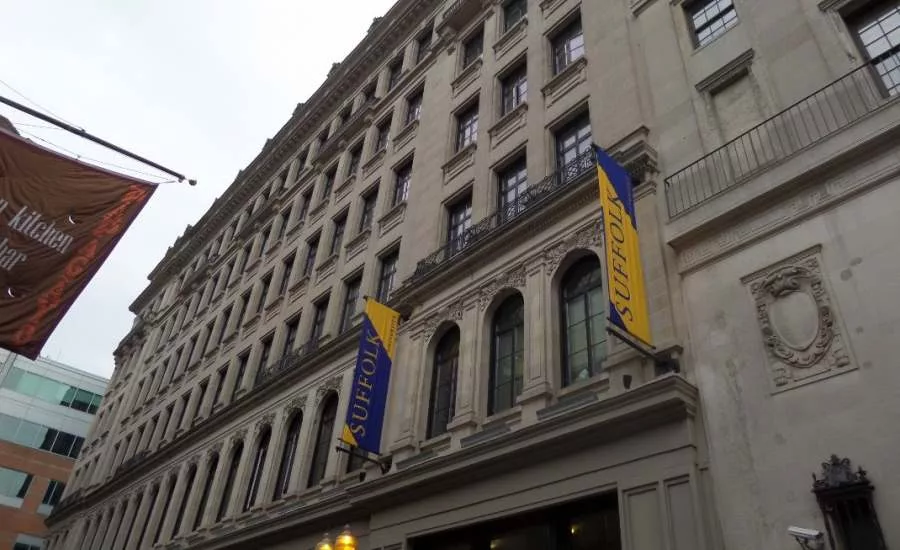
This building is located in a congested portion of downtown Boston. It is a 7-story educational facility. The top floor contains a mansard roof covered with red slate. Regularly spaced copper clad dormers protrude from the mansard. A survey of the facade was required to comply with the City of Boston Facade Ordinance.
A report with images and types of deficiencies was prepared including images from the drone.
Facade, Chimney and Silo Assessment
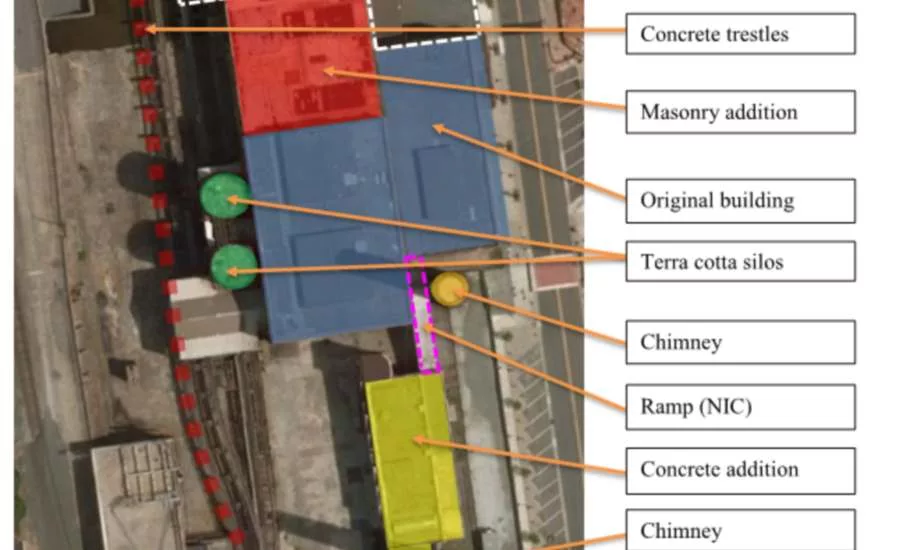
WJE performed a facade condition assessment of the Bailey Power Plant located in Winston-Salem, N.C. The purpose of our assessment was to develop a prioritized scope of repair work for the exterior facade of the building; the concrete train trestles that extend along the west side of the building, the chimneys and the silos. Our scope of services included a visual assessment of the masonry and concrete components of the complex from grade and accessible roof areas, and with the aid of a drone. In addition, close-up inspections were performed from personnel lifts at selected areas of the west, south, and east facades of the building, and inspection openings were made at select locations on the masonry portions of the facade to evaluate concealed conditions.
The Bailey Power Plant was reportedly constructed in the 1930s as part of the Reynolds Tobacco manufacturing plant. Subsequent to the original construction, the building has been modified. Currently, the building consists of the original structure; a shorter masonry addition that abuts the north facade; a concrete addition that is connected to the south facade of the original building by a metal panel clad ramp; several other metal panel clad additions that also abuts the north facade of the original building; and the north and east facades of the masonry addition.
Two brick chimneys are located along the east facade of the building; a terra cotta silo that is set on a steel frame is located adjacent to the south facade of the concrete addition; and two terra cotta silos that are set on concrete frames are located adjacent to the west facade. Regularly spaced concrete train trestles extend along the west side of the site and support train tracks that are now abandoned.
Great Potential
WJE was asked to review conditions of a slate roof that was reportedly damaged by ice damming. The roofs are on a three building complex that is a well-known tourist destination in Boston; the location is home to offices, retail and restaurant tenants. The buildings are linear with a north, central and south building. The central building is 3 stories tall and contains a large dome. The north and south buildings contain five and six floors with dormers and skylights within roof areas separated by short brick masonry firewalls that extend above the roof surface.
The insurance claim suggested that a certain percentage of slate shingles were damaged over the winter and should be replaced. Trees are planted between the buildings, which block direct views from building to building. Because of the height of each building and the distance between buildings, views of the roofs from grade is prevented. Even views from neighboring buildings is difficult except from the parking garage on the north, where the north facing slope of the north building is clearly visible.
The first firm returned the following response:
“We are able to perform those roofing surveys for $650-$750 per building (depending on roof size and proximity to the city center). I look forward to discussing this with you in further detail soon. Thank you for your interest in our services.”
Then, we received the following emails from another firm:
“My apologies. This is a significant project that will require several issues to be addressed. 1) The site is located within Boston's Logan Airport airspace and will require a COA from the FAA. 2) We are researching the permit process which, like New York, doesn't have it defined. 3) Crowd control due to the fact it is a major retail location.
It will most likely take approximately 3 weeks to hear from the FAA. I believe a shorter time frame from the city. I spoke to city officials this morning. Hoping to define a process soon.”
Then, we heard from them with their proposal:
“Our proposal is attached. We have applied for a Certificate of Authorization (COA) to operate in FAA Class D airspace (Logan Airport). We are working with the Boston, DPW on a permit process as well. Not sure how long this process will take. We have been in contact with them several times since learning of this project. We will keep you informed as we move through this process.
Please keep in mind, the two largest hurdles needed to overcome to accomplish this project are FAA approval and City of Boston permit.”
There was a wide discrepancy between prices and what will be completed between the two proposals. One contained information about safety and crew that was clearly missing from the other.
Shortly thereafter, we received an email including the following:
“As of now, UAS operations are prohibited in Boston Logan’s airspace for the foreseeable future.”
From an email received:
John,
Scott Sweet
Program Analyst—A3 Technology Inc
Contracted by JMA Solutions in support of
The FAA Unmanned Aircraft Systems Integration Office
The firm continued their explanation with the following information:
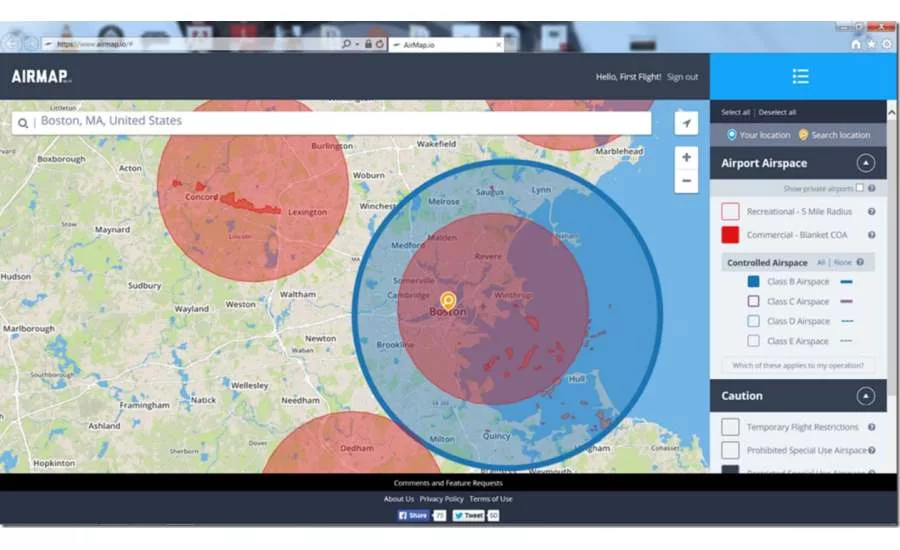
“The map below depicts Logan’s airspace in red with a larger blue circle in blue. The blue identifies class B airspace. The FAA will not permit operations until such time when UAS have transponder broadcast capability. (This will identify the exact location of the UAS to ATC and other aircraft).
The area in question is the red area within the blue circle. We can operate at lower altitudes in the blue area without requiring FAA approval. Think of it as an upside-down wedding cake.”
“We are working to see if any exceptions are possible. Please keep in mind that we are dealing with a government dinosaur here. I spoke to several individuals from the FAA this morning and their general position is that, “We should just be happy to have an exemption.” They clearly cannot see the forest through the trees.
I will keep you updated as we progress. We will still work with the city of Boston, to ensure a process is in place when the FAA catches up to itself.”
Summary
Drones are new equipment that comes available in many forms that many foresee as a great tool for this industry. Many new game changing technologies are here and on the way that will make the skies safer and structure evaluations better. The possible applications are at times beyond belief. One researcher is using drones to collect whale snot. They call it their SnotBot! Check it out at http://www.whale.org/.
Unmanned aerial vehicles are advancing in type, capabilities and application at a high rate. There are many applications that can be seen for their use by architects, engineers and consultants as we assess the buildings we deal with every day.
And some newer applications, like fitting the UAV with an infrared camera, are already here. The challenges of battery life, control during flight, and regulations of their use, all will be resolved and refined; some faster than others. This is a case where a toy and a hobby has developed to be used for many commercial applications and is here to stay.
References
1. http://www.cnn.com/2015/07/18/us/california-freeway-fire/.
Looking for a reprint of this article?
From high-res PDFs to custom plaques, order your copy today!
.webp?height=740&t=1767036885&width=auto "Header - BE 1170x658 (002).png")

.webp?height=740&t=1755781744&width=auto "KEE(2).png")