Weatherproofing the Building Enclosure
Deck Ventilation as a Retrofit Roofing Solution
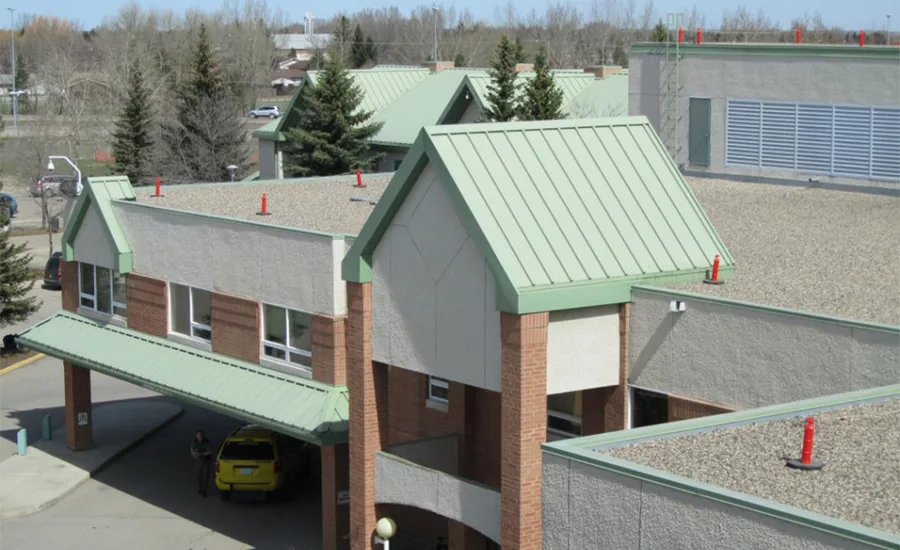
Main entry of the Centre. Photo courtesy of Walter P Moore.
The Centre
The Centre is a healthcare facility that serves as a residential-style home for patients with long-term disabilities (Photo 1). Built in the mid-1980s, the Centre was constructed of steel frame with metal stud infill walls, brick and stucco cladding, and metal roofing panels. From the beginning, the Centre has experienced serviceability issues with the weatherproofing of the building enclosure; roof leaks, flooding in crawl spaces, condensation, and moisture infiltration into the exterior wall systems created environmental conditions that were neither comfortable nor acceptable for immunocompromised patients. Over time, the building enclosure failures extended to nearly every area of the facility, exceeding what reactive maintenance could be performed by on-site staff. In 2010, Walter P Moore’s Diagnostics Group was brought in to perform an investigation into the causes of the failures and to propose permanent solutions to the pervasive leakage issues. Because the Centre is considered a critical care facility by the healthcare system and is typically operated at capacity due to demand, careful consideration for the needs of the patients had to be kept at the forefront of all investigation, and later for construction activities.
Roofing Problems or Problem Roofing?
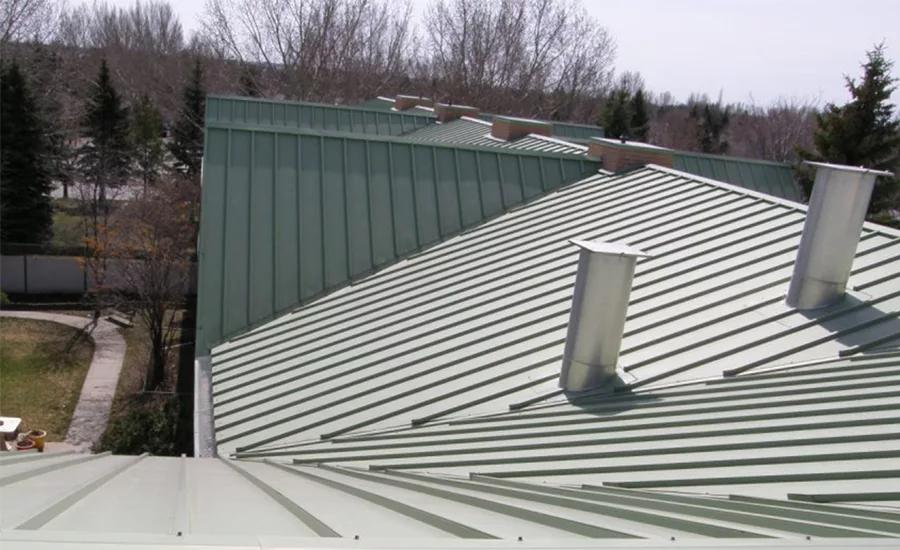
At the beginning of the investigation, the metal panel roofing system was singled out as a likely culprit for some of the more major leakage issues at the second level (Photo 2). Known problems with the integral gutters, skylights and valley flashings had been troubling the facility staff for a number of years. Repairs would be made, only for the same leaks to reoccur the next season. Ice damming was a major issue as well, causing damage to the roofing trim and gutters, and sliding sheets of ice that could potentially pose safety hazards when located over sidewalks and entries. Based on the findings of the investigation, while the roofing was not entirely to blame for the moisture infiltration issues—major points of leakage were identified throughout the exterior wall system as well. Certain details of the roofing system as constructed were directing bulk water to the building interior, causing damage to interior finishes and promoting biological growth within the wall system. Due to the severity of the conditions uncovered, the healthcare system agreed that wholesale replacement of the roofing and exterior wall systems was needed to properly correct the leakage issues. To minimize disruption to residents and to provide proper infection control during construction, the work was separated into several phases, starting with the roofing.
Digging into It
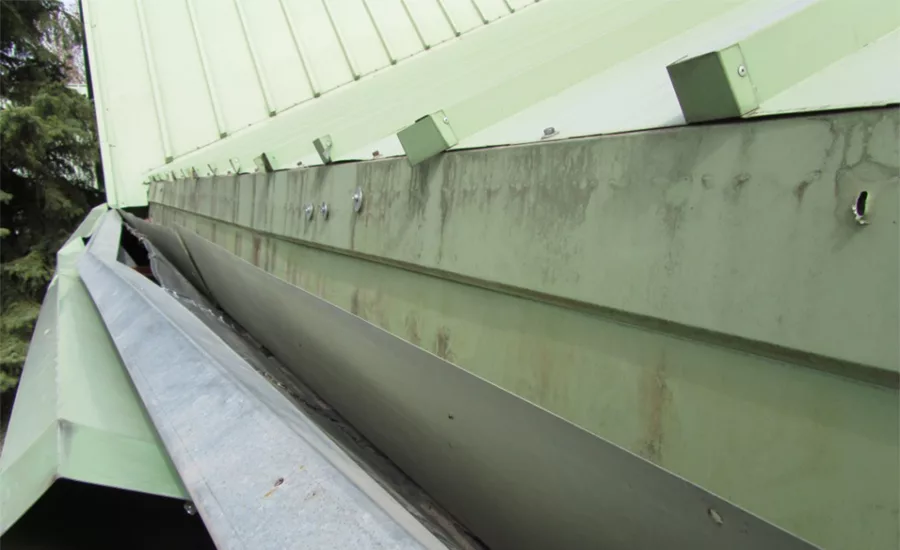
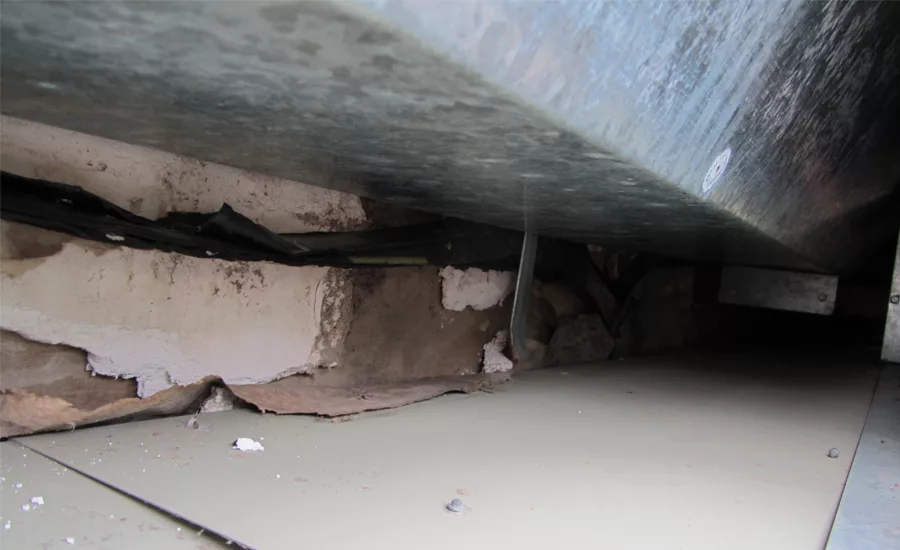
The original record documents for the building were found to be missing important information on design and detailing for the building enclosure, particularly at transitions and flashings. Early in the project, some destructive investigation into the roofing systems was performed to verify as-built construction. Typically at the steep-slope areas, the roofing system was found to be metal deck, protection board, waterproofing membrane, 8 inches of polystyrene insulation, a single ply of roofing felt and batten-seam metal panel. The metal panels were supported by z-girts fastened to the deck through the insulation without any thermal breaks, which created a thermal bridging condition that contributed to the formation of the dangerous ice dams at the eave and integral gutter. The gutter itself was constructed oddly, formed of unsealed sheet metal sandwiched around a loose-laid EPDM membrane (Photo 3). Additionally, the waterproofing membrane at the roof stopped at the eave, leaving the exterior sheathing exposed around the integral gutters. The unsealed sheathing combined with the open seams in the gutter box meant that water was leaking directly into the wall system. Areas of significant water damage to the sheathing and biological growth were found behind the gutter area (Photo 4).
It required complete removal of the existing roofing system and construction of an entirely new system to correct the thermal bridging and leakage. As part of this replacement project, the healthcare system also wanted to replace the metal panels with asphalt shingles to better allow the facility to blend in with nearby homes. The challenge with this request was accommodating the need for asphalt shingles to be vented into a building with unvented attic space and entirelyabove-deck insulation. Asphalt shingle manufacturers typically require that shingles be installed on vented assemblies because excess heat has been documented to reduce the service life of shingles. The new roofing system would need to be designed as a ventilated system, but due to adjacent construction to remain in place, the new system would need to be no greater in thickness than the existing roofing.
Vented Roofing
Because the attic space at the Centre was designed as mechanical space for ductwork and plumbing, retrofitting the existing roof assembly into a “cold roof,” where insulation is placed above the ceiling level and the entire attic space is vented to the exterior, was not possible. As a solution, a new roofing system was designed to ventilate only the asphalt shingles and to keep the insulation above the roof deck—all while fitting into the thickness of the existing system.
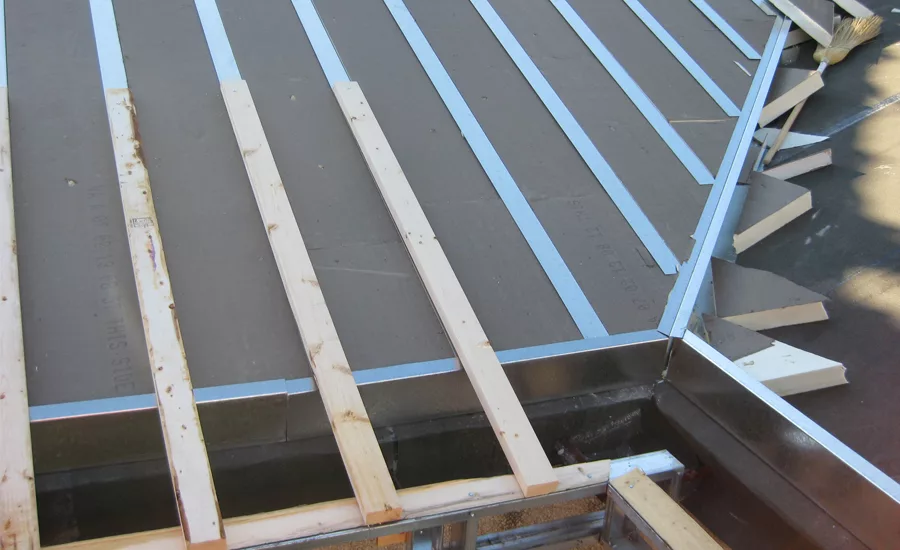
Polyisocyanurate, a more efficient insulation, was selected to reduce insulation depth that would be needed for the ventilation assembly. The plywood nailbase for the asphalt shingles was elevated to create a continuous plenum that extended from the soffit to the ridge (Photo 5). The integral gutters were removed and infilled to create the intake, and vents were added at the ridges. Ventilation is provided passively by the chimney effect created within the plenum, but consideration was made for temperature to avoid creating freeze-thaw cycles that would exacerbate ice formation. Air flow analysis was also performed to design the needed depth of the plenum and to verify that changes in slope and roof geometry would not block ventilation.
The asphalt shingles were installed over a continuous membrane underlayment to provide the primary waterproofing layer. Because of the history of past leakage issues, a secondary waterproofing layer was installed under the insulation. Should the primary layer fail, water should still be prevented from entering the building. As mentioned above, the integral gutters were removed and infilled; new hung gutters were attached to the eave edge, fully outside the exterior wall plane. If the new gutters were to be damaged or to leak, there is no path for water entry into the wall system with this assembly. The secondary waterproofing layer also served as a sealed air barrier system.
Flashing Challenges
The roofing replacement work was only the first phase of a multimillion dollar building enclosure replacement project. Where lower roofs intersect with vertical walls or where steep-sloped areas transition to low-slope roofs, allowance for future integration into replacement systems needed to be provided. In some locations, a temporary cut-off or counterflashing was provided, and at other locations, existing wall or roofing assemblies were cut away to waterproof the new roofing system. Ideally, the roofing and exterior walls could have been replaced at the same time, allowing for full continuity of the waterproofing, insulation and air barrier layers. The exterior wall replacement project was begun in 2014 and will finish in later 2016.
Conclusions
Retrofitting roofing assemblies into existing structures presents a number of challenges when the new roofing systems have different performance requirements from what had previously existed. For the Centre, the desire to change from metal panel roofing to asphalt shingle necessitated the construction of a vented roofing system to preserve the service life of the asphalt shingles. The new system was successfully integrated into the as-built construction through careful assessment of the existing conditions and performance modeling of proposed replacement systems to design the most efficient but effective system to fit within existing geometric tolerances. Replacing failing building enclosures is a challenging and invasive undertaking and advanced consideration must be given to cost, constructability, phasing, climate and as-built construction.
Looking for a reprint of this article?
From high-res PDFs to custom plaques, order your copy today!
.webp?height=740&t=1767036885&width=auto "Header - BE 1170x658 (002).png")

.webp?height=740&t=1755781744&width=auto "KEE(2).png")