Preliminary Selection of Exterior Waterproofing Systems
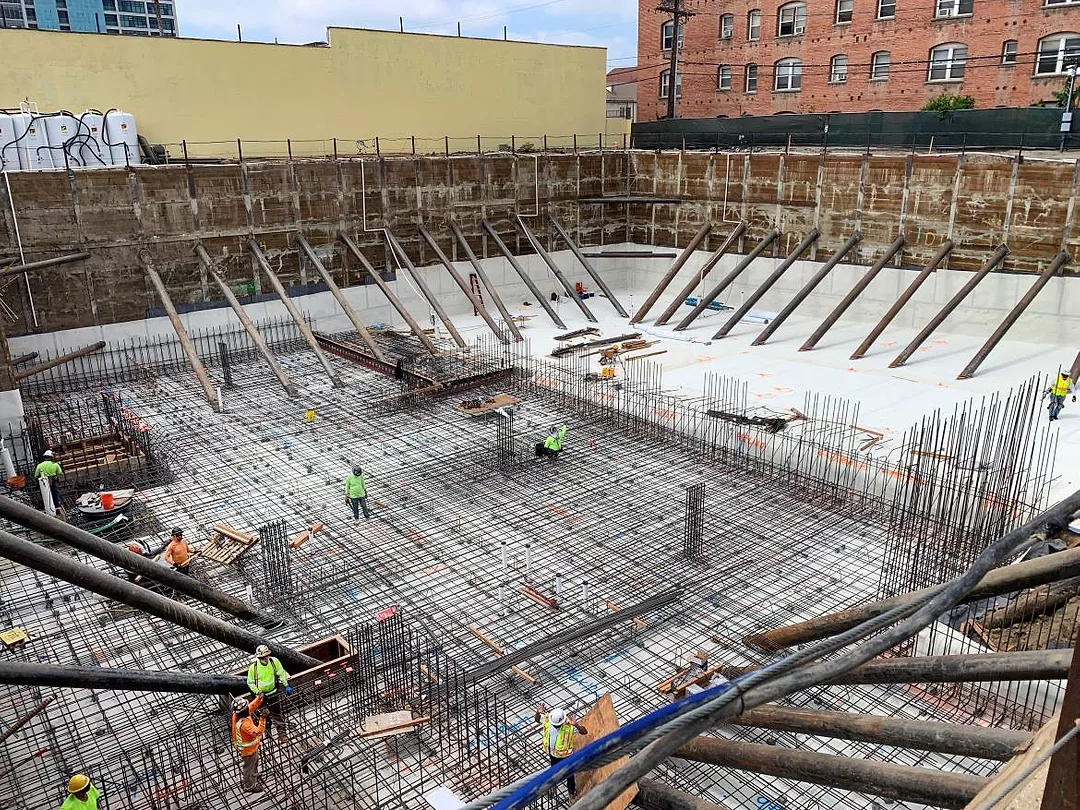
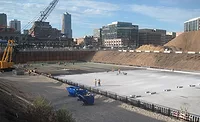
For this mat foundation with hydrostatic loads (Condition 8), the waterproofing was specified in Section 07 13 26 - Self-Adhering Sheet Waterproofing. The waterproofing had to be robust enough to serve as a work platform, and to protect against methane penetration as well as moisture. Photo courtesy of AVM Industries, Kyle Stimpson
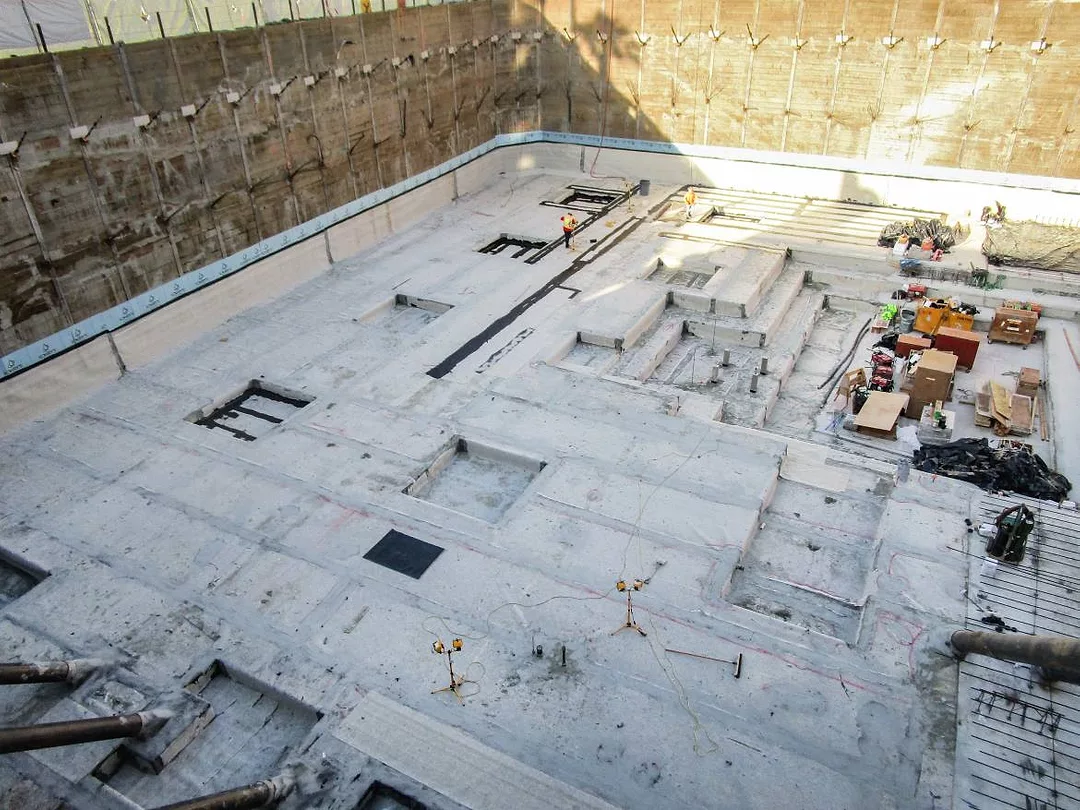
The exceptionally complex geometry of this Mat Foundation - Hydrostatic received Section 07 17 16 - Bentonite Composite Sheet Waterproofing. Photo courtesy of Simpson Gumpertz & Heger
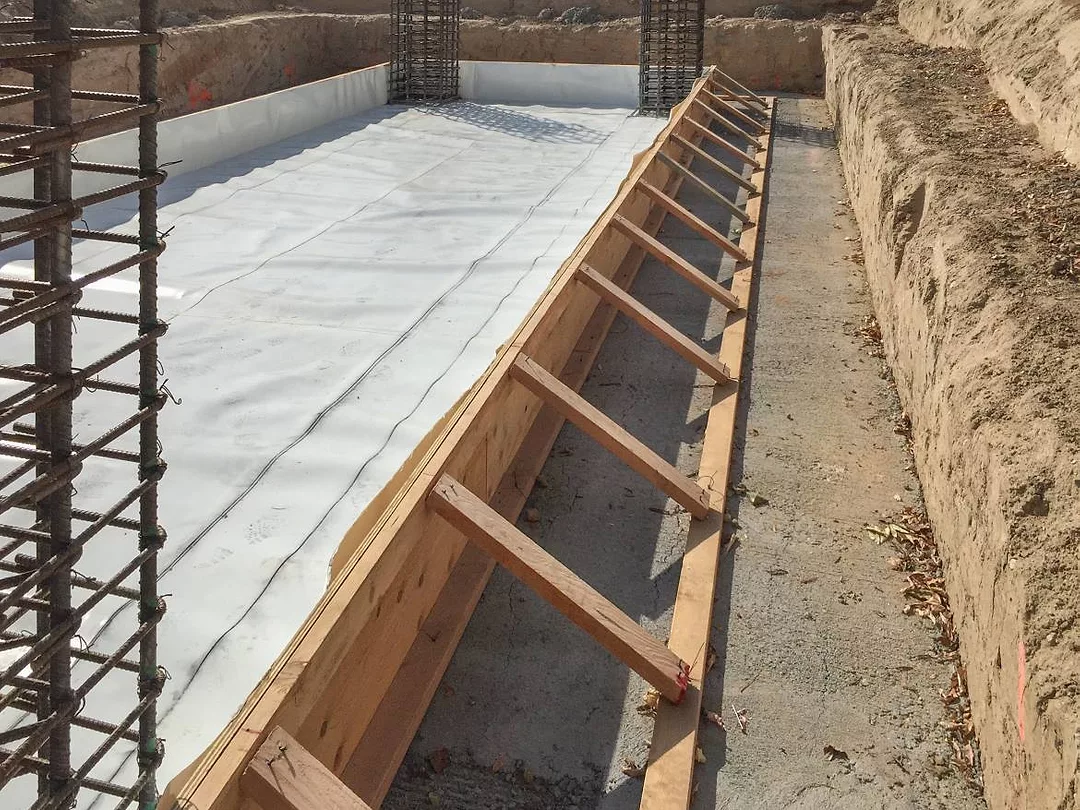
Thermoplastic sheet waterproofing being installed before re-bar. Manufacturers typically require inspections after the initial membrane installation and after re-bar has been placed to check for trade damage. Photo courtesy of DTR Consulting Services
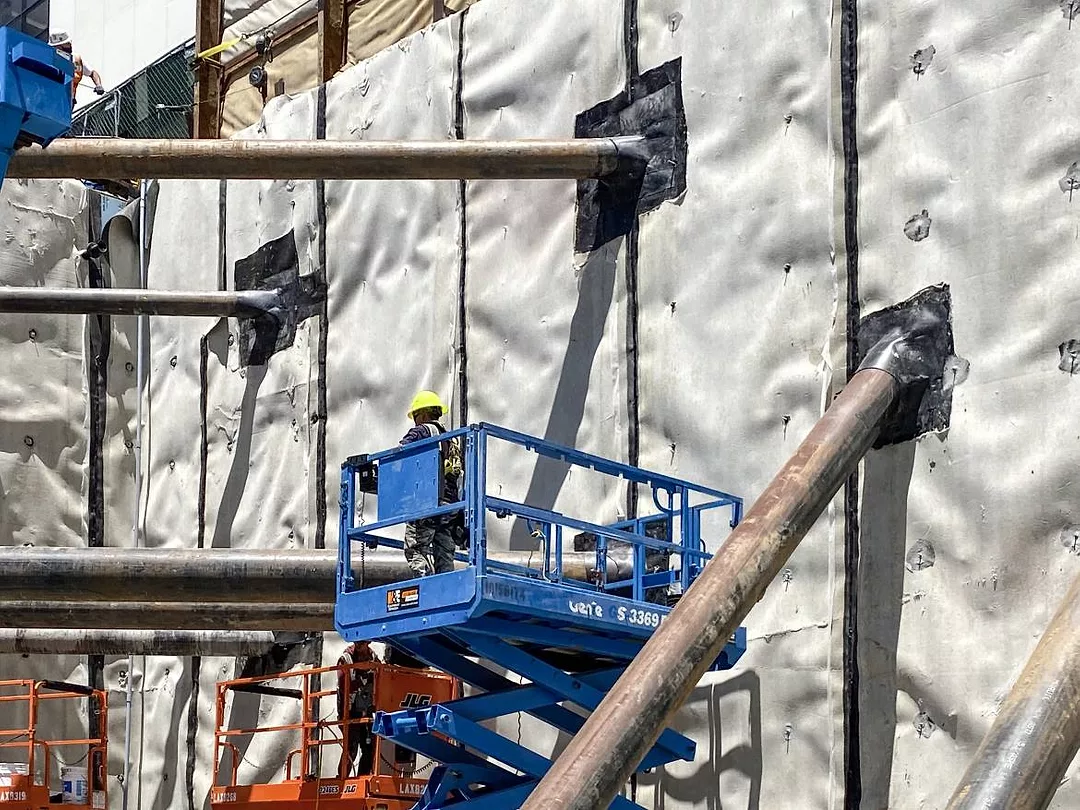
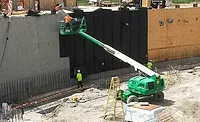
This wall condition is Shored Blindside Wall – Hydrostatic (Shotcrete), 15a in the matrix, received Section 07 17 16 - Bentonite Composite Sheet Waterproofing. Patching will be required when the rakers that brace the wall are removed. Photo courtesy of Simpson Gumpertz & Heger
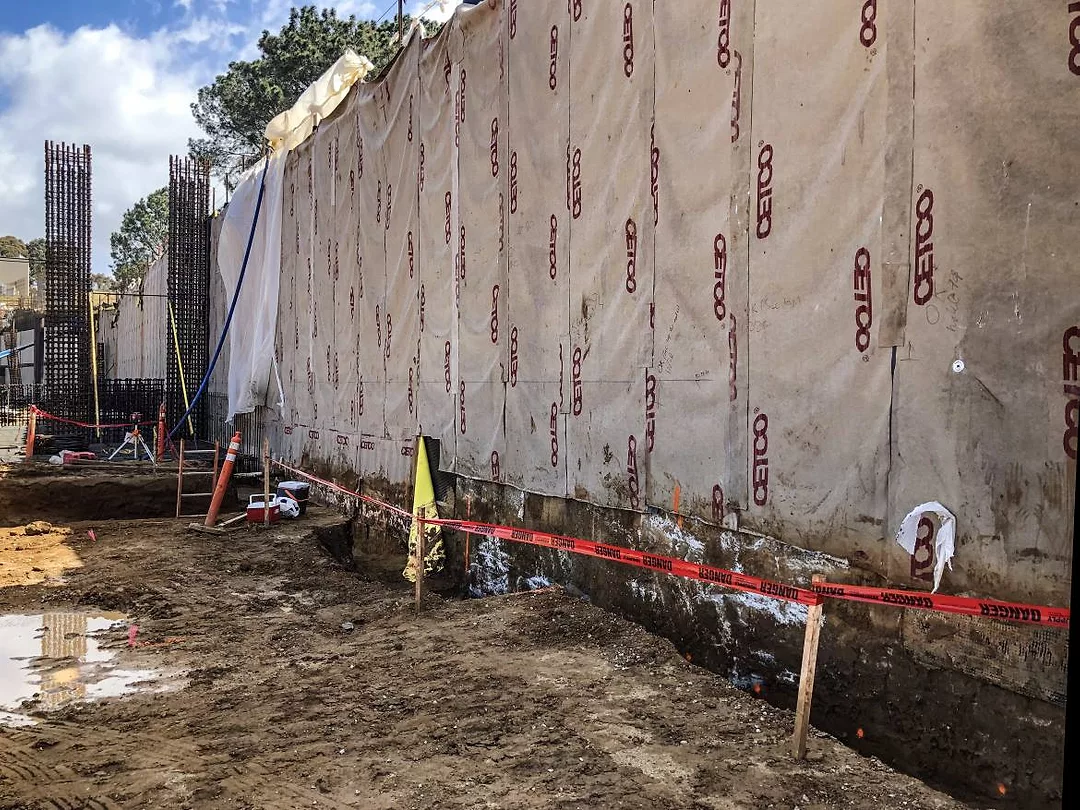
The exceptionally complex geometry of this Mat Foundation - Hydrostatic received Section 07 17 16 - Bentonite Composite Sheet Waterproofing. Photo courtesy of Simpson Gumpertz & Heger
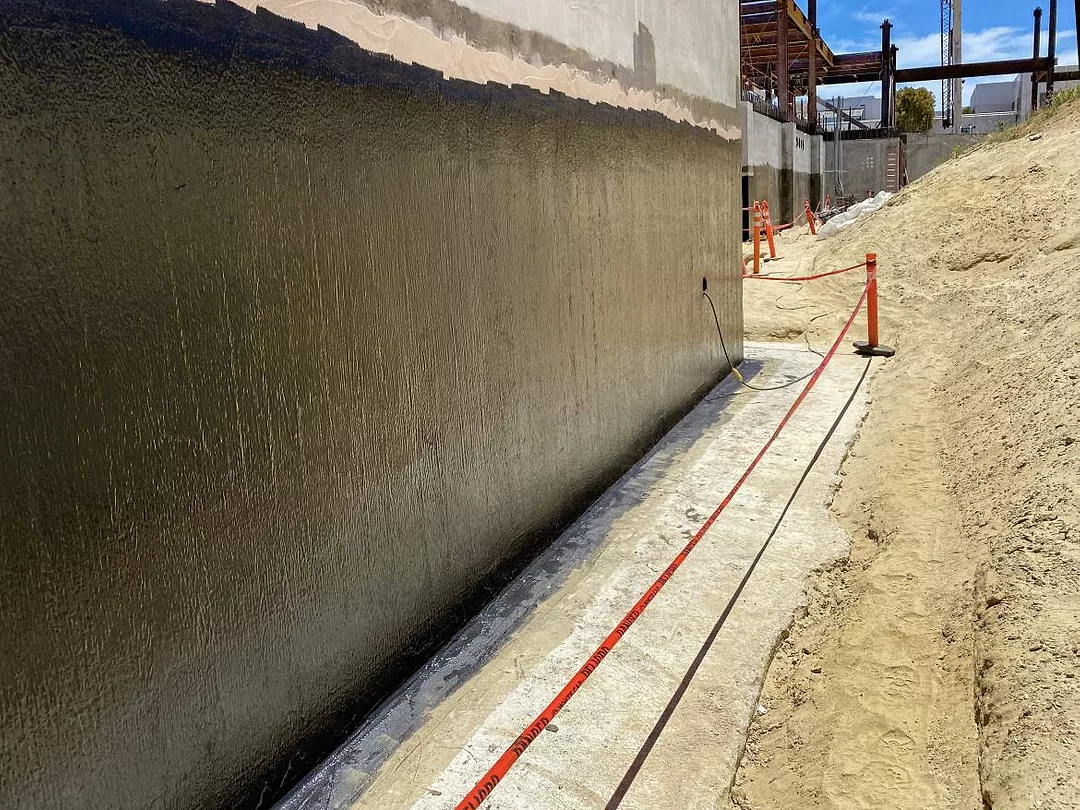
This wall condition is Shored Blindside Wall – Hydrostatic (Shotcrete), 15a in the matrix, received Section 07 17 16 - Bentonite Composite Sheet Waterproofing. Patching will be required when the rakers that brace the wall are removed. Photo courtesy of Simpson Gumpertz & Heger.
Selection of a suitable waterproofing system can present a building project team with a baffling array of choices. With dozens of manufacturers and hundreds of products to choose from, there is a formidable amount of data to evaluate in order to make a thorough investigation.
Unfortunately, there did not appear to be a standard, easy-to-follow methodology for making waterproofing product selections. The task is especially daunting for novice designers and specifiers with limited personal experience to draw upon. Even seasoned design and construction professionals can find themselves stymied when confronted with unusual project conditions.
To address this concern, the Technical Committee of the Los Angeles Chapter of the Construction Specifications Institute (LA-CSI) developed, in 2002, a guide to Preliminary Selection of Waterproofing Systems. “Our goal was to help the design team make better waterproofing decisions more efficiently,” said Roger A. Cormier, CSI, CCS, committee chair at that time. The committee looked at waterproofing as defined in MasterFormat (1995 ed.), which says the category includes: “Impervious, waterproofing membranes, coatings, and other materials applied to walls, slabs, decks, and other surfaces subject to continuous and intermittent hydrostatic pressure or water immersion.”1
“During nearly two decades since then,” according to Melisa Sharpe, Architect, CSI, CDT, DBIA, LEED-AP, current chair of the LA-CSI Technical Committee, “there have been numerous changes in waterproofing technology, conditions of use, MasterFormat (2020 ed.), and industry best practices. With this in mind the Technical Committee of LA-CSI sought to update this document by taking into consideration these changes and creating a new version of the document that makes it even easier for novices and veterans alike to make preliminary product selection decisions about waterproofing systems and to find products that address the specific project’s needs.”
The new guide seeks to simplify the selection process by installing a diagram of a structure with typical waterproofing applications illustrated throughout the diagram. These applications are referenced by number to a waterproofing application matrix which cross-references the types of waterproofing system technologies (along with the MasterFormat section names and numbers in which these materials are typically specified.), with a rating of their suitability for this application.
Limitations
The diagram and matrix are a useful guide to waterproofing systems that are generally suitable for the intended application. The diagram and matrix should not, however, be used as a “cookbook” for complete and comprehensive specification of waterproofing.
Material manufacturer technical representatives, waterproofing consultants, experienced colleagues, and specialty installers can help greatly in “tailoring” a system or systems to project conditions as well as helping assess risks and pitfalls and reasonable performance expectations. Each individual will have their own basis of experience and will have biases for and against various systems in various applications. It can be useful, therefore, to consult multiple parties to obtain a clearer picture of the range of options, and each option’s pros and cons, for a given installation.
Detailing
“God is in the details” is a cardinal rule of modernist architect Mies van der Rohe. While not glamourous and usually concealed in final construction, this rule holds true for waterproofing. Selecting an appropriate system is the first step in a long journey to successful waterproofing. Detailing and focused specifying are critical to the success of waterproofing installation.
Manufacturers generally have details and specifications that do a good job of defining typical installations for their product. The details, not surprisingly, show only conditions that are within a system or terminate generically to the adjacent architecture. Additional details are required for termination to other waterproofing, water resistive barriers, and other systems. The specifications, similarly, will need to direct coordination of adjacent systems and guide the installers toward successful interface.
Quality
The performance of a waterproofing design is limited by the skill and care of its installer. It is important, therefore, that the specifications include clear requirements on the minimum qualifications of the installer and measures to help ensure quality—such as detailed shop and installation drawings, mockups, field testing and observations. Many systems require part- to full-time monitoring as a condition of warranty. In some cases, the manufacturer’s technical representative can provide adequate field oversight. Often, however, it is advisable to retain a third-party consultant or inspector to check the work in progress.
Other Considerations and Pitfalls
Waterproofing is subject to the environmental conditions of the site as well as the built conditions that it is intended to protect. A summary of typical site and built conditions for the specifier to consider follows:
- Site soil and water table: will the ground have hydrostatic conditions? Will there be soil or groundwater conditions that are deleterious to the waterproofing? How does the structure resist hydrostatic loading? The waterproofing specifier needs to coordinate these considerations into the design. Vapor barriers can be used in non-hydrostatic conditions if required to prevent water vapor migration to impermeable finished flooring. Vapor barriers are not waterproofing and should not be used in hydrostatic conditions. Typically, hydrostatic grade waterproofing also functions as a vapor barrier.
- Shoring: many urban projects require perimeter shoring, such as steel wide-flange soldier beams with treated wood lagging. The soldier beams often have tie-backs or rakers to resist loading from adjacent soil. Tie-backs often, and rakers always, need to be removed after concrete placement – this presents out of sequence patching of waterproofing which needs to be addressed in the details and specifications.
- Waterproofed surfaces: each structural material has characteristics and limitations that must be considered in the waterproofing design. Shotcrete, for example, can be challenging due to the tendency for voids and slump to form during placement. The design should anticipate the unique challenges of each substrate and specify compensating and mitigating measures.
- Drainage: non-hydrostatic walls usually have drainage to a base-of-wall collection system that conveys water away from the structure, to a sump, or to a storm sewer. The drainage must be designed to accommodate expected site drainage in service. Misdirected surface water and/or unexpected “perched” below-grade water can increase demand on the drainage system capability. The waterproofing specifier may have to remind the design team of the need for adequate drainage for proper waterproofing performance.
- Damage during construction: waterproofing generally is installed early in a project schedule and may remain exposed for weeks or months depending on its location. It is important to consider means to protect and repair waterproofing until it is properly covered.
- Post construction repairs and supplemental waterproofing: grout injection, to help mitigate leakage, can be used to repair cracks and voids in below grade concrete walls. Grout injection can also be used as a supplement to help seal conditions that are not easily waterproofed using sheet or fluid waterproofing or waterstops. Crystalline coatings or slurries can be used on the “negative side” to help repair minor seepage or damp on below-grade walls and slabs or used as a supplement to waterproofing on the “positive” side of the below-grade structure.
Summary
Other factors that affect waterproofing are beyond the scope of Guide. For example, how will continuity and compatibility be assured where a horizontal and a vertical condition meet, especially when products from more than one manufacturer are being considered? Once a broad category of product is selected, performance and product variables such as application thickness, availability of materials and labor, costs, warranty provisions, environmental factors, project limitations and other factors must be considered to refine one’s options within the category. Moreover, Guide does not address dampproofing, water repellents, or roofing—processes that are sometimes grouped inappropriately with waterproofing.
Guide users must read manufacturers’ literature, industry reference materials, and codes, and carefully evaluate proposed materials before specifying or using them for a specific application. When necessary, advice should be obtained from trusted manufacturers’ representatives or qualified waterproofing consultants. Information from independent testing facilities should be considered and, if necessary, tests can be performed on a mock-up to demonstrate the effectiveness of a product in a particular application.
The Committee recognizes that, as with any consensus effort, Guide will not satisfy everyone in the waterproofing industry.
The Committee
Committee Chair: Melisa Sharpe, Architect CSI CDT DBIA LEED AP, DTR Consulting Services
Corresponding Author: Michael Chusid, RA FCSI CDT SCIP
Chris Brown, Port of Los Angeles
Rebecca F. Luna, EIT, Simpson Gumpertz & Heger
Roger Smith, CSI ICRI, W.R. Meadows
Kyle Stimpson, EIT CDT, AVM Industries, Inc.
A. Judson (Jud) Taylor, RA, Simpson Gumpertz & Heger
References
- MasterFormat, published by Construction Specifications Institute (CSI) and Construction Specifications Canada (CSC), provides a master list of division and section numbers and titles and is used to organize information about construction and associated activities.
Looking for a reprint of this article?
From high-res PDFs to custom plaques, order your copy today!
.webp?height=740&t=1767036885&width=auto "Header - BE 1170x658 (002).png")

.webp?height=740&t=1755781744&width=auto "KEE(2).png")