U.S. Student Competitions Elevate Talent from Africa and Worldwide
Covid. Climate. Injustice. Waste. Disparity. Hunger. Poverty. So much is at critical mass in the world that there’s no choice but to address multiple interconnected global issues simultaneously. Wege Prize, the international student design competition to create solutions to today’s “wicked problems,” is an agent of change for these lofty ambitions.
For its 2021 edition, Wege Prize — organized by Kendall College of Art and Design of Ferris State University (KCAD)—has announced 11 interdisciplinary student teams from around the world shortlisted for advance-ment to the final phase of the competition. Of the selected teams, eight include participants from African countries, and seven teams are focused on food-related or agricultural problems facing the world today.
“We are very pleased with not only the quality of the concepts advanced by these teams to help power a transition from our current linear economy—in which we take, make, and dispose—to a circular economy that’s regenerative by design,” says Gayle DeBruyn, KCAD professor and Wege Prize organizer. “We’re also very gratified to see the international, collaborative and cross-disciplinary nature of the student teams under consideration as semi-finalists.”
Wege Prize was established in 2013 to solve the most complex, layered problems. The competition requires teams of individuals capable of working across the barriers that too often divide us — to drive systems-level change. The KCAD prize offers a powerful and accessible platform for any college or university student in the world to develop tangible solutions that often find real-world acceptance and application after the competition concludes.
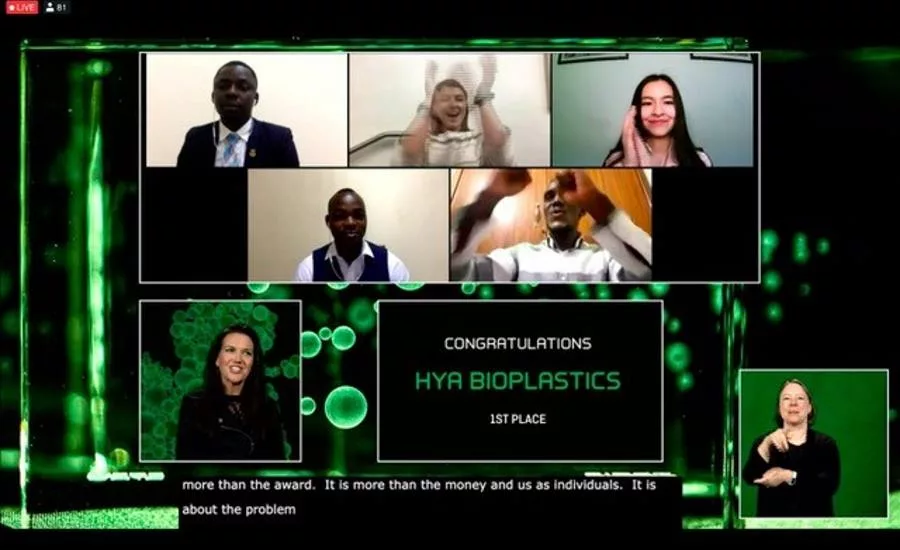
Examples from recent Wege Prize teams have included Rutopia, whose 2019 concepts for eco-sensitive tourism have got the attention of top editors at Forbes, among others (see https://www.linkedin.com/posts/emiliano-iturriaga_casapepe-tourism-travel-activity-6767581194361151488-q0fS/ ). Another is Hya Bioplastics, which created a process for blending dried water hyacinth fibers and boiled cassava starch to produce a biodegradable raw material used to make disposable food packaging. The venture’s cofounders have been accepted into a prestigious incubator and have advanced their business (info here: https://www.linkedin.com/pulse/our-year-review-hya-bioplastics-musinguzi-mark/ ).
Teams for Wege Prize 2021 accepted into the semi-final phase III of consideration include the following:
Agritrade Hub
Addressing the wicked problem of increased logging in Ghana creating wood waste and sawdust – about 97,000 metric tons annually – and the mismanagement of waste disposal, the team’s solution proposes transforming wood waste into nutrient-based substrates for mushroom production, leading to mushroom compost for use in fertilizing and growing forest and ornamental trees, thereby eliminating all forms of wood waste and mitigating environmental impacts.
Banga Na
With the high waste problem of cashew apples causes bugs, environmental, and economic problems to local farmers in Ghana, this wicked problem may be addressed by a solution of adding value to cashew apples by converting the fruit to wine, juice, and other fertilizers, generating income and employment from waste and improving food security and economic growth in the country.
Matooke Republic
The wicked problem of excessive food waste from matooke bananas creates issues of waste collection, greenhouse gas emissions, and other environmental problems in Uganda. The team proposes processing matooke banana peels into liquid sodium hydrogen carbonate, a substitute for sodium bicarbonate or rock salt, with the by-product used as organic manure. Using a preservation model that is 100% natural, the team also extends the shelf-life of the bananas by up to two weeks, slashing food spoilage and addressing food scarcity issues.
Musana
Using wood to fuel stoves for cooking has contributed to more than 80% of biomass fuels and deforestation in Uganda, making it a real wicked problem. This team has created a stove using solar power and water to fuel cooking, eliminating the need for wood fuel and helping reduce deforestation in Uganda. In addition, their solution includes a model to buy or repair used stoves to reuse raw materials.
Plant Space
In Rwanda’s dry season of June to August, landslides and flooding impact agricultural crops and livestock, contributing to food shortages. The student team is working on improving the supply of vegetables by creating a hydroponic farming method to deliver high-quality vegetables and provide food accessibility to Rwandans.
Recipe for Leftovers
Hunger is largely a problem of logistics, not actual food shortage. Food demand and the predominant linear economy leads to landfilling as the most common method of disposal, preventing the natural cycling of nutrients that is especially valuable in developing countries. A student team addressing this wicked problem proposes a platform for a food waste and food-scrap-sharing network, including linking restaurant food waste donations and receptive organizations in composting, donation, and bioenergy – not landfilling.
Safir
Harvesting waste from sugarcane farms – rather than the usual way it’s handled, by burning the unwanted materials creating carbon emissions and poor local air quality – is the goal for the Safir team. Their concept utilizes sugarcane harvesting waste to produce a wide range of bioplastics in line with government regulations and the bans on single-use plastics, while also meeting the demands of vendors.
Sutote
Synthetic pesticides are a wicked problem the world over, extremely harmful to health and the environment. In Tanzania, pesticide residues have been detected in the samples of irrigation water, and this team is devising a closed-circle production system for tomatoes using organic pesticides from the Mexican Sunflower (Tithonia Diversifolia) as well as reclaiming wastes for making organic fertilizer, preventing environmental degradation.
The Chilensis
With overcrowding already a wicked problem in Santiago, Chile, the pandemic has aggravated the impact. The Chilensis is developing sound isolators using discarded palm leaves waste to improve the quality of life by providing privacy. Old palm leaves are treated as a waste, but they have significant sound isolation properties and help address the challenge while creating a circular economic opportunity.
Wastezon
Rwanda’s low- to middle-income households don’t have affordable access to waste collection services for the country’s more than 3,000 tons of waste daily. This has led to dumping in the open and burning of waste, all grave threats to the environment, natural ecosystems, and sanitation. The student team is helping create a waste-free and food-secure world through a smart bin that provides automated waste sorting, catalyzing the decomposition of biodegradables into compost, as it tracks real-time data to improve waste collection and compost distribution.
Water Sprinklers
Also in Rwanda, abundant water resources aren’t enough to serve every citizen, including many people in rural areas who simply don’t have access to clean drinking water. Among other problems, this leads to thousands of children under five years old dying from diarrhea every year. The student team is designing a water purification device that is simple, chemical-free, using ultraviolet lights and proper filters to address water scarcity and quality issues.
More details about Wege Prize 2021 will be revealed in the coming weeks on wegeprize.org.
Looking for a reprint of this article?
From high-res PDFs to custom plaques, order your copy today!
.webp?height=740&t=1767036885&width=auto "Header - BE 1170x658 (002).png")

.webp?height=740&t=1755781744&width=auto "KEE(2).png")