Rehabilitating Soils Post Construction Using Geotechnical Polyurethanes
Innovations in Renovations
When buildings are renovated, improvements can be limited by the original building design or the techniques used in the initial construction or past renovations. Past designs or construction methods can hinder a designer's vision or cause significant delays to a construction schedule.
As many contractors, engineers and architects can attest, soil and foundation issues can be as much a problem to renovations as any other. When these problems arise, the options are typically invasive or perhaps unavailable. However, a technology gives the construction industry a new renovation tool, the use of geotechnical polyurethanes.
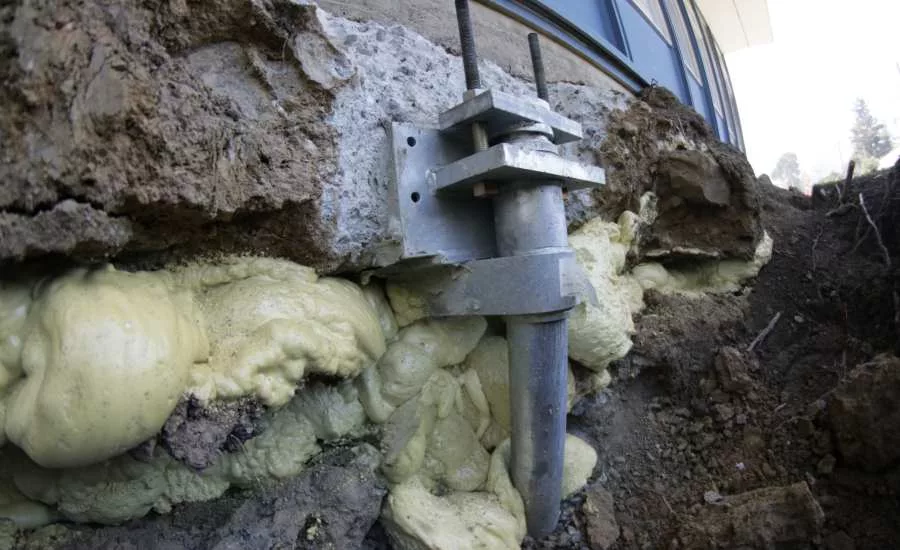
Polyurethane injection has become a popular solution for lifting and leveling concrete slabs in a method commonly known as foam jacking. Foam jacking is a relatively simple process, whereby polyurethane is injected directly below the slab through drilled holes in the concrete. After injection, the polyurethane expands, compacts the soil, and lifts the slabs upward for leveling and realignment.
Over time, as foam jacking grew as an accepted slab lifting solution, the polyurethane formulations began to evolve into more niche applications and have brought higher levels of engineering complexity into the construction industry.
"Over the past 25 years, I have seen the polyurethane's geotechnical applications truly evolve," states Joshua Burcaw, Senior Vice President at NCFI Polyurethanes. “The original formulas were excellent in certain geological conditions, but they were primarily focused on lifting foams and were challenged in their effectiveness in some soil conditions, such as highly saturated soils, soils with high plasticity, or in cold or hot climate conditions. Market demand has led the chemical industry to formulate systems to perform better in these conditions and achieve new applications.”
Burcaw continues, "Polyurethane manufacturers, such as NCFI, have dedicated R&D departments to develop and perfect formulas for all geotechnical challenges, which is allowing engineers and applicators to continue to innovate how geotechnical polyurethanes are applied."
Excavation Support
Sometimes, you need to excavate areas to remove the old and bring in the new in a renovation. Whether you are upgrading utilities, installing elevator pits, removing unneeded structures, or adding new subsurface structures, excavating in soft soils or high-water tables can be a challenging event. This is especially true in areas with limited access.
Typical methods for stabilizing a trench is the use of shoring equipment. While shoring equipment can help in deep trenches, the equipment requires space to assemble and heavy equipment to install. If in an area with a high water table, dewatering equipment may be required.
Single component polyurethanes have become an enticing solution for stabilizing excavation zones and simplifying the construction process. Single component polyurethanes are a low-viscosity, high permeation formula that reacts with moisture to gel and stabilize. Often referred to as permeation grout, the single-component polyurethane has high flowability and saturates the soil before curing. After approximately 24 hours, the treatment zone becomes a highly dense matrix of soil and polyurethane.
"We've used single-component permeation grouts to help stabilize excavation zones for a variety of applications, such as utility trenches where sandy soils were difficult to shore and would collapse into the trench area," states Cliff Frazao, Chief Operating Officer of EagleLIFT, a California based geotechnical contractor. "With hydrophobic products, such as NCFI's Terra-Lok 24-015, those treatment zones act as a water stop and limit groundwater migration into the trench."
Once injected, the permeation grout saturates the soil and fills void areas and annular space between loose soil aggregate. Permeation grout penetrates various soil types, including fines. After approximately 24 hours, the polyurethane fully cures and locks the soil together in a highly dense matrix of polyurethane and soil.
Plural component polyurethane systems have been used similarly, and there have been several documented projects where they have been used to stop contamination plumes from migrating into trench areas. Preventing contamination migration into work zones can help contractors avoid potential environmental abatement issues, which can be a costly affair.
Restoring Soil Load-Bearing Capacity
A foundation's ability to handle heavy loads are attributed to quite a few factors, the types of footing, the weight of the building, and the support soil type and strength. Any adjustment in any of these factors may require repair or rehabilitation to meet the renovation demands.
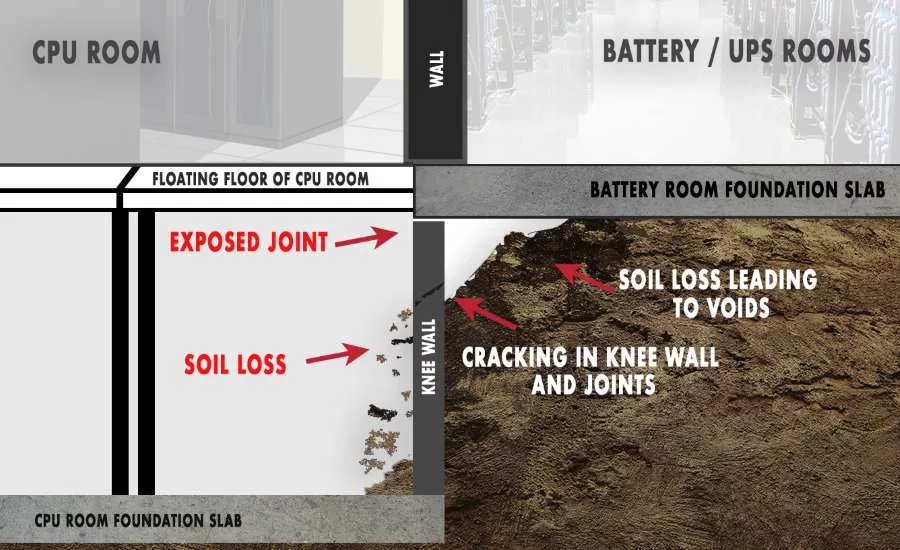
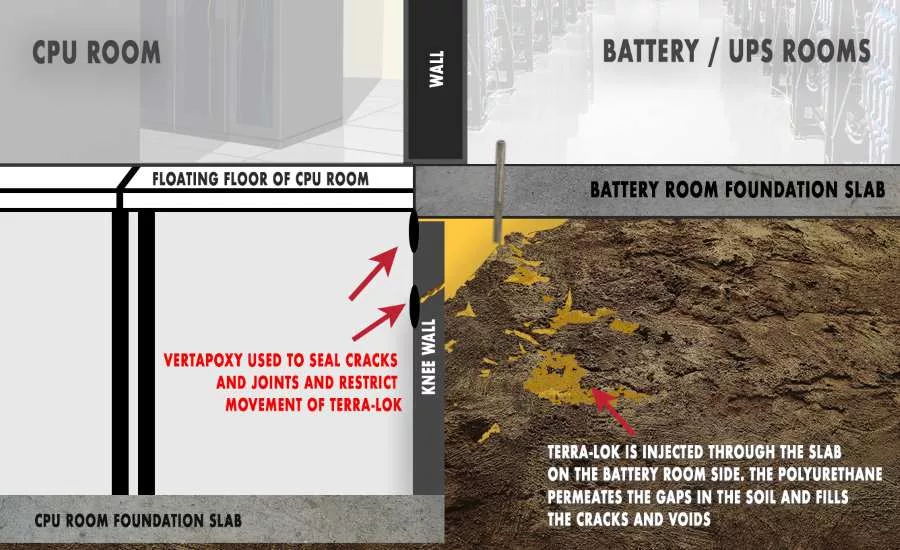
In North Carolina, an AT&T data center was repurposing an area for increased servers and backup power systems. As maintenance staff was examining the building zone, they noticed some cracking was happening in the foundation slab and walls. Upon further examination, an exposed joint in a knee wall had allowed support soils underneath the adjacent battery room foundation to settle through the joint. The soil loss caused voids to form underneath the slab and the soil had lost its load-bearing capability.
"After a look at the plans and several conversations with AT&T's engineering team, we determined that two issues needed to be resolved, the sealing of the joint and cracks and re-establishing the foundation's load back into a stabilized soil media," stated Karla Christmann, President of NEC Keystone of Tampa, Fla.
"Permeation grouting with single-component polyurethanes is a relatively well-known and exceptional application for soil densification and void-filling," continues Christmann. "With effective quality assurance such as injection patterns and volumes, polyurethane quality, pre-and post-testing, and material handling, there is a high level of control in ensuring void-fill and soil densification are achieved."
NEC Keystone re-established the foundation load back into a highly dense soil while correcting the original construction's oversight with the unsealed knee wall joint. The project took two days, and the data center avoided excavating the slab and interruptions in their operations.
Increasing Allowable Soil Load-Bearing Capacity
But what if your soils were adequate for previous designs, but you need to repurpose the area for additional weight than the original foundation designs permitted?
Restoring soil load-bearing capacity with polyurethane has been around for a while, using single and plural component systems. Increasing bearing support has shown effective, but until the last decade, the engineering has been unclear. Randy Post, a Senior Geotechnical Engineer at Golder Engineering, has been working with polyurethane grouting for years.
"I have used polyurethane grouting on several foundation projects to improve the bearing capacity and reduce the potential for excessive settlement," states Post. "On one project, in particular, we designed a grouting plan to improve the allowable bearing capacity beneath column footings of a building that was being demolished and replaced with a structure that was one story taller."
"By treating beneath the footings with polyurethane grout, the project team was able to limit demolition to above grade only, and the basement level and foundations were reused. This saved a great deal of money, allowed for a more aggressive construction schedule, and contributed to the project achieving LEED Silver certification. It was a great success; the grout provided the increased capacity required while successfully limiting additional settlement to below the thresholds set by the contract."
There have been several documented instances where polyurethane has successfully increased soil bearing capacity for beneficial reuse, such as silos, cranes, support columns, and elevator pits. In each instance, the polyurethane has allowed the owners to utilize the same foundation elements and dramatically increase the treated soils' loads.
Geotechnical Polyurethane Benefits
There are many benefits to using polyurethanes for geotechnical applications, but perhaps one of the most glaring benefits is convenience. Polyurethanes are highly adaptable and can solve soil-related issues quickly and cost-effectively. While the economics may or may not pan out in direct project costs, but when accounting for operational downtime, footprint and adaptability, alternative options have a tough time keeping up.
Post had this to say about polyurethane's adaptability, "One thing about polyurethane grouting that most other methods of ground improvement can't match is the small footprint needed to perform the grouting. I have seen crews angle the 5/8-inch injection tubes to treat beneath basement walls or thread the needle between existing concrete reinforcement or existing utilities, minimizing disturbance while achieving the desired performance objectives."
A typical injection crew consists of three to five man teams, depending on the project complexity, and a box truck or trailer. As long as the equipment can get within 250 feet of the injection locations, they can perform the injections. With plural component polyurethane cure times ranging from 25-30 minutes and single-component systems at around 24 hours, projects can often be completed within days.
Geotechnical polyurethanes have evolved a great deal in terms of chemistry, applications, and costs. As industry demands increase, polyurethane systems will continue to adjust to compete in areas where traditional methods may fall short. So be on the lookout for how these applications evolve because they could be the answer to your next project.
Looking for a reprint of this article?
From high-res PDFs to custom plaques, order your copy today!
.webp?height=740&t=1767036885&width=auto "Header - BE 1170x658 (002).png")

.webp?height=740&t=1755781744&width=auto "KEE(2).png")