Building Enclosure logo
search
cart
facebook twitter linkedin youtube instagram Spotify Podcasts Apple Podcasts Spotify Podcasts Apple Podcasts
  • Sign In
  • Create Account
  • Sign Out
  • My Account
Building Enclosure logo
  • NEWS
    • Breaking News
  • SECTIONS
    • Columns
    • Project Profiles
    • Trade Shows
    • Sponsor Insights
  • SYSTEM DESIGNS
    • Low-Slope Roofs
    • Pitched Roofs
    • Metal Roofing Materials
    • Waterproofing
    • Sustainability
    • Insulation
    • Exterior Claddings
    • Wall Systems
    • Building Envelope
  • BLOG
    • The BE Blog
  • MEDIA
    • Podcasts
    • Webinars
    • Quiz
    • Videos
    • Polls
    • Interactive Spotlights
    • Newsletter
    • Photo Galleries
  • DIRECTORIES
    • Directory: Blue Book
    • Directory: Roofing Resource
  • PRODUCTS
  • TECHNICAL
    • Codes
      • Waterproofing
      • Roofing
    • Details
      • Waterproofing
      • Roofing
  • CONTINUING ED
  • ABOUT
    • Advertise
      • Editorial Calendar
    • Contact
    • eMag Archive Issues
  • SIGN UP!
Wall SystemsWaterproofing

Ensuring WRB Performance in Innovative Wall Designs

Pushing the Envelope
By Adrian Jacobs, Heather Paschal
Marriott
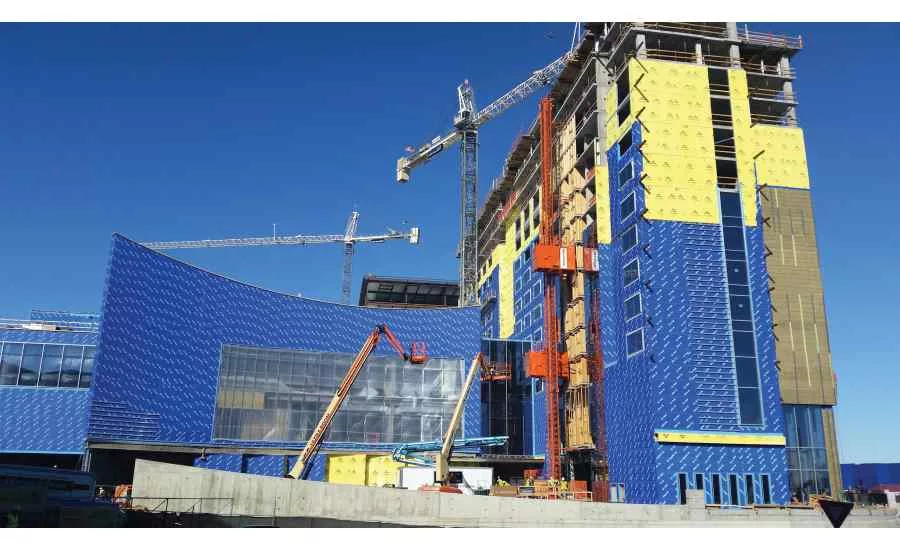
The JW Marriott Minneapolis Mall of America. Photo courtesy of the design firm: DLR Group.
Marriott2
"Standards need to be applied using good judgement. You can’t rely on rote anymore; you have to go back to fundamental understanding," – John Straube, Ph.D., Principal for RDH Building Science Inc. Photo courtesy of the Henry Company.
Marriott
Marriott2
July 3, 2017

When designing high-profile buildings, architects are continually trying to “push the envelope,” creating innovative forms that challenge the status quo. The result can be building envelopes that also challenge traditional approaches to water-resistance. With such innovative wall assemblies, how can architects, building engineers and building owners be assured that a water-resistive barrier (WRB) will perform as expected?


Limitations of Standard Test Methods  

Industry codes and related standardized tests may be of limited help in answering this question. Standard tests used to assess water penetration of WRBs include AATCC 127 and ASTM D779, both alternative methods listed in ICC-ES AC38. The AATCC 127 test evaluates the membrane’s resistance to water penetration under extremely high hydrostatic pressures that will never be experienced in real enclosures. ASTM D779 probes the resistance to water penetration while the membrane floats on a pool of water. Both of these methods test the WRB in isolation, ignoring common wall features, such as fasteners and other penetrations.

ASTM E331 provides a standard method for testing water penetration of small-scale mock-ups of a complete wall assembly under water and pressure conditions meant to simulate wind-driven rain. This goes beyond single-component testing of just the WRB and toward testing of walls that could be representative of a building—a big step in the right direction. However, it has fundamental limitations, according to John Straube, principal at RDH Building Science Inc. and associate professor of building science at the University of Waterloo in Ontario, Canada.

“Test specimens are almost always blank, featureless walls built by lab technicians in controlled environments. The wall assembly as described in ASTM E331 doesn’t prescribe the same exterior elements or installation sequence specified for your project,”  Straube says. “So if you are using this most basic configuration, the results will not be representative of what happens on the actual building.”

If a wall has unusual features—such as extreme angles or unusual cladding connections—this “disconnect” between the test and real-world performance will be even greater. Straube notes that applying a “one size fits all” approach just isn’t sufficient for evaluating the true water resistance of progressive building designs. “Solving this problem requires an experienced design team that understands the project, making sure that the WRB products and the manner in which they are assembled align with the project requirements.”

ASTM standards can provide guidance but performance should be measured within the configuration of the final assembly to be relevant.


A Holistic, Real-World View

Instead of viewing the wall as a collection of discrete elements, architects and building engineers need to view wall assemblies holistically, in the context of the completed structure. In this view, the WRB becomes one piece—albeit a very important piece—of the interconnected design solution. Determining the appropriate WRB and installation methods requires a detailed understanding of the relationship of the outermost cladding through the wall’s other elements. The many environmental factors impacting the performance of the completed wall assembly—from typical wind pressure and rain volume to temperature extremes—must also drive the selection process.

Viewed this way, it becomes clear that some innovative wall designs require equally innovative approaches to WRB selection and to the details of application. To achieve performance expectations, careful consideration of the interaction of all elements within the completed wall assembly along with a host of important questions well before construction begins. For example:

  • Will the wall be exposed to extreme wind and water pressures, such as on a very tall building, in a hurricane zone, or due to a steep wall slope? This may demand enhanced detailing, requiring collaboration with product manufacturers and/or alternative testing of the proposed assembly to ensure it delivers a higher degree of water resistance prior to building construction.
  • Does the wall feature open joint cladding? Is the joint baffled or open? This may increase exposure of the underlying WRB to the elements, requiring UV resistance or supplemental detailing.
  • Does the wall design call for a high number of windows, fasteners, anchors, or other components that pose water control continuity challenges?  These factors may require supplemental sealant at key areas to maintain the integrity of the WRB in the completed assembly.
  • Will the wall be composed of prefabricated, modular units assembled on-site? Additional detailing may be required as well as special attention to installation sequencing.


Collaboration for Innovation

Working in close collaboration with a trusted and reputable WRB expert throughout the design and construction process can help in the performance of the completed building envelope.

“The architect or building designer is responsible for making judgements about what materials to use and how to use them. However, close collaboration with the WRB manufacturer is extremely important to help the architect select the optimum product and installation details given the specific factors at play in their project,” Straube says.

KEYWORDS: ASTM (American Society for Testing and Materials) moisture WRB (weather resistant barrier)

Share This Story

Looking for a reprint of this article?
From high-res PDFs to custom plaques, order your copy today!


Adrian Jacobs is Director of Technical Services at Henry Company. He is a graduate of University of Texas with over 30 years of experience in design and installation of building envelope and roof assemblies.
Heather Paschal is the Technical Information Manager for Henry Company. She has a degree in architecture, obtained her LEED AP and CDT certificates, and is a member of AIA.

Recommended Content

JOIN TODAY
to unlock your recommendations.

Already have an account? Sign In

  • bar graph shows LEED v4/LEED v5/LEED v6 in various colors

    When Will LEED v4 / v4.1 and LEED v5 Expire?

    The latest version of the LEED rating system, LEED v5, is...
    Sustainability
    By: Daniel Overbey
  • Celebrating Women In AEC-2026

    Celebrating Women in The AEC Industry Part 1

    A round-up of women in the design, engineering and...
    Sustainability
    By: Lindsay Lewis
  • KEE membrane application on a roof

    A Beginner’s Guide to Single-Ply Roofing Membranes

    While PVC and TPO appear extremely similar, the chemistry...
    Low-Slope Roofs
    By: Peter Gross
Manage My Account
  • Sign up for the Newsletter
  • Online Registration
  • Manage My Preferences
  • Registration Customer Service

More Videos

Sponsored Content

Sponsored Content is a special paid section where industry companies provide high quality, objective, non-commercial content around topics of interest to the Building Enclosure audience. All Sponsored Content is supplied by the advertising company and any opinions expressed in this article are those of the author and not necessarily reflect the views of Building Enclosure or its parent company, BNP Media. Interested in participating in our Sponsored Content section? Contact your local rep!

close
  • HITT Construction headquarters
    Sponsored byBuilding Composites® LLC

    Pushing the Envelope

  • 2 construction workers and a DEXcell panel
    Sponsored byDEXcell Roof Boards

    Designing Low-Slope Roofs for Resilience

  • Bell Bank headquarters in Fargo, North Dakota
    Sponsored bySto Corp.

    Drained and Back-Ventilated Rainscreens vs Pressurized-Equalized Rainscreens

Popular Stories

Open vs. closed cell foam in an attic

Open-Cell vs. Closed-Cell Spray Foam

graphic shows white arrows pointing to the right on a light green background

A Breakdown of Air Leakage Testing in LEED v5 BD+C

graphic shows a building destoryed by tornados with information on the amount of torandos in 2026 in the US

Record-Breaking Tornado Activity in Illinois Signals New Challenges for Architects

Building Enclosure Newsletter

BE Poll

Events

April 9, 2026

Strategies for High-Performance Below-Grade Waterproofing

Credits: 1 AIA LU/HSW ; 1 IIBEC CEH; 0.1 IACET CEU

On-Demand Designing a high-performance building enclosure requires more than just surface-level protection; it demands a rigorous, performance-based mastery of below-grade water and gas mitigation. This discussion will provide an expert-level analysis of below-grade waterproofing within the comprehensive framework of the high-performance building enclosure.

April 28, 2026

Roof Design Considerations That Prevent Installation Failures and Change Orders

Credit: 1 AIA LU/HSW; 1 IIBEC CEH; 0.1 ICC CEU

On-Demand This course provides visual examples of actual field conditions. Some good, some not so good; along with design suggestions that can cut installation costs and reduce construction change orders. Upon completion of this course, you will have a better understanding of the requirements the roofing contractor must meet to provide the specified roofing system warranty, and long-term value to the owner.

View All Submit An Event

Products

Plaster and Drywall Assemblies Manual

Plaster and Drywall Assemblies Manual

This is a comprehensive manual that goes beyond codes and standards, providing expert guidance in design, detailing, material selection and troubleshooting for plaster and drywall.

See More Products

Related Articles

  • Garland Introduces New Wall Panel Designs

    See More
  • Innovative Wall Solution Solves Thermal Bridging Problem

    See More
  • Greeley City Center in Denver, Colo.

    Permeability and Performance in Water-Resistive Barriers

    See More

Related Products

See More Products
  • 978-0-7643-3022-3.jpg

    Award-winning Green Roof Designs: Green Roofs for Healthy Cities

  • 1118458605.jpg

    Sustainable Facades: Design Methods for High-Performance Building Envelopes

  • studentguidebook.jpg

    Integrating Building Performance with Design: An Architecture Student’s Guidebook

See More Products
×

Enhance your expertise with unparalleled insights.

Join thousands of building professionals today. Shouldn’t you know what they know?

SUBSCRIBE TODAY!
  • RESOURCES
    • Advertise
    • Contact Us
    • Store
    • Want More
  • SIGN UP TODAY
    • Create Account
    • Newsletter
    • Customer Service
    • Manage Preferences
  • SERVICES
    • Marketing Services
    • Reprints
    • Market Research
    • List Rental
    • Survey/Respondent Access
  • STAY CONNECTED
    • LinkedIn
    • Facebook
    • Instagram
    • YouTube
    • X
  • PRIVACY
    • PRIVACY POLICY
    • TERMS & CONDITIONS
    • DO NOT SELL MY PERSONAL INFORMATION
    • PRIVACY REQUEST
    • ACCESSIBILITY

Copyright ©2026. All Rights Reserved BNP Media, Inc. and BNP Media II, LLC.

Design, CMS, Hosting & Web Development :: ePublishing