The Design of High-Performance Buildings

In today’s world, building owners, tenants and inhabitants have higher expectations for buildings to be sustainable, high performing and energy-efficient. A successful building outcome requires builders and architects to understand that today’s building codes are designed to push the performance of each building to higher levels of comfort and health in a more durable, low maintenance structure than ever before.
An expert in building science should be a part of every build to advise and assist the design and construction processes. This specialist can answer many questions such as, how to make certain water will not be trapped in the walls. How much ventilation is needed and what is the proper way to vent the building? What are the long-term impacts of higher insulation levels and a tighter building envelope? A building science expert can advise the team on the answers to these questions while providing input on the construction process.
Higher performing buildings operate outside the realm where old rules of thumb and that’s how we’ve always done it are sufficient to stay out of trouble. Engaging the assistance of a building science expert will bring the latest engineering and quality assurance practices to the project at hand. These principles are not difficult or mysterious. In many cases, they are simply the application of common sense based on an understanding of the physics involved. The complexity of the building process, however, can make them complicated to implement and easy to mess up if we don’t adjust the way we think about building design and construction. We must think of the building as a system, not as individual parts. Under the new codes, builders cannot expect to deliver satisfactory results if they don’t follow today’s best practices.
The new energy-specific building codes aim to reduce energy consumption by more than half. This is an important goal considering that in 2014 residential and commercial buildings used more than 40 percent of total U.S. energy consumption — exceeding the amount used by the entire transportation sector¹.
In order to meet these new standards, it is crucial to keep two factors in mind: while reducing the energy use of buildings we must not sacrifice creating a comfortable and healthy environment for the inhabitants of the building.
Energy Efficient Buildings
Reducing a building’s energy consumption by nearly half is not as difficult as it sounds; our baseline building stock has historically set the bar rather low, so making improvements is fairly simple. The bigger challenge is ensuring that all systems in the building will work together to provide the energy efficiencies requested and expected by today’s building owners without creating compromises to health, comfort or durability due to a reduced tolerance to moisture intrusion.
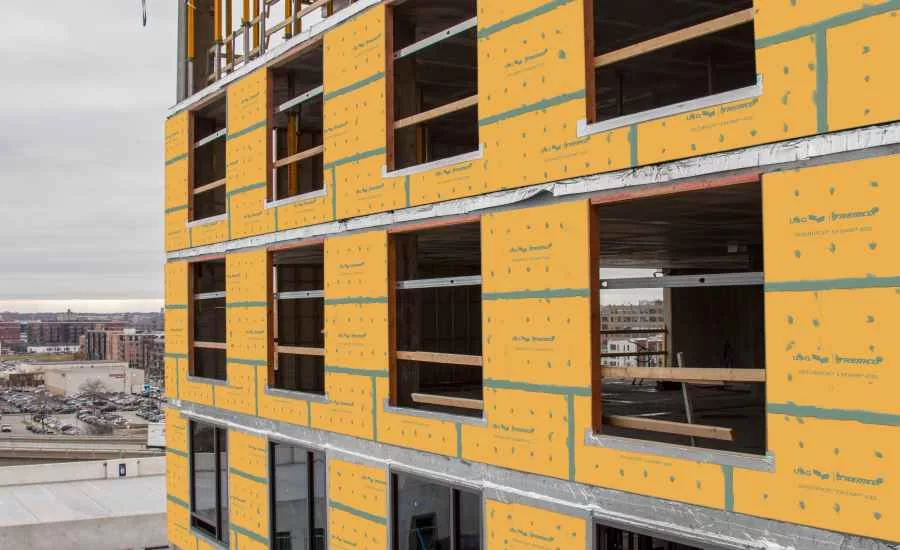
An important and effective part of meeting this goal of reduced energy use is to reduce winter heat loss and summer heat gain through the building envelope. This is done by adding insulation to the exterior envelope and blocking uncontrolled air leakage by using an air barrier.
Previously, there has not been an air barrier requirement at all, and buildings leaked like sieves. Our new energy codes now specify a maximum number of air changes per hour that are allowed to leak through the building envelope. In the past, it was common practice for contractors to confirm the integrity of the air barrier by visual inspection. Now, the codes require buildings to be tested with blower fans to verify compliance. This is a big change as many air leakage sites are not obvious or easily detected from a simple visual inspection.
In the past, air leaking through the building envelope had the potential to dry out areas where moisture accumulated due to leaks or other causes. This could provide a certain measure of tolerance for water leakage in buildings when the air leaking through was warmer and drier than the building cavity. It also wastes a great amount of energy, just as would be the case if you regularly used a hair dryer to dry your building. To reduce energy waste, tighter building envelopes are required in addition to higher levels of thermal insulation—higher R-values. When insulation is added, the warm side of the wall becomes slightly warmer and the cold side of the wall becomes slightly colder. Therefore, the potential for moisture condensation on the cold side increases if the conditions are such that the cold side is operating near the dew point temperature of the air it contacts. The bottom line is that energy efficient structures are more sensitive to moisture because there is less drying potential and greater wetting potential with the reduced air and heat flow. Only through the proper application of building science principles can we be assured that buildings will remain on the safe side of the condensation threshold for the local climate.
Creating a Comfortable and Healthy Environment
Today’s tighter building envelopes provide both advantages and challenges to creating a comfortable and healthy indoor environment. In many settings, it is a mistake to assume the local outdoor air is cleaner and healthier than a properly maintained indoor environment. It is also the case that relying on uncontrolled air leakage to ventilate your building will often result in too little or too much ventilation depending on the vagaries of wind and weather, compromising both thermal comfort and air quality with respect to humidity, pollens, exhaust fumes and numerous other allergens and noxious gases. A well-sealed building also requires a well-designed and functioning ventilation system that consistently provides sufficient fresh, filtered air to the interior while exchanging heat with the conditioned exhaust air to reduce energy loss. The problem occurs when this isn’t taken into consideration during the design of the building. For example, when the building is sealed tightly but proper ventilation exhaust is not provided in particular areas, airborne pollutants from cooking or other indoor activities can be trapped within the building.
In order to provide a balance of fresh air in the building to maintain good indoor air quality, the building needs to be ventilated properly. Ventilation is one of the most important features in creating a comfortable and healthy environment. It is also part of the building codes required in today’s high performance building industry. An air-to-air heat exchange recovers the energy that would otherwise be lost in the exhaust stream out of the building leading to improved energy efficiencies.
One of the most important tenets of building science, and of construction in general, is that it is much more expensive to find and fix a problem than it would have been to do it right the first time. Coordination of trades and the construction schedule will contribute to the tightness of the envelope, but builders must watch for construction compromises that can lead to an increase in energy usage and poor moisture performance. This is another area where the building science expert’s knowledge plays an important role.
The Results
Buildings today must be more energy efficient than their predecessors. They must also provide a comfortable and healthy indoor environment to their inhabitants. Building owners and tenants are much more knowledgeable about today’s working environment than in the past. Builders, building science experts and architects must work as a team to design and build to meet these needs.
¹ U.S. Energy Information Administration
Looking for a reprint of this article?
From high-res PDFs to custom plaques, order your copy today!
.webp?height=740&t=1767036885&width=auto "Header - BE 1170x658 (002).png")

.webp?height=740&t=1755781744&width=auto "KEE(2).png")