Choosing the Best Insulation
Halogenated Flame Retardants and Insulation Selection
Over the last several years, there has been increasing awareness and discussion about the use of flame-retardants in building materials.1 Much of this has centered around the use of halogenated flame-retardants (HFRs) in insulations. HFRs are materials which contain halogens, chemical elements in group VII of the periodic table. They are the chemical elements whose names end in “ine,” such as fluorine, chlorine or bromine. Concerns have been raised by some groups about the use of HFRs in a range of products, including furniture, clothing and insulations such as polystyrenes, polyurethanes and polyisocyanurates.
Many articles and publications on this issue use very broad, all-encompassing statements about “plastic foam insulations” and “halogenated flame retardants.”2 It is important to remember, that by having such broad classifications, sweeping claims and statements tend to be made which can be inaccurate and misleading. For example, “plastic foam insulations” incude expanded polystyrene, extruded polystyrene, spray polyurethane foam and polisocyanurate—very different materials, with very different thermal, physical, mechanical and fire properties, and different flame-retardants. Similarly, the category “HFRs” includes materials which are known to have poor environmental performance,3 materials where there is no data and materials where the current data gives them a clean bill of health.4,5 An analogy would be to classify all mineral fiber insulations together, treating glass fibers, rockwool fibers and asbestos fibers in a single category, and claiming that they all cause chronic lung problems. This would not be a true of fair comparison.
These broad-brush statements make it difficult for the roofing designer to make informed decisions on materials selection. Since there is seldom a “one-size-fits-all” solution, a way to access and compare independent, third-party data would be helpful so designers can select the optimum material to meet their needs and the needs of their clients.
Some groups opposed to the use of HFRs take a very one-dimensional approach to materials selection, saying that they should not be used, period. In discussions with architects and roof designers, who tend to have broader perspectives, they certainly have an interest in the HFR discussion, but their concerns and questions go beyond into areas such as global warming, ozone depletion, chemical content, Red List materials, etc. The all-encompassing word is transparency. Architects, roof designers and building owners and operators want to know everything about the materials being used in their buildings. Manufacturers can choose how much they want to disclose, or how transparent they want to be. In fact, the degree of transparency a manufacturer provides may itself become part of the criteria for materials selection, for example, in helping designers determine which manufacturer or supplier they choose to work with. In 2010,6 Tom Lent from Pharos stated, “Speak-up for disclosure … push them (manufacturers) to disclose what they are using and explore alternatives.”
There is not enough time here for a detailed discussion of different HFRs, but as stated above, a wide variety of materials is available. Some of the most commonly used HFRs over recent years are HDCB and TCPP, the flame-retardant used in polyisocyanurate roofing insulation. There is general agreement that HDCB is a bad actor, and the European Union banned its use in 2009. TCPP, however, looks to be on the other end of the spectrum.4,5 There is no data showing that TCPP is a problem, and even some of the groups opposed to HFRs state that, “A 2008 European Union risk assessment concluded that no further restrictions on its use were required after a comprehensive review of available data on environmental and health effects,” and there is no evidence that TCPP can migrate from plastic foam insulation into occupied spaces.2 Studies are continuing,6 but to date, there is no independent data about any harmful effects of TCPP.
Transparency and Independent Data
With all this complexity, claims and counter-claims, how can a roof designer access information to make an informed insulation material selection decision? Fortunately, there is helpful and informative, independent, third-party information available to the public.
HPD: The Health Product Declaration is a self-declaration by the manufacturer about the chemical content of a material. This is not a mandatory document, and the manufacturer can decide what level of detail they want to disclose, from 1 percent down to 100 parts per million. It provides an assessment of health impacts of the product throughout its life cycle. Having an HPD may be considered the first step towards transparency.
Declare: The next step towards full transparency is provided by the Living Future Institute, and its “Declare” database, which offers a platform for public disclosure, which “rises above the greenwash and enables a deep connection between suppliers and consumers.” Declare takes complex chemical analyses and raw material source location information and puts it in an easy-to-use “nutrition label” for consumers. Designers can make selections that meet the Living Building Challenge’s stringent materials requirements by searching their product database in order to “equip your building with the world’s greenest products.” Manufacturers must report product contents down to 100 parts per million, although there are exceptions for proprietary ingredients (up to 1 percent) if the manufacturers choose to use the exception. Products on the “Declare” database are approved for use in “Living Building Challenge” projects, where the goal is to achieve the highest measure of sustainability in the build environment.
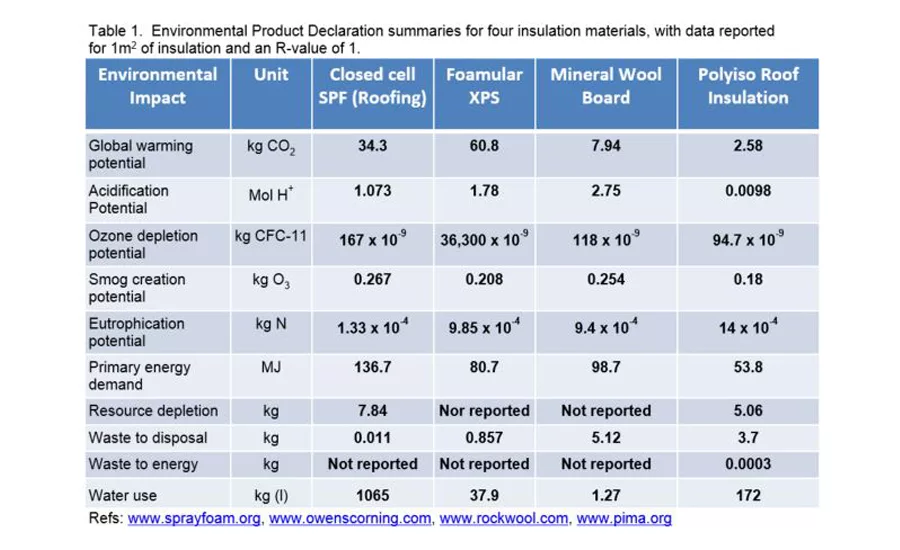
EPD: Another key step towards transparency is to have an Environmental Product Declaration. EPDs are complex and expensive, yet provide an ISO-approved method of comparing the full environmental impact of a product or system over the life of the product, from raw materials extraction to end-of-life disposal. In order to provide a fair and equal comparison, product category rules are established to standardize the evaluation and comparison. For example, for roofing insulations, the standard unit of measure is 1 meter-square of insulation, with an R-value of 1. The total environmental impact of the insulation can easily be scaled by multiplying the environmental impact by the roof area and by the total R-value required. There are 10 evaluation criteria, listed in Table 1. Of these 10, the first five are the ones most commonly used as the primary comparison criteria, although the other five may also be important to roof designers. Table 1 includes published EPD results for several different roof insulation options.
Red List: The final step towards full transparency is an extension of “Declare,” where the full chemical composition must be disclosed, with no exceptions. Products can only be classified as “Red List-Free” if they do not contain Red List materials, such as asbestos, formaldehyde and HFRs. There are a total of 21 identified chemicals and chemical families on the database. Designers can access the database, free of charge, to identify materials which meet the most stringent criteria related to environmental and toxicological performance.
Products which have HPDs, EPDs are on the “Declare” database and are designated “Red List-Free” can be considered to demonstrate full transparency.
How Do Architects Select Roofing Insulations?
Discussions with several major architects and roof designers over the past year, and reading published articles, suggest the following are the most important criteria, although no order of preference or priority is suggested: that is for the designer to decide.
Cost; meeting fire and wind uplift codes; durability/compressive strength; full chemical disclosure and transparency; insulation ratings; the presence of HFRs, Red List materials and carcinogens; global warming and ozone depletion impacts; primary energy demand or embodied energy in the product. There may be additional criteria, but these seem to be the ones most frequently discussed.
How Do Roofing Insulation Materials Compare?
For low-slope roofing applications, the two primary insulation options are polyioscyanurate and mineral wool. Those will be compared here.
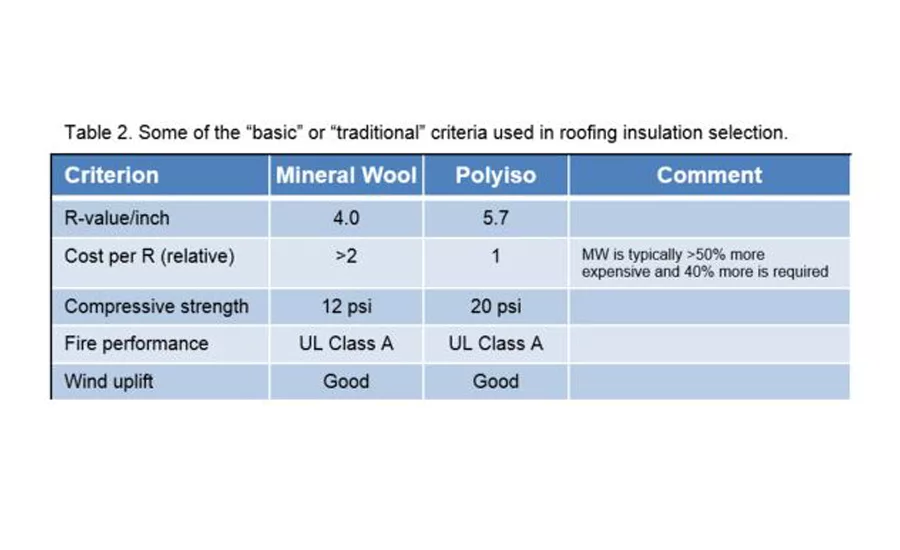
The “basic” or “traditional” selection criteria are based around how the insulation product actually works. Table 2 details some of these requirements.
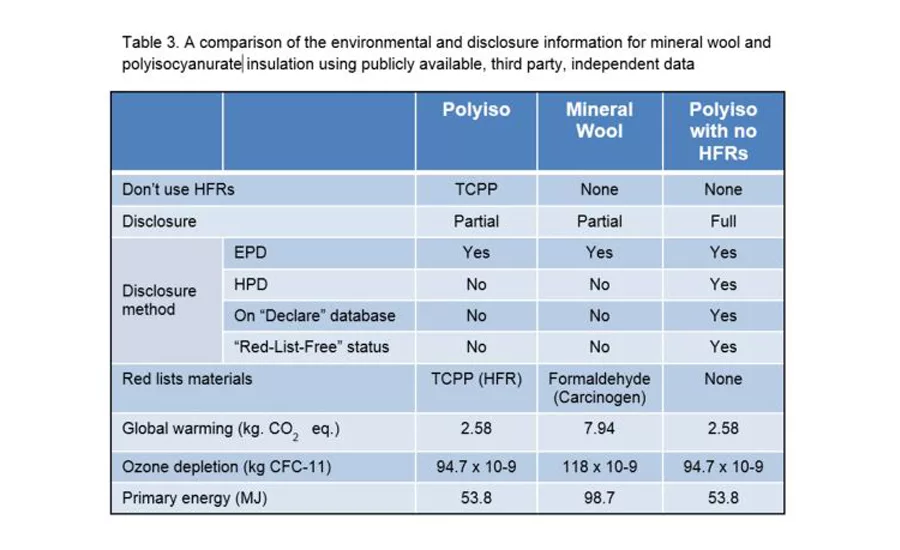
For more environmentally conscious designers, where environmental concerns may supplement more traditional selection criteria, Table 3 provides a comparison for mineral wool and polyiso. Table 3 also includes polyiso which contains no HFRs, a product currently available from only one roofing systems manufacturer.7
Which is the Best Roofing Insulation Solution?
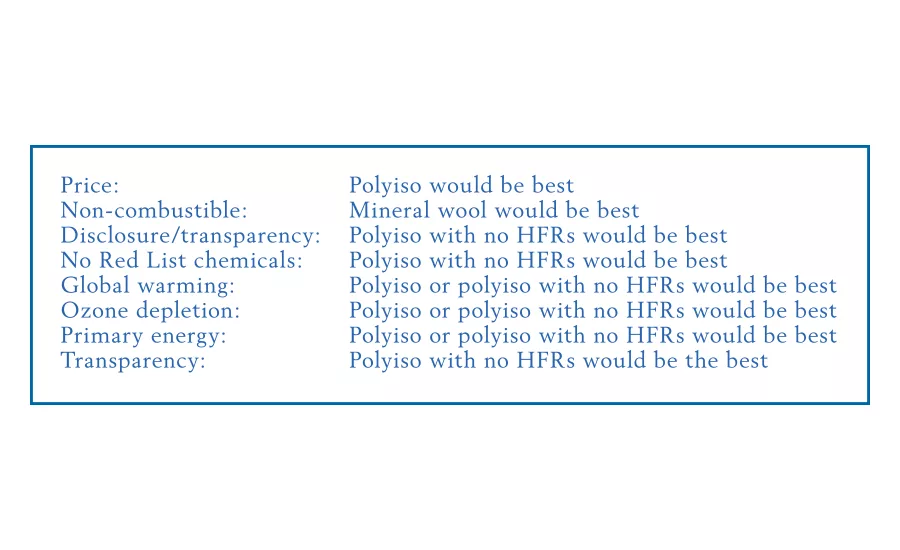
This is certainly for the individual roofing designer to decide, based on which performance criteria are most important for them and their clients. The most important factor is to ensure that designers have access to independent, third-party, objective data, such as the data shown in this article. If there is one over-riding decision factor, the decision could be relatively simple.
Generally, the decision is more complex, based on multiple criteria and weighting factors, depending on budgets, the designer, the building owner or operator, regional building code requirements etc. and possibly also the degree of transparency required. Overall, the materials selection decision will be a compromise: there is seldom a one-size-fits-all. The most important factor, however, is having access to independent, objective third-party data. The goal of this paper is to help identify where that information can be found and used.
References
1. Perkins+Will, Healthy Environments White Paper, October 15, 2014.
2. Babrauskas et al, Flame Retardants in Building Insulation: a Case for Re-evaluating Building Codes, Building Research and Information, 40(6), 2012.
3. Alex Wilson, Avoiding Polystyrene Insulation, Environmental Building News, August 2009.
4. European Union, TCPP Summary Risk Assessment Report, Final report, 2008.
5. U.K. Government Department for the Environment, Food and Rural Affairs, Fire Retardant Technologies: safe products with optimized environmental hazard and risk performance, November 2010.
6. U.S. EPA, TSCA Work Plan, Chemical Problem Formulation and Initial Assessment, Chlorinated Phosphate Ester Cluster Flame Retardants, August 2015.
7. Enrgy3.E, Johns Manville, www.jm.com. ARW/WCA
Looking for a reprint of this article?
From high-res PDFs to custom plaques, order your copy today!
.webp?height=740&t=1767036885&width=auto "Header - BE 1170x658 (002).png")

.webp?height=740&t=1755781744&width=auto "KEE(2).png")

.webp?height=200&t=1754344371&width=200 "ICP(1).png")