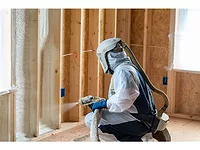
Utilizing Spray Foam Insulation
A local Phoenix builder is in the national spotlight after receiving the Grand Award from the DOE Builders Challenge program and for the houses built at Gordon Estates. The award was the result of excellent construction strategies, utilization of high performance building products, such as spray foam insulation, and the consulting services of green building expert Philip Beere.
the result of excellent construction strategies, utilization of high performance building products, such as spray foam insulation, and the consulting services of green building expert Philip Beere.
Beere was hired to help create a better performing home and to consult with marketing and certifications at Gordon Estates. The result, an award winning house with an average monthly electric bill of less than $60, and the most highly rated and certified green sub-division in the United States.
Beere’s builder clients typically seek his help with strategies to improve energy efficiency, among other things. Following, Beere addresses the five most common questions heard from builders seeking his services.
Background
In an effort to create energy efficient structures, municipalities are rapidly adopting energy codes. Many builders are already exceeding the standards of the 2012 International Energy Conservation Code, which sets a minimum baseline for energy efficiency with a HERS Index of near 70, depending upon climate zone. The HERS Index of near 70 is the same baseline to achieve Energy Star v3. A majority of builders are already exceeding the requirements of their local energy code.
Previously, the 2006 IECC was acceptable; this code sets a minimum baseline of a HERS Index of 100 or better. Now, municipalities are updating to the 2012 IECC, and builders are being guided to make new homes 30 percent more efficient than the 2006 IECC. Next, the move to the 2015 IECC will require 30 percent more efficiency than the 2012 IECC, meaning a HERS Index of near 50 depending on climate zone.
Question #1
Is building green or improving energy efficiency more expensive?
Beere: Over the past seven years, stricter industry standards and product innovation have resulted in products being “green” by default. For example, today where would you find a single pane window or incandescent light bulb? Not so long ago, spray foam insulation was considered too expensive an investment compared to batt insulation. Now, and after calculating the savings in downsizing mechanical, spray foam insulation can offer a significantly better return on investment. With the greater affordability and availability compared to seven years ago, maybe the better question is, “why wouldn’t you build green?”
Question #2
I am already building a quality home, now what?
Beere: The first thing I look at with my clients is budget and their current construction practices. From there, we assess what items may be overlooked or improved upon.
My first recommendation is to embrace the HERS Index as a tool to guide energy efficiency design. A good energy rater and accurate energy modeling are the most critical first steps of energy efficient design. If a client is not already working with an energy modeler, we help make that connection.
Question #3
There are so many ratings, which ones to pursue?
Beere: This answer depends on one’s geographic location. Also, it depends on the builder’s objective. It’s important that there is a clearly defined purpose to pursuing ratings and standards. Ratings and standards may be used to increase buyer confidence, enhance marketing and PR, or as a management tool. Through the process of defining the builder’s objectives, we sometimes discover pursuing specific ratings and standards does not make sense for the project.
Question #4
Our homes are already achieving a sub 70 HERS Index or ENERGY STAR v3, is there anything else we should be doing?
Beere: A sub 70 HERS Index is impressive, but the challenge is to score in the low 50’s and stay within budget, and always be thinking of areas to improve upon. Be sure to capitalize on your work. My job is to help my client create “their story” and turn it into a marketing program. Too often, we see an attempt at telling the energy efficiency story without proper support, a good Web site, sales team, or cohesive message. All parts must connect; if you build an amazing home your marketing material should also be amazing. This requires translating your marketing message into simple terms for your buyers to understand why the home they are buying is superior.
Usually, builders are so busy with the construction process that they do not have time to work on marketing. So, we offer our clients support with content writing, web design, PR, marketing, and training material for the sales team. We are able to offer this service and make it affordable for builders at all levels.
For Gordon Estates, my number one objective was to help create a message that reflected the uniqueness of the project and to tell its story. The strategy paid off; we earned national recognition, increased buyer demand, and community involvement. The program I created for Gordon Estates included onsite education workshops, educational videos, construction team charrettes, ratings and certifications, a detailed homeowners’ manual, and improved marketing tools, such as a Performance sticker placed on the window of each home.
Important, I tell my clients that simply claiming a home has superior energy efficiency or is green, is no longer a story. In the case of Gordon Estates, I chose to present the project as “the most highly rated and certified green subdivision in the U.S.”; this message was supported by EPA, DOE, IECC, and ICC certifications and standards. When the builder committed to the ratings, I had to make sure the proper information was being presented to the construction and sales team.
Question #5
Do green homes sell for more?
Beere: This may be the most frequently asked question, and is often debated. I think the better question for a builder to assess is whether or not their green homes are more profitable. And, to measure profitability beyond the bottom line. In other words, green homes should be more durable and result in fewer call backs, green homes should have fewer days on market, green homes should allow increased marketability and PR for the builder, and green homes should create broader demand.
*****
In closing, we asked Beere what top five strategies resulted in the greatest benefits at Gordon Estates, as related to efficiency, air quality, social value, highest return based on investment, and marketing.
His list is as follows:
- Energy modeling and mechanical design
- The pre-design team charrette
- Conditioned attic
- Education and marketing
- The use of landscape architect
Looking for a reprint of this article?
From high-res PDFs to custom plaques, order your copy today!
.webp?height=740&t=1767036885&width=auto "Header - BE 1170x658 (002).png")

.webp?height=740&t=1755781744&width=auto "KEE(2).png")