Building Enclosure logo
search
cart
facebook twitter linkedin youtube instagram Spotify Podcasts Apple Podcasts Spotify Podcasts Apple Podcasts
  • Sign In
  • Create Account
  • Sign Out
  • My Account
Building Enclosure logo
  • NEWS
    • Breaking News
  • SECTIONS
    • Columns
    • Project Profiles
    • Trade Shows
    • Sponsor Insights
  • SYSTEM DESIGNS
    • Low-Slope Roofs
    • Pitched Roofs
    • Metal Roofing Materials
    • Waterproofing
    • Sustainability
    • Insulation
    • Exterior Claddings
    • Wall Systems
    • Building Envelope
  • BLOG
    • The BE Blog
  • MEDIA
    • Podcasts
    • Webinars
    • Quiz
    • Videos
    • Polls
    • Interactive Spotlights
    • Newsletter
    • Photo Galleries
  • DIRECTORIES
    • Directory: Blue Book
    • Directory: Roofing Resource
  • PRODUCTS
  • TECHNICAL
    • Codes
      • Waterproofing
      • Roofing
    • Details
      • Waterproofing
      • Roofing
  • CONTINUING ED
  • ABOUT
    • Advertise
      • Editorial Calendar
    • Contact
    • eMag Archive Issues
  • SIGN UP!
Project ProfilesSustainability

New Office Building Design is a Testament to Sustainability
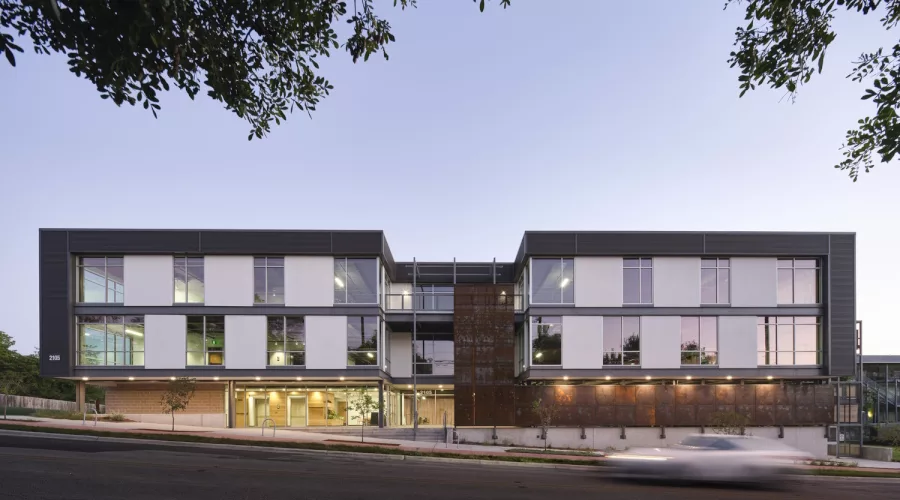
CBTX_2115MLK_N5_medium.jpg

Photo courtesy of Andrea Calo.

June 10, 2024

Nestled in a vibrant, walkable area of near-downtown East Austin that is steeped in history and local neighborhood amenities, The Ferdinand is not just a build-to-suit office building but a unique structure that functions as a testament to sustainability and wellness: the three-story, 70,000-square-foot building is designed to meet both the standard of The American Institute of Architects’ (AIA) “Framework for Design Excellence,” as well as the WELL Building Standard. In recent years, the neighborhood has experienced significant development, becoming a destination for young families. The area is home to restaurants, food trucks, coffee shops, and bars, intermingled between large multifamily projects and older, single-family residences. 

The Ferdinand includes 40,000-square-feet of leasable space and a 30,000-square-foot parking garage. Balancing efficiency, cost, and aesthetics, the design meets the challenge of maximizing leasable space on a small site while adhering to off-street parking requirements, Austin's Core Transit Corridor requirements, and stringent zoning height restrictions.

The building’s design is not just about the present, but also about the future. The design strives to anticipate future tenants’ needs of security, evolving technology, flexibility, and seamless operation. The onset of the COVID-19 pandemic during the design phase provided the opportunity to evolve a solution that promotes occupants’ health, safety, and welfare in the context of a post-pandemic workplace, making it a truly adaptable and future-proof building. The importance of air quality, access to outdoor spaces, social distancing, and occupant comfort became foundational and integral elements of the design. The adaptable design can accommodate the needs of one, two, three, or four prospective technology tenants.

The design team engaged in rigorous testing to find the perfect balance to satisfy financial constraints, regulatory requirements including parking, and site challenges. Sloped parking decks are matched to the site’s nature slope to reduce cost and maximize utility. Energy modeling was used to optimize long-term building performance while ensuring thermal comfort and access to natural light and views. Native plants and locally sourced materials providing long lifespans and minimal maintenance were specified and selected to support the local economy, workforce, and ecology. In addition, the visual impact of the ground-level parking garage was designed to integrate the building into the aesthetic of the local neighborhood. A decorative, raw steel screen wraps the north and west facades. The screen, which has developed a rich patina, features a custom perforation pattern to aid in ventilating the garage.

The lobby boasts a biophilic-inspired accent wall with sustainably sourced materials and natural elements, and a feature stair to encourage tenants to “get their steps in.” Balconies on each building level provide much sought after outdoor space, as well as via an open courtyard with monument stairs to welcome visitors. Conceived as an active part of the neighborhood, the design encourages alternative transit and engagement with the community through its new bike path, on-site bike lockers, seamless bicycle entry sequence, and showers. The building seamlessly blends into the local environment by prioritizing sustainability and health and wellness, offering an elevated sense of place to occupants and the greater community.

The result is a design that can flexibly accommodate typical office, conference rooms, collaborative areas, and workstation layouts, showcasing the versatility of our design approach. 


Cushing Terrell team

Sarah Shearer, Architect; Kevin Feldman, Structural; Elliot McCraw, BIM/CADD; Brad Thigpen, Architect; Jesse Hart, Architect; Jim Beal, Principal/Architect; Diego Zapata, Design Technician; Tom Calla, Director; James Sanders, Electrical; Danielle Johnson-Hazlewood, Structural; Steven Bingham, Mechanical; Kendrick Ostergaard, Landscape Design Professional; Sawyer Arneson-Nelson, BIM/CADD; Bryan Hallowell, Architect; Brady Gauer, Roofing & Building Envelope; Priscilla Sager, Mechanical; Garett Mitchell, Mechanical; John Tobol, Commissioning Tech; Hollie Mellgren, Structural


Project team

Architecture: Cushing Terrell

Structural Engineer: Cushing Terrell 

Mechanical Engineer: Cushing Terrell 

Electrical Engineer: Cushing Terrell 

Landscape: Cushing Terrell 

Lighting: Cushing Terrell

Interior Designer: Cushing Terrell

Civil Engineer: Kimley Horn

General Contractor: Sabre Commercial, Inc.


Photography

Andrea Calo


Brands / Products

Kawneer 451 Aluminum Storefront

Carlisle TPO 60 mil Reinforced Membrane Roof

Berridge HC-16 Metal Wall Panel

Schindler 3300 MRL Traction Elevator

STO XPS Exterior Insulation Finish System

KEYWORDS: building façade COVID-19 health and health care sustainable design

Share This Story

Looking for a reprint of this article?
From high-res PDFs to custom plaques, order your copy today!


Recommended Content

JOIN TODAY
to unlock your recommendations.

Already have an account? Sign In

  • bar graph shows LEED v4/LEED v5/LEED v6 in various colors

    When Will LEED v4 / v4.1 and LEED v5 Expire?

    The latest version of the LEED rating system, LEED v5, is...
    Sustainability
    By: Daniel Overbey
  • Celebrating Women In AEC-2026

    Celebrating Women in The AEC Industry Part 1

    A round-up of women in the design, engineering and...
    Sustainability
    By: Lindsay Lewis
  • KEE membrane application on a roof

    A Beginner’s Guide to Single-Ply Roofing Membranes

    While PVC and TPO appear extremely similar, the chemistry...
    Low-Slope Roofs
    By: Peter Gross
Manage My Account
  • Sign up for the Newsletter
  • Online Registration
  • Manage My Preferences
  • Registration Customer Service

More Videos

Sponsored Content

Sponsored Content is a special paid section where industry companies provide high quality, objective, non-commercial content around topics of interest to the Building Enclosure audience. All Sponsored Content is supplied by the advertising company and any opinions expressed in this article are those of the author and not necessarily reflect the views of Building Enclosure or its parent company, BNP Media. Interested in participating in our Sponsored Content section? Contact your local rep!

close
  • 2 construction workers and a DEXcell panel
    Sponsored byDEXcell Roof Boards

    Designing Low-Slope Roofs for Resilience

  • Bell Bank headquarters in Fargo, North Dakota
    Sponsored bySto Corp.

    Drained and Back-Ventilated Rainscreens vs Pressurized-Equalized Rainscreens

  • A construction worker using DEXcell roof boards
    Sponsored byDEXcell Roof Boards

    The Hidden Strength of Low-Slope Roof Systems: Why Roof Cover Boards Matter

Popular Stories

construction industry workers in hard hats stand around a city scape

Construction Industry Revolts Over New CSI Licensing Plan

graph shows green, orange and red dot lines going up

LEED v5 and the Cost Impacts of ASHRAE Standard 90.1-2019

2 construction workers and a DEXcell panel

Designing Low-Slope Roofs for Resilience

Building Enclosure Newsletter

BE Poll

Events

April 9, 2026

Strategies for High-Performance Below-Grade Waterproofing

Credits: 1 AIA LU/HSW ; 1 IIBEC CEH; 0.1 IACET CEU

On-Demand Designing a high-performance building enclosure requires more than just surface-level protection; it demands a rigorous, performance-based mastery of below-grade water and gas mitigation. This discussion will provide an expert-level analysis of below-grade waterproofing within the comprehensive framework of the high-performance building enclosure.

April 28, 2026

Roof Design Considerations That Prevent Installation Failures and Change Orders

Credit: 1 AIA LU/HSW; 1 IIBEC CEH; 0.1 ICC CEU

On-Demand This course provides visual examples of actual field conditions. Some good, some not so good; along with design suggestions that can cut installation costs and reduce construction change orders. Upon completion of this course, you will have a better understanding of the requirements the roofing contractor must meet to provide the specified roofing system warranty, and long-term value to the owner.

View All Submit An Event

Products

Plaster and Drywall Assemblies Manual

Plaster and Drywall Assemblies Manual

This is a comprehensive manual that goes beyond codes and standards, providing expert guidance in design, detailing, material selection and troubleshooting for plaster and drywall.

See More Products

Related Articles

  • 804 Carnegie Center West

    New Jersey Office Building Earns Green Design Award

    See More
  • Is Resiliency a Threat to Sustainability?

    See More
  • Perforated Metals Give Punch to Sustainability

    See More

Related Products

See More Products
  • tall building.jpg

    Tall Building Design: Steel, Concrete, and Composite Systems

  • ninteeth century.jpg

    Sustainable Building Design: Learning from nineteenth-century innovations

  • ecology.jpg

    Architecture and Systems Ecology: Thermodynamic Principles of Environmental Building Design, in three parts

See More Products

Events

View AllSubmit An Event
  • September 30, 2025

    Loss Mitigation Through Building Design

    Credits: 1 AIA LU/HSW; 1 IIBEC CEH; 0.1 ICC CEUOn-Demand Through this course, learn about how specifying the roof edge is the single most cost-effective enhancement for wind uplift on a commercial roof and how you can help mitigate risk and protect lives through design.
View AllSubmit An Event
×

Enhance your expertise with unparalleled insights.

Join thousands of building professionals today. Shouldn’t you know what they know?

SUBSCRIBE TODAY!
  • RESOURCES
    • Advertise
    • Contact Us
    • Store
    • Want More
  • SIGN UP TODAY
    • Create Account
    • Newsletter
    • Customer Service
    • Manage Preferences
  • SERVICES
    • Marketing Services
    • Reprints
    • Market Research
    • List Rental
    • Survey/Respondent Access
  • STAY CONNECTED
    • LinkedIn
    • Facebook
    • Instagram
    • YouTube
    • X
  • PRIVACY
    • PRIVACY POLICY
    • TERMS & CONDITIONS
    • DO NOT SELL MY PERSONAL INFORMATION
    • PRIVACY REQUEST
    • ACCESSIBILITY

Copyright ©2026. All Rights Reserved BNP Media, Inc. and BNP Media II, LLC.

Design, CMS, Hosting & Web Development :: ePublishing