Building Enclosure logo
search
cart
facebook twitter linkedin youtube instagram Spotify Podcasts Apple Podcasts Spotify Podcasts Apple Podcasts
  • Sign In
  • Create Account
  • Sign Out
  • My Account
Building Enclosure logo
  • NEWS
    • Breaking News
  • SECTIONS
    • Columns
    • Project Profiles
    • Trade Shows
    • Sponsor Insights
  • SYSTEM DESIGNS
    • Low-Slope Roofs
    • Pitched Roofs
    • Metal Roofing Materials
    • Waterproofing
    • Sustainability
    • Insulation
    • Exterior Claddings
    • Wall Systems
    • Building Envelope
  • BLOG
    • The BE Blog
  • MEDIA
    • Podcasts
    • Webinars
    • Quiz
    • Videos
    • Polls
    • Interactive Spotlights
    • Newsletter
    • Photo Galleries
  • DIRECTORIES
    • Directory: Blue Book
    • Directory: Roofing Resource
  • PRODUCTS
  • TECHNICAL
    • Codes
      • Waterproofing
      • Roofing
    • Details
      • Waterproofing
      • Roofing
  • CONTINUING ED
  • ABOUT
    • Advertise
      • Editorial Calendar
    • Contact
    • eMag Archive Issues
  • SIGN UP!
ColumnsSustainability

New Tools Make Sustainability Affordable and Achievable
By Dominique Davison
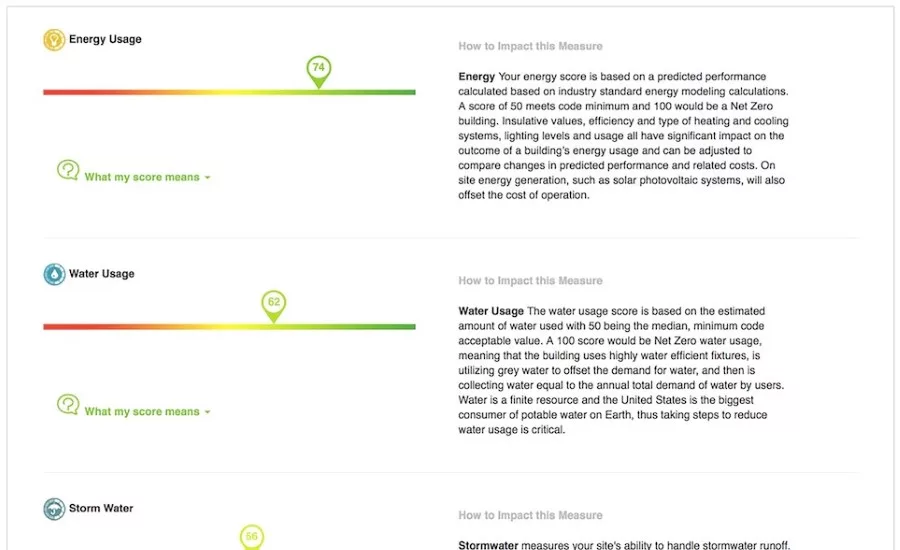
Results
Results from using Open data.
February 16, 2017

For more information, visit www.PlanITImpact.com.


It is no surprise that peak sustainability is a top concern of the construction industry. Yet it is rarely accomplished due to the real or perceived higher costs and a lack of resources available in the early stages of design and planning that illustrate clearly what the potential benefits are.

Architects, designers, planners and builders aspire to creating sustainable buildings at every opportunity, as they can save measurable amounts of costs on utilities, promote efficient and eco-friendly materials. The process also introduces improved ideas for the intelligent management of natural resources, such as capturing storm water run-off, positioning buildings for optimal sunlight and wind, or even using less conventional strategies such as geothermal heat and cooling.

Thus, the proof is clear that higher quality construction provides dividends to building owners. So why is it still such a challenge?

Boosted sustainability comes down to measuring building performance as early in the planning and design process as possible. It is especially difficult for mid-sized construction firms to pre-measure building performance for sustainability as constrained budgets are more common among small and medium firms, either to register their projects with LEED or to undergo custom consulting.  

However, a turning point for building performance is now in sight as different technologies and ideas are coming together to solve the problem and make sustainability affordable, efficient and simple. For example, using information gleaned from open data, more strategic use of the cloud and ultra-fast gigabit networking, and, when all the data is in place, leveraging a holistic scoring system to turn data into clear information. This application of technology makes sustainability more affordable, achievable, and best of all, simple to carry out for small to medium firms.

Affordability: How can the many components of sustainable design, including energy efficiency from solar PV, better insulation, or water savings measures be measured in a cost-effective method, before construction begins? The need is for a single way to bring relevant data into a single view, where multiple measurements and variables can be input and considered holistically instead of tackling just one aspect at a time.

Efficiency: How can key data be obtained quickly instead of being laboriously hunted for by accessing separate and inconsistent silos? Commercial construction codes only provide a small portion of the data needed. There is a clear need for more easily found data to plug into the model, and a smoother method to integrate multiple data points affecting a sustainable building into a single view.

Simplicity: How do contractors relate the impacts of the materials and choices available to their clients in a way that they will easily comprehend? A scoring system that rates different elements as efficient or non-efficient helps solve the problem.

Open Data
More easily accessible information and a straight-forward scoring system can turn the complexity and cost problem for sustainability around. This is part of the Open Data Movement. Along with integration of 3D modeling and integrating meaningful metrics into a pre-construction score.

Open data is any data that can be freely published, used, reused and redistributed by anyone for anyone. Open Data information means getting data, sometimes even in real time, that empowers developers while saving time and costs. Open Data is now helping to drive key real time information from federal and local government entities and private companies. For example, hundreds of regional utilities are now providing gas and water rates and the NOAA is providing local rainfall/weather data. WalkScore is now publishing statistics regarding the precise proximity of desired resources, such as parks, stores, libraries and businesses, which is very important to millennials.  

Converge these streams of data into a single model, next apply an easily understood score with rational for improvements, and construction designers can turn a weakness into a great advantage.

The result is that a holistic data model is conceived with anticipated energy savings that steer optimal and budget friendly outputs.

Key Examples

  • Storm water Infiltration: Quantifies the overall perviousness of a site and amount of rainfall, based on weather data from the NOAA, and includes site area, composition/area of site surfaces and exemplifies the application of the system to see potential impact on city utility infrastructure
  • Energy Savings: Returns the savings in dollars per year from energy improvements to the project based on planned use, compared to Code Minimums, based on your utilities’ local rates.
  • Water Usage: Returns a water savings score based on planned and standard water usage calculations as well as expected Simple Payback of those efficiency improvements.
  • Transportation Access: Represents an average score of U.S. Census data, Transportation and Walkscore.com data, as walkability and connectivity via transportation options is a growing priority for communities.

Conclusion
In 2017, the revolution of Open Data is in its early stages, and is poised to play an expanding role in resilient and sustainable building designs. This helps our industry make good on the vision for tomorrow’s smart communities.

KEYWORDS: climate change LEED sustainability

Share This Story

Looking for a reprint of this article?
From high-res PDFs to custom plaques, order your copy today!


72 dpi dominique davison headshot web

Dominique Davison, AIA LEED APtm, is the founder of PlanIT Impact, a cloud-based, resource assessment tool whose goal is to make sustainable design and planning more accessible, affordable and achievable. More information can be found at www.planitimpact.com.

Recommended Content

JOIN TODAY
to unlock your recommendations.

Already have an account? Sign In

  • bar graph shows LEED v4/LEED v5/LEED v6 in various colors

    When Will LEED v4 / v4.1 and LEED v5 Expire?

    The latest version of the LEED rating system, LEED v5, is...
    Sustainability
    By: Daniel Overbey
  • Celebrating Women In AEC-2026

    Celebrating Women in The AEC Industry Part 1

    A round-up of women in the design, engineering and...
    Building Envelope
    By: Lindsay Lewis
  • KEE membrane application on a roof

    A Beginner’s Guide to Single-Ply Roofing Membranes

    While PVC and TPO appear extremely similar, the chemistry...
    Low-Slope Roofs
    By: Peter Gross
Manage My Account
  • Sign up for the Newsletter
  • Online Registration
  • Manage My Preferences
  • Registration Customer Service

More Videos

Sponsored Content

Sponsored Content is a special paid section where industry companies provide high quality, objective, non-commercial content around topics of interest to the Building Enclosure audience. All Sponsored Content is supplied by the advertising company and any opinions expressed in this article are those of the author and not necessarily reflect the views of Building Enclosure or its parent company, BNP Media. Interested in participating in our Sponsored Content section? Contact your local rep!

close
  • 2 construction workers and a DEXcell panel
    Sponsored byDEXcell Roof Boards

    Designing Low-Slope Roofs for Resilience

  • Bell Bank headquarters in Fargo, North Dakota
    Sponsored bySto Corp.

    Drained and Back-Ventilated Rainscreens vs Pressurized-Equalized Rainscreens

  • A construction worker using DEXcell roof boards
    Sponsored byDEXcell Roof Boards

    The Hidden Strength of Low-Slope Roof Systems: Why Roof Cover Boards Matter

Popular Stories

construction industry workers in hard hats stand around a city scape

Construction Industry Revolts Over New CSI Licensing Plan

a man wearing a mask installs insulation into a wall system

Quiet Rooms and Healthier Air: A Second Look at What Goes Inside the Wall Cavity

Canalino Elementary School and Canalino Family School exterior

Daylighting Design to Support Rapidly Growing Trend in Modular Building Construction

Building Enclosure Newsletter

BE Poll

Events

June 17, 2025

Addressing Condensation in Low-Slope Roof Assemblies

Credits: 1 AIA LU/HSW; 0.1 ICC CEU; 1 IIBEC CEH; 0.1 IACET CEU

On Demand In modern roofing systems, vapor retarders and air barriers do more than just minimize air leakage—they’re essential to maximizing performance and longevity. This engaging course dives into the next generation of moisture control: permeable vapor retarders and air barriers. Discover how these cutting-edge technologies are transforming low-slope roofing assemblies by improving energy efficiency, managing moisture, and boosting wind uplift resistance.

April 9, 2026

Strategies for High-Performance Below-Grade Waterproofing

Credits: 1 AIA LU/HSW ; 1 IIBEC CEH; 0.1 IACET CEU

On-Demand Designing a high-performance building enclosure requires more than just surface-level protection; it demands a rigorous, performance-based mastery of below-grade water and gas mitigation. This discussion will provide an expert-level analysis of below-grade waterproofing within the comprehensive framework of the high-performance building enclosure.

View All Submit An Event

Products

Plaster and Drywall Assemblies Manual

Plaster and Drywall Assemblies Manual

This is a comprehensive manual that goes beyond codes and standards, providing expert guidance in design, detailing, material selection and troubleshooting for plaster and drywall.

See More Products

Related Articles

  • IMETCO and BIMsmith logos

    IMETCO Partners with BIMsmith to Launch NEW BIM Tools

    See More
  • kingspan.jpeg

    Kingspan Insulated Panels North America Launches Innovative New BIM Tools to Streamline Design Process

    See More
  • Breaking News Image #1

    ICC Launches New Digital Tools for the Building Industry

    See More

Related Products

See More Products
  • heating cooling.jpg

    Heating, Cooling, Lighting: Sustainable Design Strategies Towards Net Zero Architecture, 5th Edition

  • interior design.jpg

    Building Cost Planning for the Design Team

  • ecodesign.jpg

    Successful Building Using Ecodesign

See More Products

Events

View AllSubmit An Event
  • Specialty Tools & Fasteners Distributors Association (STAFDA) Conference

View AllSubmit An Event
×

Enhance your expertise with unparalleled insights.

Join thousands of building professionals today. Shouldn’t you know what they know?

SUBSCRIBE TODAY!
  • RESOURCES
    • Advertise
    • Contact Us
    • Store
    • Want More
  • SIGN UP TODAY
    • Create Account
    • Newsletter
    • Customer Service
    • Manage Preferences
  • SERVICES
    • Marketing Services
    • Reprints
    • Market Research
    • List Rental
    • Survey/Respondent Access
  • STAY CONNECTED
    • LinkedIn
    • Facebook
    • Instagram
    • YouTube
    • X
  • PRIVACY
    • PRIVACY POLICY
    • TERMS & CONDITIONS
    • DO NOT SELL MY PERSONAL INFORMATION
    • PRIVACY REQUEST
    • ACCESSIBILITY

Copyright ©2026. All Rights Reserved BNP Media, Inc. and BNP Media II, LLC.

Design, CMS, Hosting & Web Development :: ePublishing